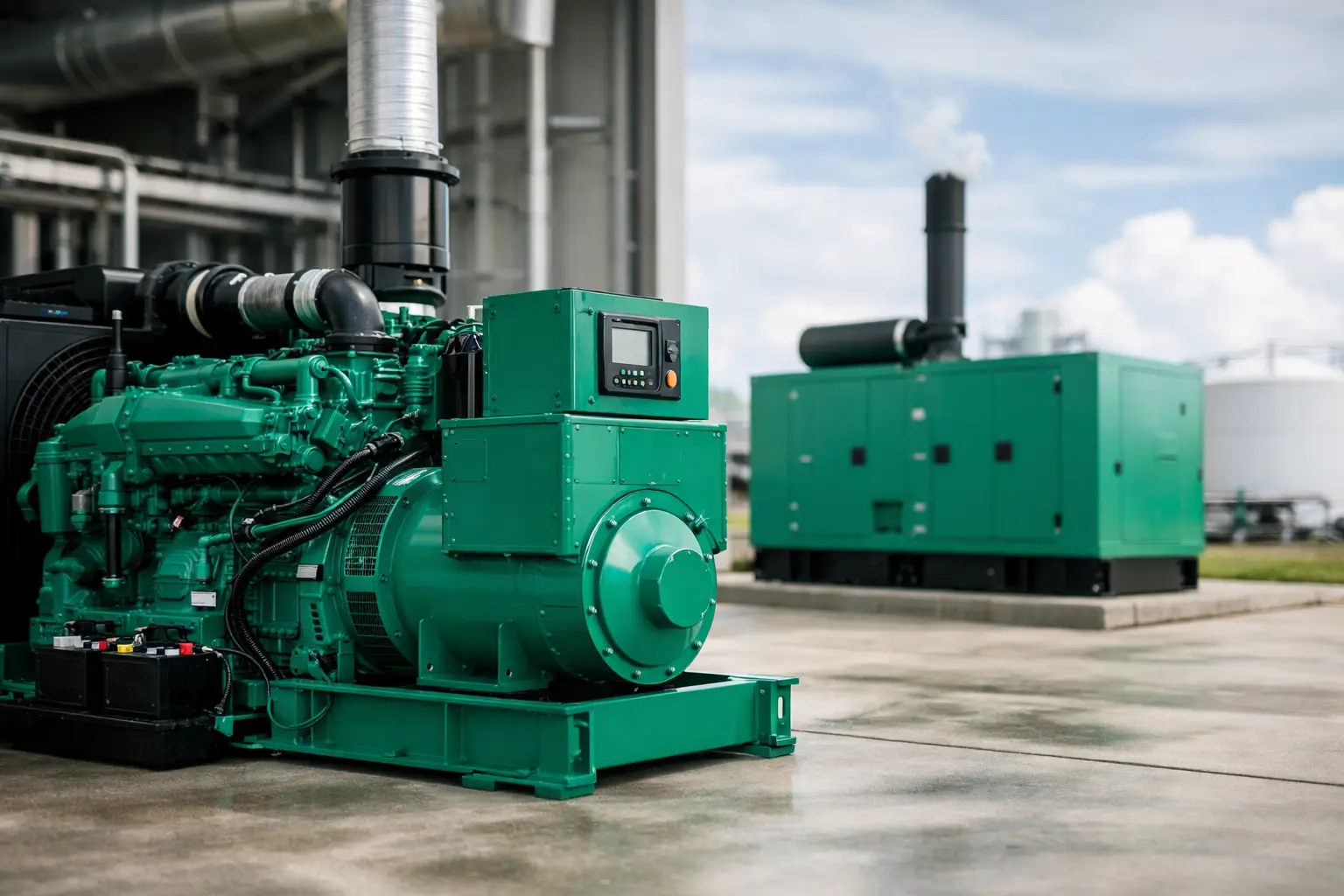
A genset is not simply an item of plant to be switched on when the mains supply fails. For a hospital, factory, logistics site, telecoms installation or construction project, it is the final line of defence against lost production, safety exposure, damaged stock and operational disruption. The right specification starts with a clear view of what must remain powered, how the load behaves and how long the equipment will be required to run.
Buying on headline kVA alone can create an expensive mismatch. A set may appear large enough on paper but struggle with motor starts, suffer from unsuitable operating duty, or prove impractical once fuel storage, noise limits and installation access are considered. A properly specified generator set is sized around the site, its risk profile and its duty cycle.
Start with the duty the genset must perform
The first decision is whether the generator is required for standby power, prime power or continuous operation. These ratings are not interchangeable, and treating them as such can reduce reliability and affect engine life.
A standby-rated generator is intended for emergency use following a utility failure. It is generally selected where a reliable mains supply is present but downtime is unacceptable. Typical applications include commercial buildings, care facilities, data rooms, warehouses and critical building services. Standby operation is usually subject to defined annual running-hour limits and variable load conditions set by the manufacturer.
Prime power is for sites where the generator provides the main supply for extended periods or where the grid is unreliable. Construction compounds, remote operations, temporary infrastructure and industrial sites may require this duty. A prime-rated set must be assessed against the expected average load and annual hours, not just its maximum available output.
Continuous-duty applications are more specialised. Where a generator will run at a substantially constant load for long periods, engine, alternator and cooling arrangements must be selected specifically for that operating pattern. Always confirm the applicable rating conditions, including ambient temperature, altitude and permitted load factor, with the supplier before placing an order.
Size the load, not the building
A credible genset selection begins with a load schedule. Identify every circuit that needs generator support, its running kW or kVA, power factor, starting method and whether it must operate immediately after a power failure. This is particularly important where the set will feed pumps, compressors, lifts, conveyors, cranes, refrigeration plant or other motor-driven loads.
Motor starting can be the deciding factor. A direct-on-line motor may impose a high instantaneous starting current, even when its normal running demand is modest. If several motors start together, the alternator and engine may experience a significant voltage and frequency dip. That can cause sensitive controls to trip just when the site needs them most.
Soft starters, variable speed drives and staged start sequences can reduce the starting burden, but each has its own electrical characteristics. Variable speed drives may introduce harmonic distortion, while electronic loads such as UPS systems, chargers and IT equipment can affect generator performance if not considered at design stage. The supplier needs the actual load data, not only a total connected-load figure.
A sensible allowance for future load growth is often appropriate, especially for facilities expected to add production equipment or expand refrigeration capacity. Oversizing, however, has a cost. A diesel engine repeatedly run at very light load may not reach suitable operating conditions and can be more prone to poor combustion and wet stacking. The objective is enough capacity for starting, peak demand and controlled growth, while maintaining a healthy operating load in normal use.
kVA, kW and power factor
Generator sets are commonly quoted in kVA, while a site load may be recorded in kW. The relationship depends on power factor. At a power factor of 0.8, a 500 kVA generator supplies 400 kW. A site with a different power factor may need a different arrangement, even where the kW figure appears unchanged.
Do not assume every genset is rated at the same power factor or that its alternator can support any level of reactive demand. Specify the expected power factor, load type and harmonic profile. This provides the basis for selecting a suitable alternator, control system and engine output rather than relying on a nominal rating.
Choose the right generator configuration
Once capacity and duty are defined, the physical format must suit the operating environment. An open generator is generally appropriate for a plant room or a purpose-designed acoustic enclosure. It can offer efficient access for maintenance, but the room itself must provide suitable ventilation, cooling-air paths, exhaust routing, fire precautions and noise control.
A silent generator, supplied in an acoustic canopy, is often the practical option for outdoor installations and noise-sensitive locations. It protects the equipment from weather and reduces sound levels, but canopy dimensions, access doors and air discharge routes still need to be checked against the proposed location. Placing a silent set into a tight compound without adequate clearance can restrict airflow and create overheating risk.
Voltage and phase are equally fundamental. Large commercial and industrial installations usually require a 400/230 V three-phase generator, often with neutral arrangements tailored to the site distribution system. Single-phase sets remain suitable for selected smaller loads, but should not be chosen where future three-phase demand is likely. The output configuration, frequency, earthing system and distribution interface should be agreed before delivery.
Engine choice matters where uptime is critical. Proven diesel engine platforms, such as Cummins-powered units, are widely specified because service knowledge and parts availability are important over the equipment's working life. The correct engine is still determined by the rating, fuel requirements, environment and support strategy, not by name alone.
Plan the installation around uptime
The generator itself is only one part of a dependable power system. Automatic transfer equipment determines how the site moves between utility and generator supply. For most standby installations, an automatic transfer switch monitors the mains supply, starts the generator following a confirmed failure and transfers the load when voltage and frequency are stable. It must be correctly rated, interlocked and coordinated with the site distribution arrangement.
Fuel autonomy deserves equal attention. The required tank size depends on generator loading, expected outage duration, delivery access and the resilience target for the site. A set with a large base tank may be sufficient for a short outage, whereas an industrial facility may require a bulk fuel tank, transfer pump, filtration and remote level monitoring. Fuel quality management is essential for equipment that may stand unused for long intervals.
Environmental conditions can materially reduce available capacity. High ambient temperatures, altitude, dust, salt air and restricted ventilation all affect performance or maintenance requirements. Coastal sites may need enhanced corrosion protection. Dusty construction environments can require more frequent filter inspection. Cold-weather locations may need jacket-water heaters and battery chargers to ensure the set starts promptly.
Access should be assessed before procurement, not on delivery day. Confirm transport route, crane or forklift requirements, plinth dimensions, service clearances, exhaust position and cable entry. Also establish the local requirements for emissions, noise, fuel storage, electrical installation and testing. These elements vary by site and jurisdiction, so they should be reviewed as part of the project design.
Specify for testing and maintainability
A generator that has not been tested under meaningful load is not proven protection. The specification should include routine exercising, preferably with sufficient load to bring the engine to stable operating temperature. For critical applications, planned load-bank testing can verify performance where the live site load is too low or unsuitable for a full test.
Controls and monitoring should match the operational risk. At minimum, operators need clear visibility of running status, alarms, fuel level, battery condition and service hours. Remote monitoring can be valuable for unmanned sites or geographically dispersed estates, but it does not replace physical inspections, fuel checks and scheduled maintenance.
Consider the maintenance plan before selecting a set. Engineers need safe access to filters, belts, batteries, coolant points and the control panel. Critical sites may require common spare parts on site, a defined response arrangement and a replacement-power contingency during major service work. These provisions are often more valuable than a marginal increase in nominal kVA.
When issuing an enquiry, provide the intended duty, maximum and normal load, motor starting information, voltage, phase, preferred enclosure, operating hours, site location and required delivery date. This allows Global Generators to match available stock and configuration to the actual application rather than offering a generic unit.
The right decision is the one that gives your site proven capacity when conditions are least favourable: at the moment of transfer, under the required load and for as long as the operation needs to continue.