Quick answer
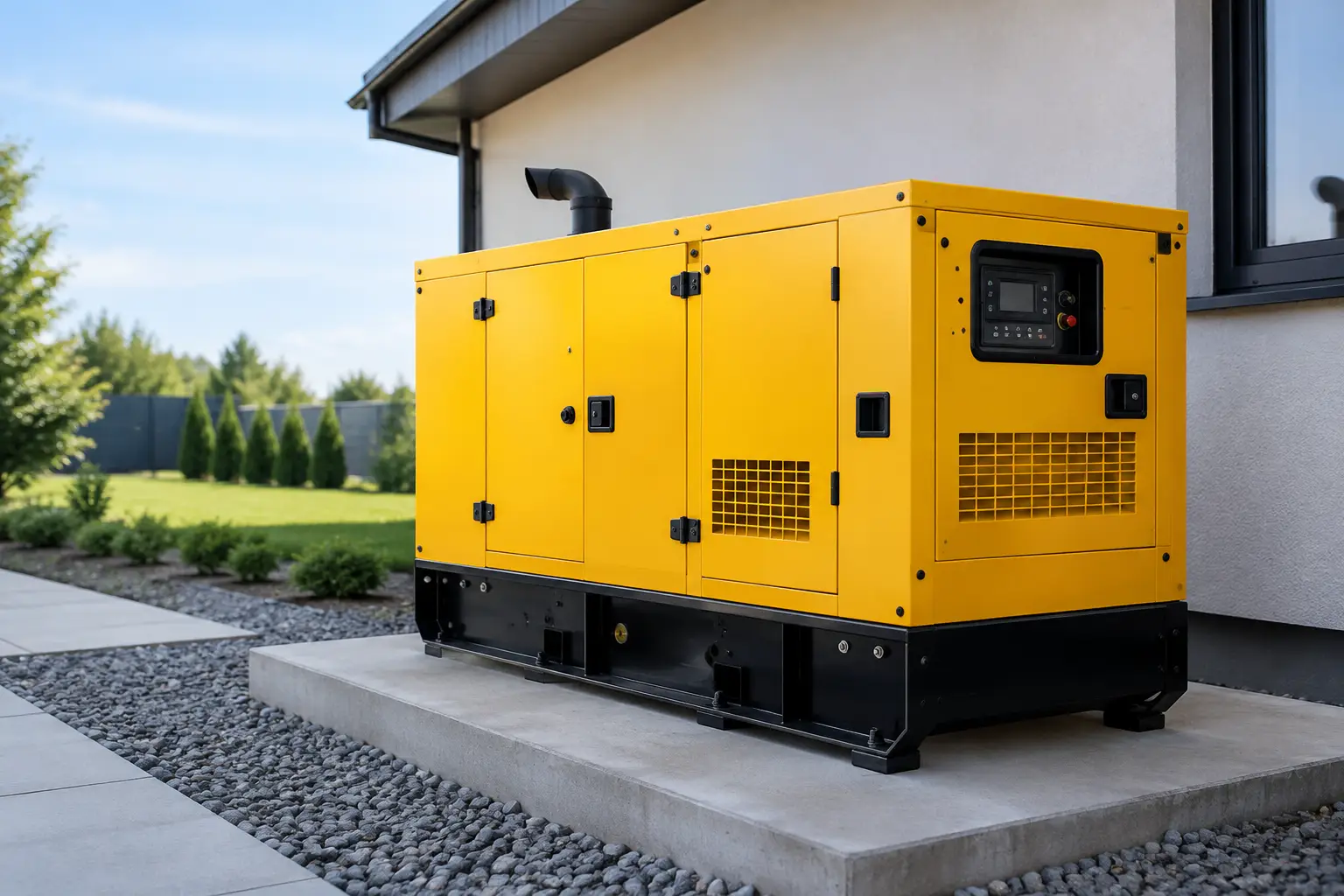
A 10 kVA diesel generator delivers between about 7 and 9 kW of usable power, depending on the model. The three-phase Cummins C10D5Q gives 7.2 kW on its prime rating, while a single-phase Pramac P11000-1P lists 9 kW. That is enough to keep the essentials of a small house running, power a shed or home workshop, or supply a small café or site cabin, as long as the biggest loads are switched on one at a time. It will not run an electric shower, an EV charger or several heavy appliances together.
This guide uses datasheet figures from the 10 kVA diesel generators in our range to show what a 10 kVA set can realistically run in homes, workshops, cafés and small sites. Where a job is better suited to a bigger set, we say so.
What does 10 kVA actually mean?
kVA measures apparent power. Most appliances are labelled in watts or kW, which is real power. To convert, multiply kVA by the power factor. The power factor differs between sets, which is why the same "10 kVA" label gives different kW figures.
| Model | Supply | Standby rating | Prime rating |
|---|---|---|---|
| Cummins C10D5Q | Three phase, 400 V | 10 kVA / 8 kW | 9 kVA / 7.2 kW |
| Pramac P11000 AMF | Three phase, 400 V | 10.8 kVA / 8.6 kW | 10 kVA / 8 kW |
| Pramac P11000-1P | Single phase, 230 V | 10.8 kVA / 9.7 kW | 10 kVA / 9 kW |
Three points stand out:
- The usable power varies by about a quarter. Prime output runs from 7.2 kW on the Cummins to 9 kW on the single-phase Pramac. Always plan around kW and check which rating a listing quotes.
- Standby is for emergencies only. A standby rating is for backup during a mains failure, and a prime rating is for regular running. Plan around the prime figure if you will use the generator often. Our guide to prime versus standby power explains the difference.
- Phase matters. The Cummins C10D5Q is rated at 14.4 A per phase and the Pramac P11000 AMF at 15.5 A per phase, because both are three-phase sets.
> Expert tip: When comparing "10 kVA" generators, compare kW on the prime rating and the supply type, not the headline kVA. The 1.8 kW gap between them is roughly the load of a kettle.
Why starting loads matter
Motors, compressors, pumps and fridges draw three to seven times their running current for a second or two when they start. A diesel generator can absorb that surge, but only within limits. A rough guide is that a motor started direct-on-line should be no more than about a third of the generator's kW rating, which is around 2.4 kW on a 7.2 kW set and 3 kW on a 9 kW set. Alternators differ, so confirm the figure with the supplier for the exact set.
Single phase or three phase?
Most UK homes have a single-phase supply, so a single-phase set such as the P11000-1P suits a house. A three-phase set gives each phase only about a third of its total capacity for single-phase loads. For the Cummins C10D5Q that is roughly 3 kVA per phase on the prime rating, about 13 A at 230 V. So a three-phase 10 kVA set is a poor match for a single-phase house and is best kept for premises with three-phase equipment.
For a deeper comparison, see our guide to single phase vs three phase, or browse our single phase generators and 3 phase generators.
What can a 10 kVA diesel generator run in a house?
A single-phase 10 kVA set covers the circuits that keep a house safe and comfortable. Typical running loads:
| Appliance | Typical running load | Notes |
|---|---|---|
| Fridge-freezer | 100 to 300 W | Higher surge on start |
| LED lighting (whole house) | 100 to 300 W | Very light load |
| Gas boiler, pump and controls | 100 to 250 W | Keeps heating running |
| TV, router, laptops | 200 to 400 W | Light load |
| Kettle | 2 to 3 kW | Short bursts |
| Microwave | 0.8 to 1.5 kW | Short bursts |
| Washing machine | 0.5 to 2.2 kW | Peaks when heating water |
| Electric oven | 2 to 3 kW | Cycles on and off |
| Electric shower | 7.5 to 10.5 kW | Uses most or all of the generator |
Two realistic set-ups on a 9 kW single-phase set:
- Essentials (about 4 to 5 kW): fridge-freezer, lighting, boiler and pump, TV and router, and a kettle. The generator runs at around half load, which suits a diesel engine well.
- Comfortable (about 7 kW): the essentials plus the oven. That is roughly 81% of the 9 kW prime rating, so run the washing machine and kettle at different times.
- Not realistic: an electric shower or a 7 kW EV charger alongside anything else. Each one on its own takes most of the generator.
Connection matters as much as size. A house generator should be wired through a properly installed changeover switch by a qualified electrician, never plugged into a socket, which can send power back into the network and endanger anyone working on it. The HSE's electrical safety guidance covers the general principles. If you are comparing options for a property, see our range of generators for homes.
> Expert tip: If your home has an electric shower or electric heating you want backed up, a 10 kVA set will need those circuits left off the backed-up supply. A larger set gives you more freedom, as our guide to what a 15 kVA generator can power explains.
What can a 10 kVA diesel generator run in a shed or home workshop?
Single-phase power tools suit this size well, provided you start them one at a time. Typical loads:
| Equipment | Typical running load | Notes |
|---|---|---|
| Circular or table saw | 1.8 to 2.2 kW | Surge on start |
| Router or planer | 1.2 to 2.2 kW | Modest load |
| Small air compressor (3 hp) | About 2.2 kW | Biggest starting load |
| Dust extractor | 1 to 1.5 kW | Start it first |
| Angle grinder | 1 to 2.2 kW | Short bursts |
| Inverter MIG welder (160 A) | 4 to 6 kVA at full output | Check the welder's input rating |
| Lighting | 0.2 to 0.5 kW | Negligible |
A worked example. A 2.2 kW compressor, a 1.1 kW extractor, 0.4 kW of lighting and a 2 kW tool in use total about 5.7 kW. That is about 63% of the 9 kW single-phase prime rating, but about 79% of the 7.2 kW Cummins, which is tight. If you add a welder, run it on its own and leave the other machines switched off.
What can a 10 kVA diesel generator run in a café or small shop?
Small commercial sites use many light loads and a handful of heavier ones. Refrigeration is the priority, since stock is lost quickly once the compressors stop.
| Equipment | Typical running load | Notes |
|---|---|---|
| Two-group espresso machine | 3 to 4.5 kW | Heating element cycles |
| Display or undercounter fridge | 300 to 800 W each | Compressor surge on start |
| Panini grill or toaster | 2 to 3 kW | Short bursts |
| Microwave | 1 to 1.5 kW | Short bursts |
| LED lighting | 0.3 to 0.8 kW | Steady load |
| Tills, card machines, CCTV | 0.3 to 0.6 kW | Keep on a stable supply |
A worked example. A café with a 3.5 kW espresso machine, two fridges (0.8 kW), a 2.2 kW panini grill, 0.5 kW of lighting and 0.3 kW of tills comes to about 7.3 kW. That is 81% of the 9 kW single-phase prime rating and about 91% of the 8 kW standby rating of the Cummins, and it is more than the Cummins can supply on prime. Either run the coffee machine and grill at separate times or choose a larger set.
What can a 10 kVA diesel generator run on a small site?
On a small site or at an event, a 10 kVA set typically covers:
- One or two site cabins, each using 2 to 3 kW with a heater or small air conditioning unit
- LED floodlights or work lights (0.4 to 0.8 kW)
- 110 V power tools through a 3.3 kVA transformer, which draws up to around 2.5 kW
- A kettle or microwave for the welfare cabin, but not every item at once
A typical set of one cabin (3 kW), floodlights (0.8 kW) and two 110 V tools through a transformer (2.5 kW) comes to about 6.3 kW. That is about 88% of the Cummins prime rating and about 70% of the 9 kW Pramac. Temporary installations need careful earthing, so read our generator earthing requirements guide before setting up.
What a 10 kVA diesel generator will not run comfortably
- An electric shower, which can use all of the generator's output on its own.
- A 7 kW EV charger, which would take most of the capacity.
- Several large heating or cooking appliances running together.
- A motor above about 2.4 to 3 kW started direct-on-line.
- Single-phase loads concentrated on one phase of a three-phase set.
- Continuous running at close to 100% load with no headroom.
How to size a 10 kVA diesel generator for your site
- List everything that must keep running. Be strict and include only essentials.
- Find each running load on the rating plate, in watts or amps. For single phase, watts = volts × amps.
- Find the largest starting load and check it against the generator's motor-starting capability.
- Check the kW of the prime rating, and add 20 to 25% headroom. For a 7.2 kW set that means keeping your typical load under about 5.8 kW.
- Aim for a typical load of 40 to 80%. Diesel engines run lightly loaded for long periods can suffer from wet stacking, where unburnt fuel builds up in the exhaust.
> Not sure your load list adds up? Send us your equipment list and we will check it against a set from stock. Speak to our team through the contact page or call +44 1302 700200.
Fuel use and run times
Fuel use depends on the model and the load, and the tank sizes differ a lot.
| Model | Fuel use | Tank | Run time |
|---|---|---|---|
| Cummins C10D5Q at 100% prime (7.2 kW) | 2.3 litres per hour | 55 litres | About 23.9 hours |
| Pramac P11000 AMF at 75% prime (6 kW) | 2.47 litres per hour | 24 litres | About 9.7 hours |
| Pramac P11000 AMF at 100% prime (8 kW) | 3.48 litres per hour | 24 litres | About 6.9 hours |
Both sets of figures come from the product pages. The Cummins' larger tank gives much longer autonomy, which matters for outages that last more than a day. Run times use nominal tank capacity, so allow a reserve in practice. For ways to run a generator efficiently, see our guide to fuel saving methods for generators.
Standby, prime and how it starts
Warranty reflects the duty. On the Cummins C10D5Q, standby cover is two years or 500 hours and prime cover is one year with unlimited hours. On the Pramac P11000 AMF, standby cover is two years or 1,000 hours and prime cover is one year or 3,000 hours.
Automatic starting. The Cummins C10D5Q uses the PowerStart 0600 controller, which supports automatic mains failure functionality, remote start and fault history logging. The Pramac P11000 AMF comes with a pre-wired auto mains failure panel mounted on the set. Both suit standby generators that must start without anyone on site, when installed with correctly specified transfer equipment.
Size, weight and noise
| Specification | Cummins C10D5Q | Pramac P11000 AMF |
|---|---|---|
| Length × width × height | 1,960 × 820 × 1,285 mm | 1,400 × 650 × 975 mm |
| Dry weight | 715 kg | 332 kg |
| Canopy noise | 77 dB(A) at 1 m / 65 dB(A) at 7 m | 81 dB(A) at 1 m / 68 dB(A) at 7 m |
| Engine speed | 1,500 rpm | 3,000 rpm |
| Made in | Europe | Europe |
The Pramac is less than half the weight and noticeably smaller, which helps in tight spaces. The Cummins is quieter at 7 m, and the 1 m and 7 m figures are not directly comparable. Our guide to how quiet a silent generator really is explains how to read them, and you can compare enclosures in our range of silent generators.
10 kVA or 20 kVA?
Choose a 10 kVA set if your realistic load stays under about 5.8 kW on the Cummins, or about 7.2 kW on the single-phase Pramac, and you have no large motors to start. Look at a 20 kVA generator if any of these apply:
- You want to run the oven, kettle and washing machine together
- You have an electric shower or electric heating you want backed up
- A motor above about 3 kW needs to start direct-on-line
- Your load list already sits above 7 kW
It is almost always better to size correctly at the start than to replace an overworked set later.
Siting, safety and regulations
- Ventilation and exhaust. Diesel exhaust contains carbon monoxide. Never run a generator indoors or in an enclosed space, and keep exhausts away from doors, windows and air intakes.
- Connection. Use a changeover switch fitted by a qualified electrician. Never back-feed a building through a plug.
- Fuel. Stop the engine and let it cool before refuelling, and store diesel in approved containers.
- Permits. Environmental permit rules apply to medium combustion plants and specified generators, which are far larger than a 10 kVA set. You can confirm the thresholds in the GOV.UK guidance on medium combustion plants and specified generators.
- Servicing. Regular servicing and a monthly on-load test keep a standby set reliable.
Frequently asked questions
How many kW is a 10 kVA generator?
It depends on the model. The Cummins C10D5Q gives 7.2 kW on its prime rating and 8 kW on standby, the three-phase Pramac P11000 AMF gives 8 kW prime and 8.6 kW standby, and the single-phase Pramac P11000-1P lists 9 kW prime and 9.7 kW standby.
Can a 10 kVA diesel generator run a house?
It can run the essential circuits of most houses, including the fridge-freezer, lighting, heating controls and a kettle, and the oven as well on a single-phase set. It cannot run an electric shower or an EV charger alongside other loads. Have it connected through a changeover switch by a qualified electrician.
How much diesel does a 10 kVA generator use per hour?
On the Cummins C10D5Q, 2.3 litres an hour at full prime load. On the Pramac P11000 AMF, about 2.47 litres an hour at 75% prime load and 3.48 litres an hour at full prime load.
Is a 10 kVA diesel generator single phase or three phase?
Both exist. The Cummins C10D5Q and Pramac P11000 AMF are three phase at 400 V, and the Pramac P11000-1P is single phase at 230 V. Choose by your supply and your largest single-phase load.
Can a 10 kVA generator run a welder or air compressor?
Often yes, within limits. A 160 A inverter welder can run when other loads are off, and a small 2.2 kW compressor can start on a 9 kW set. Keep direct-on-line motors to around 2.4 to 3 kW and check the welder's input rating before connecting.
How long can a 10 kVA diesel generator run continuously?
A well-maintained diesel generator can run for many hours or days if it is refuelled and kept within its rated load. For regular running rather than emergency use, check that the set is rated for prime power and follow the manufacturer's service intervals.
Conclusion
A 10 kVA diesel generator is a practical size for small houses, sheds, workshops, cafés and small sites, but the usable power ranges from 7.2 to 9 kW depending on the model. Check the kW on the prime rating, choose the phase type first, and step up to 20 kVA if your load list will not fit.
> Talk to a real person: Global Generators is an authorised Cummins reseller and an authorised Grupel and Pramac dealer, with new diesel generators in stock for UK delivery and export. Browse the stock list, then contact our team on +44 1302 700200 or at enquiries@global-generators.com and we will help you match a set to your load.