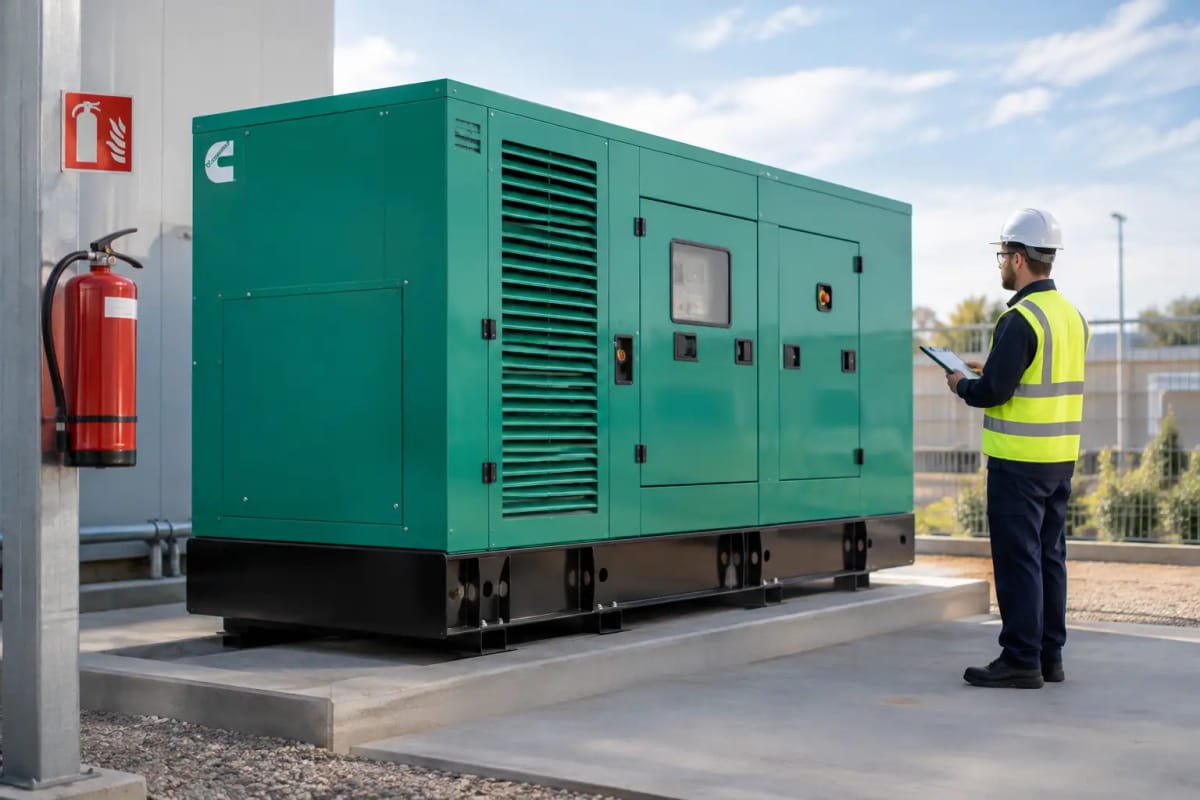
A generator fire can remove both normal power and the standby capacity intended to protect the site. For facilities with critical loads, this is not simply an equipment issue. It can affect life-safety systems, production, data, security, environmental compliance and business continuity. This diesel generator fire safety guide sets out the practical controls that should be considered from specification and installation through to routine operation.
Diesel Generator Fire Safety Guide: Start With the Site
Fire risk is substantially influenced by where and how the generator is installed. A correctly sized Cummins-powered set with a suitable enclosure is only part of the solution. The surrounding fuel system, ventilation arrangement, electrical installation and access for maintenance all need to support safe operation.
The generator should be positioned on a stable, non-combustible base with sufficient clearance for cooling airflow, inspection and emergency access. Open generator sets require particular care because hot surfaces and electrical components are more exposed. A weatherproof or acoustic enclosure can provide valuable protection, but it must not be treated as a substitute for proper ventilation, fire separation and housekeeping.
Generator rooms and external compounds should be kept clear of packaging, waste, vegetation, stored materials and parked vehicles. On construction sites, this control is often overlooked as the site layout changes. A clear exclusion zone around the generator reduces the likelihood that a minor fuel leak, exhaust fault or electrical arc develops into a wider incident.
The final layout should be assessed alongside local planning requirements, fire strategy, building regulations, insurer requirements and the applicable electrical and fuel installation standards. There is no universal safe distance or one enclosure specification that suits every application. A healthcare facility, logistics depot and temporary construction project have different fire loads, operating hours and evacuation considerations.
Control Fuel Before It Becomes a Fire Risk
Diesel is less volatile than petrol, but it remains a combustible fuel. Leaks can travel, collect beneath equipment, soak into insulation or come into contact with hot engine and exhaust components. Fuel management is therefore one of the most important parts of generator fire safety.
Day tanks, bulk tanks, transfer pumps, flexible hoses, filters and connections should be selected for the operating environment and installed to prevent mechanical damage. Fuel lines must be adequately supported and protected from vibration, abrasion and accidental impact. Where a generator operates for extended prime power duty, the fuel arrangement requires even closer consideration because transfer equipment and pipework are used more frequently.
Bunds and secondary containment should have sufficient capacity for the stored fuel and be inspected for water, debris or corrosion. Drain valves must remain secure. A bund that has filled with rainwater can lose its containment function at the exact point it is needed.
Fuel should not be stored in improvised containers beside the generator. Refuelling must take place with the set shut down where operationally possible, with ignition sources controlled and spill equipment immediately available. For mission-critical sites that cannot tolerate a shutdown, establish a documented refuelling procedure that defines authorisation, communication, supervision and emergency actions before fuel is transferred.
Manage Heat, Exhaust and Ventilation
A diesel engine produces high temperatures at exhaust manifolds, turbochargers, silencers and pipework. Inadequate ventilation raises engine bay temperatures, reduces cooling performance and can increase the chance that combustible contamination reaches a hot surface.
The cooling airflow design must match the generator's heat rejection, enclosure arrangement and ambient conditions. Intake and discharge paths should not be obstructed by temporary barriers, stored stock, filters that have not been maintained or alterations to the building. Recirculation of hot discharge air is a common cause of overheating, particularly where a set has been installed in a restricted plant room or a poorly designed external acoustic enclosure.
Exhaust systems need to be securely supported, correctly routed and insulated or guarded where personnel could contact them. Inspect joints for soot staining, which may indicate an exhaust leak. Keep combustible materials away from the exhaust route and confirm that rain caps, lagging and flexible sections remain serviceable. Exhaust insulation that is saturated with fuel or oil should be treated as an immediate corrective action, not a minor maintenance defect.
Design Electrical Protection for Fault Conditions
Electrical faults can create arcs, excessive heat and ignition sources. Generator safety depends on the correct coordination of alternator protection, circuit breakers, earthing arrangements, automatic transfer switches and downstream distribution.
The generator must be earthed in accordance with the site electrical design. The correct arrangement depends on whether the set is operating as a separately derived source, the type of transfer equipment in use and the wider installation. Assumptions in this area are unsafe. The earthing and switching design should be verified by a competent electrical engineer during installation and after material changes.
Cables should be correctly rated, terminated, supported and protected from physical damage. Loose connections create resistance and heat, especially under high load. Thermographic inspection can be useful for identifying abnormal temperatures at terminals, breakers and transfer panels before a fault escalates.
Avoid repeated overloading. A generator may start and run with an unsuitable load profile, but persistent overload, poor power factor or unbalanced three-phase loading can raise temperatures and shorten component life. Load-bank testing and planned operational tests help establish whether the set, controls and distribution system perform as specified under realistic conditions.
Detection and Suppression Need a Defined Strategy
The generator area should be included within the site's fire detection and alarm plan. Smoke, heat or flame detection may be appropriate depending on the environment, ventilation and enclosure design. Detection must provide a meaningful warning without creating nuisance alarms that site teams learn to disregard.
For enclosed generator rooms, automatic fire suppression may be justified where the generator supports a critical load, is located within a building or cannot be rapidly isolated by staff. The system selected should suit the enclosure volume, fuel risk, ventilation arrangement and occupancy. It must also be interlocked correctly. In many applications, a suppression discharge should initiate generator shutdown, stop fuel transfer pumps, isolate ventilation where required by the fire strategy and signal the building management or fire alarm system.
Portable extinguishers should be positioned for safe access outside the immediate hazard area, not placed where an operator would need to pass a developing fire to reach them. Staff should understand when it is safe to use an extinguisher and when evacuation and escalation are the correct response. No portable extinguisher makes it acceptable to tackle a well-developed fuel or electrical fire without trained support.
Inspection Must Be Planned, Not Reactive
A generator that starts during a weekly test is not necessarily fire-safe. Inspections should combine routine operator checks with scheduled servicing by competent personnel. The exact frequency depends on duty cycle, environmental conditions, fuel storage duration and manufacturer recommendations, but the following checks should form part of the site regime:
- Inspect for diesel, oil or coolant leaks around the engine, tanks, hoses and filters.
- Check exhaust guards, lagging, flexible joints and supports for damage or contamination.
- Remove dust, oil residue, debris and stored items from the generator area.
- Confirm ventilation openings, louvers and cooling paths are unobstructed.
- Examine battery leads, cable terminations and electrical enclosures for heat damage or looseness.
- Test alarms, emergency stop functions, fuel shut-off arrangements and remote monitoring signals.
Records matter. Logging defects, corrective actions, test run hours, load levels and alarm events gives facilities teams evidence of control and helps identify recurring faults. If a low coolant alarm, high temperature warning or fuel leak appears more than once, treat the trend as a reliability issue requiring investigation rather than resetting the alarm and returning the set to service.
Set Clear Actions for an Incident
Operators should not need to interpret emergency arrangements under pressure. The generator emergency procedure should state who can initiate shutdown, how fuel is isolated, who contacts emergency services, how critical loads are managed and where staff assemble. It should also identify any equipment that must remain energised for life safety or controlled shutdown.
Where generators support data centres, healthcare estates, telecoms infrastructure or continuous industrial processes, the response plan should recognise the trade-off between protecting the generator and maintaining the protected load. There may be circumstances where a controlled transfer, staged shutdown or alternative source is needed before the generator can be safely isolated. These decisions should be agreed in advance by operations, facilities, electrical engineering and health and safety teams.
After any fire, significant fuel spill, overheating event or electrical fault, do not return the generator to service solely because it appears operational. Inspect the engine, alternator, control panel, cable system, exhaust, fuel installation and enclosure before recommissioning. Hidden heat damage and contaminated insulation can cause a second failure when the set is needed most.
Specify Safety Alongside Capacity
Generator procurement should assess fire safety alongside kVA rating, standby or prime power duty, voltage and enclosure type. A silent generator may be appropriate for a populated commercial site, while an open set may suit a controlled plant environment with a purpose-designed generator room. Neither format is inherently safer without the right installation controls.
Global Generators can support buyers in matching generator capacity and configuration to the operating requirement, but the site design must account for fuel, ventilation, exhaust routing, electrical protection and emergency management from the outset. The best time to reduce generator fire risk is before the unit arrives on site, when access routes, separation distances and system interfaces can still be properly engineered.
A dependable power system is one that can start when the mains fails and remain safe throughout the event. Treat fire controls as part of availability planning, review them after every site change, and give the generator installation the same operational scrutiny as the critical load it protects.