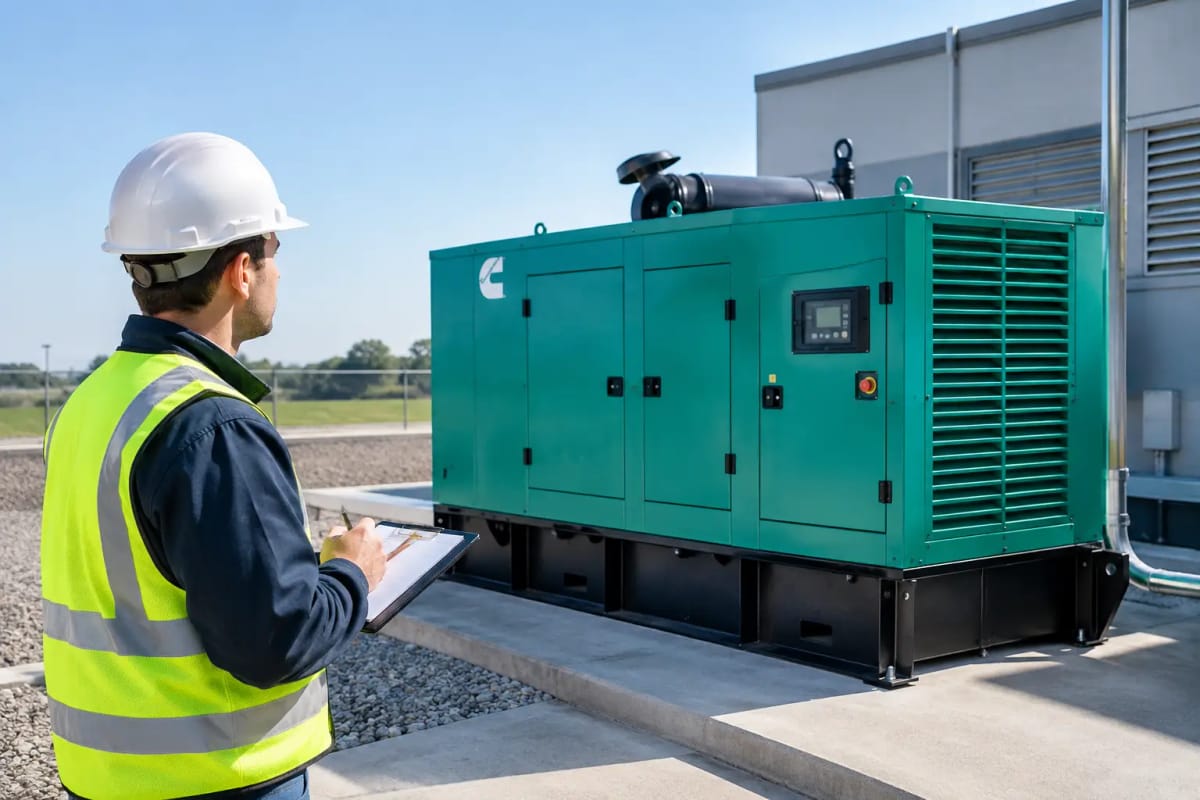
A generator purchase can appear straightforward until the first loss of mains power exposes a missed assumption. An undersized set may fail at motor starting, an unsuitable enclosure may overheat, and inadequate fuel autonomy can turn a short outage into a site shutdown. This generator procurement checklist is designed for buyers who need to specify dependable standby or prime power without leaving critical decisions to guesswork.
Start the Generator Procurement Checklist With the Duty
The first procurement decision is not the kVA rating. It is the operating duty. Standby power and prime power are different applications, with different rating rules and expected running profiles.
A standby generator is intended to support a site during utility failure. It normally operates for limited annual hours and at variable load. Hospitals, offices, logistics facilities and commercial buildings often require standby sets, but the required runtime, transfer arrangement and fuel reserve still need definition.
Prime power is for sites where the generator is the normal or principal source of electricity, whether continuously or for extended, variable-duration operation. Construction compounds, remote infrastructure, temporary utility works and off-grid industrial processes may need a prime-rated set. Do not procure a standby-rated generator for a continuous-duty application simply because its headline kVA figure appears sufficient.
Define the required duty in writing before requesting quotations. Record anticipated annual running hours, expected load profile, acceptable downtime, maintenance windows and whether the set must run in parallel with another generator or the mains supply. These details determine the correct engine, alternator, control system and rating.
Establish the Real Electrical Load
Nameplate totals are useful, but they are not a final load study. Procurement teams should obtain an electrical schedule from the site engineer or contractor, then separate essential loads from loads that can remain off during an outage.
Consider the running load, the maximum coincident demand and the highest starting demand. Motors, compressors, pumps, lifts and refrigeration equipment can draw substantial current when starting. A generator that carries the normal running load may still suffer unacceptable voltage and frequency dip when a large motor starts.
Check the following load characteristics before selecting capacity:
- Total connected load and maximum demand in kW and kVA.
- Power factor, including any correction equipment and non-linear loads.
- Motor starting method, such as direct-on-line, star-delta, soft starter or variable speed drive.
- Load sequence, particularly where pumps or process equipment can be staged.
- Future expansion allowance, based on a defined project plan rather than an arbitrary percentage.
The relationship between kW, kVA and power factor must be clear. A generator may be rated in kVA, while the site load is recorded in kW. At a power factor of 0.8, a 500 kVA set provides 400 kW. If the operating power factor differs, or harmonics are high, the alternator and control specification may need adjustment.
Avoid excessive oversizing as well. Running a diesel generator persistently at a very low load can create poor combustion conditions and wet stacking. The right answer is often a correctly sized set with staged loads, load-bank provision or multiple generators, rather than one unnecessarily large machine.
Confirm Voltage, Frequency and Distribution Requirements
For most UK commercial and industrial applications, the requirement will be 400/230V, 50Hz, three phase. That should still be confirmed against the existing installation. Export projects may require a different voltage, frequency, earthing arrangement or socket configuration.
Decide whether the set will feed a main switchboard through an automatic transfer switch, supply a dedicated essential-services board, or operate as a temporary source with distribution equipment. The generator controller must suit the operating arrangement. A basic manual-start panel is not appropriate where an unattended site requires automatic mains failure operation and alarm notification.
Where continuity requirements are strict, specify the transfer philosophy early. Break-before-make transfer is common, but some applications need synchronising, closed-transition transfer or load sharing between generator sets. These systems increase capital cost and commissioning requirements, yet they may be necessary where even a short interruption affects safety, production or data systems.
Assess the Installation Environment Before Ordering
A generator specification is only as sound as the proposed installation. Establish whether the set will be installed indoors, outdoors, on a roof, in a plant room, in a containerised package or as a mobile temporary unit. Each environment changes the requirements for cooling, exhaust routing, access, acoustics and protection.
An open generator may suit a properly designed internal plant room. It requires adequate ventilation, combustion air, heat rejection and safe exhaust discharge. A silent canopy generator provides weather protection and reduced noise for many outdoor installations, but the acoustic rating must be measured at a stated distance and under stated conditions. Do not compare sound figures without confirming both.
Survey access routes from delivery point to final position. Check gate widths, turning areas, lifting points, floor loading and crane or forklift requirements. Larger industrial sets, integral fuel tanks and acoustic enclosures create significant transport and lifting demands. A lorry arriving with a generator that cannot reach its base is an avoidable programme delay.
Also verify local planning, noise and emissions requirements. Urban, healthcare and residential-adjacent sites may require tighter acoustic control, while enclosed locations demand careful carbon monoxide management and fire-safe fuel arrangements.
Specify Fuel Storage and Runtime Properly
Fuel resilience should match the site risk, not a generic tank size. Calculate expected fuel consumption at realistic load points and determine the required operating duration before refuelling. A standby set supporting life safety systems may need a substantially different fuel strategy from a construction site that has a planned refuelling schedule.
Consider integral base tanks, bulk tanks, bunding, fuel transfer pumps, filtration and low-fuel alarms. Fuel quality management matters for generators that stand unused for long periods. Water ingress, microbial growth and degraded fuel can prevent a set from starting when it is needed most.
For critical installations, include fuel polishing arrangements, day-tank controls where relevant, and an agreed refuelling route during an extended utility outage. The generator is not resilient if its fuel supply depends on access that will be unavailable during the same incident.
Review Engine, Alternator and Control Package
Recognised engine manufacturers, correctly matched alternators and proven controllers reduce procurement risk. The evaluation should go beyond the badge. Request clear data on standby and prime ratings, fuel consumption, dimensions, weight, sound level, emissions configuration and service intervals.
The controller should provide the functions the site genuinely needs: automatic start, mains monitoring, programmable inputs and outputs, fault protection, event logging, remote monitoring or synchronising where applicable. For a remotely managed estate, communications capability may be a core requirement. For a simple temporary installation, a straightforward and serviceable control package may be more appropriate.
Ask how the set will perform with non-linear loads, large motor starts and step-load changes. Sensitive equipment, UPS systems and modern drives can place demanding requirements on voltage regulation and waveform quality. These issues should be resolved at specification stage, not during commissioning.
Include Compliance, Testing and Handover in the Purchase
Generator procurement should cover more than delivery of the equipment. Confirm the scope for installation, cabling, exhaust works, fuel connections, automatic transfer equipment, commissioning and operator training. If separate contractors are involved, define the interface responsibilities precisely.
Before handover, require documented checks for protection settings, automatic start and transfer, load acceptance, alarms, emergency stops and remote signals. A load-bank test is particularly valuable where the actual building load cannot adequately prove the generator's performance during commissioning.
The procurement file should include operating manuals, wiring diagrams, test records, serial numbers, warranty details, maintenance schedules and a spare-parts recommendation. Establish who will provide planned maintenance and emergency response once the set enters service.
Build Availability Into the Buying Decision
A technically correct specification has limited value if it does not meet the project programme. Confirm stock status, manufacturing lead time, UK delivery arrangements and any export documentation before committing. If a required set is available from stock, verify that the proposed configuration, enclosure, tank and control system match the approved specification rather than assuming all units are identical.
Price should be evaluated against whole-life risk. A lower initial figure may exclude critical accessories, commissioning, warranty support or the fuel capacity needed to meet the duty. For time-sensitive projects, a dependable stockist with clear technical data and responsive enquiry support can protect both programme and uptime. Global Generators can assist buyers in matching available diesel generator sets to defined standby and prime power requirements.
A procurement decision is complete only when the generator, site infrastructure and operating plan have been treated as one system. Specify the duty clearly, prove the load, plan the installation and test the result before the site depends on it.