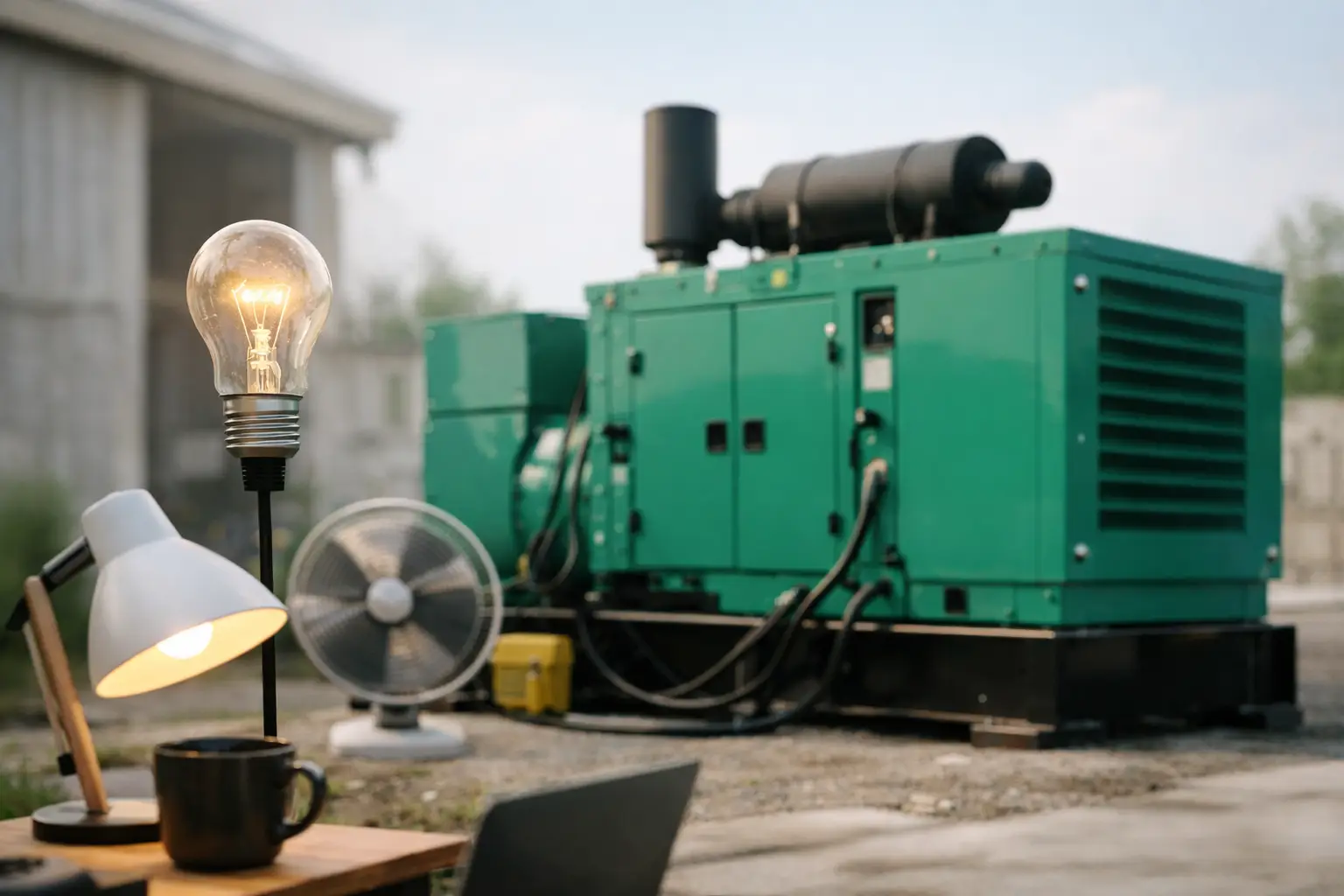
A 1,000 kVA standby generator carrying a 60 kW overnight load may start, run and produce the correct voltage. That does not mean it is operating in a healthy long-term condition. Can generators run lightly loaded? Yes, but diesel generator sets should not be specified or routinely operated at very low load without considering engine temperature, fuel combustion and the actual site demand.
For facilities responsible for critical power, the issue is usually not whether a generator will run. It is whether prolonged light-load operation will compromise reliability when the set is needed at full output. An oversized set can create maintenance problems that only become visible during a power failure.
Can generators run lightly loaded in normal service?
A diesel generator can operate below its rated capacity, particularly for short periods, during commissioning, or while site demand is temporarily low. Standby sets commonly experience changing loads as essential systems start in sequence. This is normal.
The concern begins when a diesel engine repeatedly runs at a very low percentage of its rated output for extended periods. Low cylinder temperatures can prevent fuel from burning as cleanly as intended. Unburnt fuel, soot and lubricating oil residues can then accumulate in the exhaust system. This is commonly known as wet stacking.
There is no single minimum-load figure that applies to every generator. Engine design, emissions equipment, ambient temperature, duty cycle, fuel quality and load profile all affect the result. However, a minimum continuous load of around 30% of rated capacity is often used as a practical planning guideline for conventional industrial diesel generators. The engine manufacturer's operating manual and the generator set specification must take priority.
A set that carries 20% load for a brief weekly exercise is not the same as a prime-power generator running at 20% load for months. Duty classification matters. Prime-rated sets are expected to work for long hours and should be selected around the genuine operating demand. Standby-rated equipment may have limited running hours, but it still needs adequate periodic loading to confirm that the engine and alternator will perform when called upon.
What light loading does to a diesel generator
Diesel engines work most efficiently when combustion temperatures and cylinder pressures are high enough to burn fuel properly. When demand remains low, the engine may not reach its intended operating condition. The immediate effect may be limited, but repeated operation can create faults that increase service costs and reduce confidence in the set.
Wet stacking is the most recognised consequence. It can appear as black, oily or wet deposits around the exhaust outlet, together with increased smoke. The term is sometimes used broadly, but the underlying issue is incomplete combustion and the build-up of residues within the engine and exhaust path.
Low-load running can also contribute to cylinder glazing. Deposits on cylinder liners reduce the ability of piston rings to seal correctly, which may increase oil consumption and allow combustion gases to bypass the rings. Injector fouling, carbon deposits on valves and turbocharger contamination can follow. These are not inevitable after a single lightly loaded run, but they are credible risks where underloading becomes a permanent operating pattern.
Modern control systems may also mask the problem. A generator controller can show stable frequency, acceptable oil pressure and normal coolant temperature while the engine is still operating below its preferred load range. A clean-looking dashboard is not proof that the generator has been properly exercised.
The alternator itself generally tolerates low load better than the diesel engine. However, a lightly loaded alternator does not remove the need to consider power factor, harmonic loads and load step performance. UPS systems, variable-speed drives and switch-mode power supplies can produce a load profile very different from the simple resistive load used to state a generator's kVA rating.
Correctly assess the real load, not the assumed load
Generator oversizing often starts with reasonable intentions. Buyers allow for future expansion, motor starting currents, fire pumps, lift systems or a requirement to support an entire building rather than essential circuits. The problem arises when every allowance is added together without examining which loads will actually operate at the same time.
A proper load assessment should identify the running kW, starting kVA and power factor of each essential load. It should also establish the sequence in which loads reconnect after a mains failure. A large motor may need significant starting capacity, but that does not necessarily justify a generator that is substantially oversized for its continuous load.
Four points should be confirmed before selecting or reviewing a set:
- the maximum simultaneous running load in kW and kVA;
- the largest motor or other step load the set must accept;
- the anticipated power factor and any harmonic-producing equipment;
- expected future demand, with a defined timescale rather than an undefined allowance.
This process often identifies a better solution than simply increasing generator size. It may be possible to sequence large loads, use soft starters or variable-speed drives where appropriate, separate non-essential circuits, or specify a different generator rating. For larger installations with widely changing demand, multiple smaller sets operating in parallel may provide better efficiency and resilience than one oversized unit.
Prime power and standby power require different decisions
A prime power generator is selected for regular or continuous site operation. Construction compounds, remote infrastructure, processing sites and temporary utilities may run for long periods with no mains support. In these applications, a generator should be sized so that normal demand places a meaningful load on the engine while retaining capacity for planned peaks.
A standby generator has a different role. Its primary duty is to start automatically, accept the essential load and maintain supply through a utility outage. It may remain idle for most of the year, yet its condition is more critical because there is no opportunity to correct a weakness once the mains has failed.
For standby applications, the solution is not to deliberately connect unnecessary site load during an outage. The solution is to test and maintain the set under an appropriate load at planned intervals. A data centre, healthcare facility or logistics operation may have strict operational constraints, so the testing method must suit the site risk assessment and continuity plan.
Load-bank testing is the practical control measure
Where the normal site load is too low, a load bank provides a controlled electrical load for testing. It allows the generator to be exercised without placing non-essential building systems at risk. The test can verify engine response, governor stability, cooling performance, fuel delivery, alternator output and control panel alarms under a known demand.
A load bank should not be treated as a box-ticking exercise. The load level, duration and frequency should be agreed with the engine manufacturer, service provider and site operating requirements. In many cases, technicians will increase load in stages and monitor temperatures, frequency, voltage, exhaust condition and alarms throughout the test.
Testing at a higher load can help burn off accumulated deposits, but it is not a guaranteed repair for an engine with established glazing, injector issues or significant exhaust contamination. If wet stacking is evident, the correct response is inspection and diagnosis, not simply running the set harder without checks.
Fuel maintenance also matters. A generator that is underloaded and rarely used can suffer from a separate problem: degraded fuel. Fuel polishing, water removal, filter replacement and tank inspection should form part of the maintenance plan. A healthy load profile cannot compensate for contaminated fuel.
When an oversized generator is still justified
There are valid reasons to choose a generator with spare capacity. A hospital may require room for phased expansion. A manufacturing site may have high motor-starting demands. A telecoms or utility installation may need an N+1 resilience strategy. The correct answer is not always a smaller generator.
The key is to recognise the operational consequence of spare capacity. If the set will regularly operate well below its preferred load range, include load-bank testing in the operating plan from the outset. Confirm that the enclosure, exhaust arrangement, fuel system and controls are suitable for the intended duty, and ensure the maintenance contract reflects the actual running pattern.
For buyers comparing industrial generator sets, the most dependable specification is rarely the biggest available rating. It is the rating that matches the real kW demand, accommodates starting and future requirements, and can be exercised properly throughout its service life. Global Generators can support this assessment across standby and prime power requirements, from smaller commercial installations to high-capacity industrial schemes.
A generator should be ready to carry the load that matters, not simply capable of starting with no meaningful work to do. Establish the site load profile before procurement, then make planned load testing part of the uptime strategy from day one.