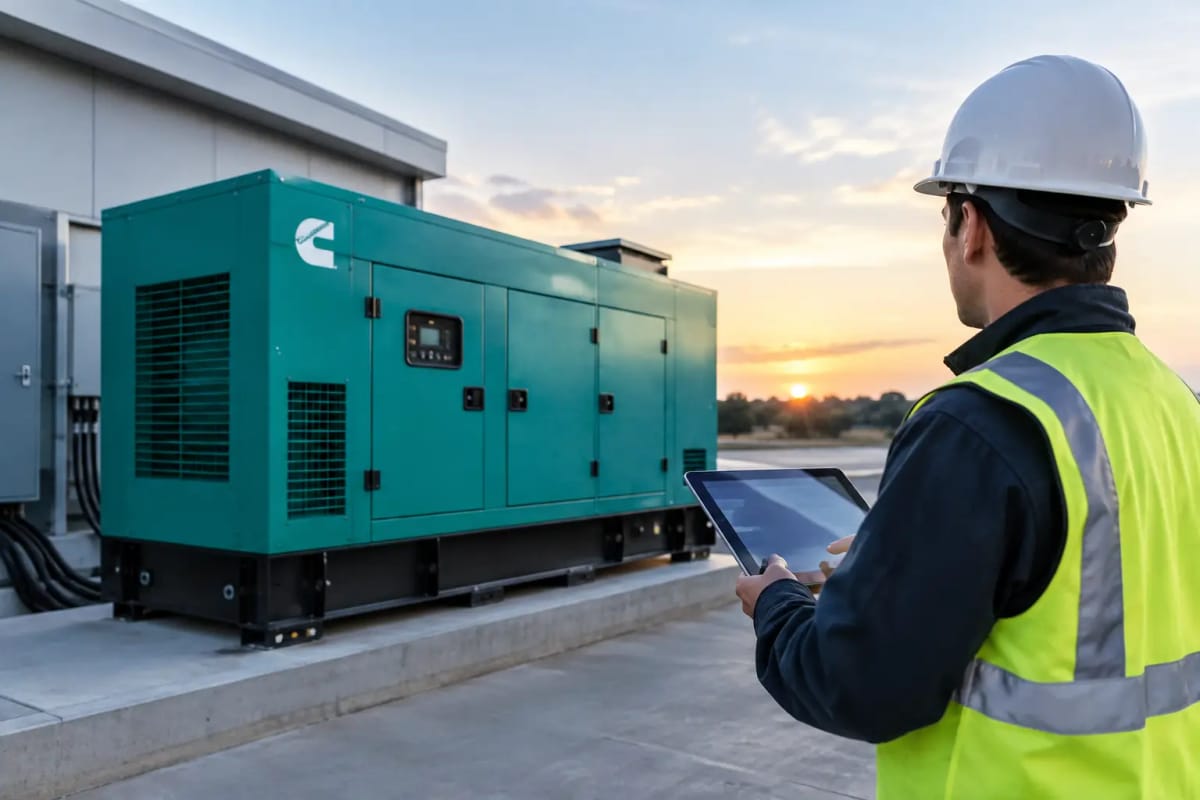
A generator that starts but cannot accept the site load is not correctly specified. Effective generator sizing methodology begins with the actual electrical behaviour of the installation, not a broad estimate of the utility supply or a simple total of equipment nameplates. For hospitals, manufacturing lines, telecoms installations, logistics sites and major commercial premises, the consequences of undersizing can include failed transfers, voltage dip, nuisance trips and extended downtime.
The correct set is the one that supports the required load profile, motor starting demand, operating duty and site conditions with a realistic allowance for change. It must also be matched to the intended application: standby power during mains failures, or prime power where the generator is expected to carry variable load for extended periods.
Start with the duty rating, not the largest kVA figure
Generator ratings are not interchangeable. A standby-rated generator is intended for emergency operation during a utility outage, generally with limited annual running hours and no sustained overload provision. Prime power is for variable loads over longer operating periods, such as construction compounds, remote facilities or sites with an unreliable grid supply.
Selecting a standby rating for a prime power application can reduce engine life and compromise availability. Conversely, specifying prime power where standby duty is sufficient may add unnecessary capital cost. The required rating should therefore be agreed before sizing calculations begin.
The load profile matters as much as the peak. A facility may have a 500 kW connected load but only require 280 kW of essential services during an outage. Another site may require its full process load to continue, with several large motors starting in sequence. These are entirely different generator duties, even where the site appears similar on paper.
Generator sizing methodology: establish the real load
The first task is to identify every load that will be supplied by the generator. Separate essential from non-essential circuits, then record each item’s running kW, kVA, power factor, phase, voltage and method of starting. A current load study is preferable to relying only on original drawings, particularly on older sites where equipment and operating practices may have changed.
For a three-phase installation, apparent power is commonly calculated as:
kVA = kW ÷ power factor
This is useful for steady-state loads, but it is only one part of the calculation. Generator alternators respond to kVA demand, while the engine must provide the corresponding real power in kW. Poor power factor increases the kVA requirement without delivering additional usable kW, which can make an apparently adequate set unsuitable.
A practical schedule should include lighting, HVAC equipment, pumps, compressors, lifts, refrigeration, IT loads, battery chargers, fire systems, process machinery and any equipment that must remain live during a transfer. Consider the load that will operate at the same time, rather than adding every connected item without question. Diversity can reduce the running requirement, but it must be justified by the site’s actual operating sequence and criticality.
Avoid applying aggressive diversity factors to life-safety systems or a process that needs to restart immediately. For critical installations, the consequence of being wrong is usually greater than the saving achieved by selecting a smaller generator.
Measure where the load is uncertain
Temporary power analysers can establish real kW, kVA, current, power factor and demand peaks over a representative period. Measurement is especially valuable where variable speed drives, welders, UPS systems, compressors or fluctuating process loads are present.
A single maximum-demand reading may not reveal the full requirement. Review normal operation, shift changes, seasonal plant, start-up conditions and recovery following an outage. After a mains failure, several systems may attempt to restart together unless the control strategy deliberately stages them.
Account for motor starting and step loading
Motor starting is one of the most common reasons for generator sizing errors. A direct-on-line motor can draw several times its running current at start-up. The resulting inrush can cause a generator voltage and frequency dip, preventing other equipment from starting or causing sensitive controls to trip.
The size of the issue depends on motor type, starting method, motor load, generator alternator design and the maximum permitted voltage dip. A pump that starts comfortably on the utility supply may impose a significant transient demand on a generator.
Direct-on-line starting creates the highest starting demand. Star-delta starters, soft starters and variable speed drives can reduce the starting current, but each has its own electrical characteristics. Drives and UPS equipment may introduce harmonic currents or leading power factor conditions that require careful alternator selection. Manufacturer data should be used for these loads rather than assuming a standard multiplier.
Where several motors are involved, sequenced starting is often more cost-effective than selecting a substantially larger generator. The control system can start the largest motor first, allow voltage and frequency to recover, then bring on subsequent loads in stages. Load shedding can also protect the generator by disconnecting non-critical circuits when demand exceeds the available capacity.
The design review should identify the largest single step load, the maximum combination of loads likely to start together and the acceptable voltage and frequency limits for connected equipment. A set that carries the final running load may still fail if it cannot accept these transitions.
Check the installation conditions that change capacity
A generator’s published rating is based on defined ambient and altitude conditions. High ambient temperatures, elevation, restricted ventilation and poor plant room design can reduce available engine output. If the set will operate in a hot enclosure, on an elevated site or in a location with high inlet-air temperatures, derating must be considered during selection.
The enclosure is part of the specification, not an afterthought. A silent generator may be essential where noise limits apply, but the canopy, radiator arrangement and airflow route must suit the installation. Open generators are appropriate for protected plant rooms and containerised projects where ventilation, exhaust routing and acoustic treatment are designed separately.
Fuel autonomy also affects dependable operation. The daily fuel tank may be sufficient for a short outage but inadequate for a site that needs 24, 48 or 72 hours of independent operation. Critical facilities should assess fuel storage, delivery access, fuel polishing requirements and the operating load that determines consumption.
For installations with automatic mains failure equipment, confirm that the generator, control panel and transfer arrangement are compatible. The transfer sequence must avoid unnecessary simultaneous starts, and the changeover equipment must be rated for the prospective fault conditions and site duty.
Apply a sensible capacity margin
A margin is necessary, but excessive oversizing creates its own operational problems. Diesel generators that spend long periods at very low load can suffer from poor combustion, wet stacking and inefficient fuel use. The objective is not simply to buy the biggest set available. It is to select a capacity that operates within an appropriate load range while retaining room for verified starting demand and foreseeable expansion.
Future load should be considered where a facility has approved expansion plans, additional production equipment or growing IT demand. A defined future phase may justify selecting a larger set now. A vague possibility does not always justify the capital cost, fuel consumption and physical footprint of oversizing. In some cases, provision for parallel operation or space for a second generator is the more practical route.
As a working principle, establish the calculated running demand, test it against the worst starting or step-load event, apply any environmental derating, then add a justified operational allowance. Do not use a universal percentage without understanding what it is covering. A site with a large direct-on-line motor needs a different allowance from a building with mainly resistive loads.
Validate the specification before procurement
Before placing an order, the proposed generator should be checked against a final load schedule and single-line diagram. Confirm voltage, frequency, phase configuration, neutral and earthing arrangement, standby or prime rating, enclosure type, control requirements and fuel runtime. For three-phase systems, verify phase balance as well as total kVA. A heavily loaded phase can create problems even when the overall generator capacity looks acceptable.
The specification should also state any special requirements for synchronisation, remote monitoring, fire suppression interfaces, external fuel tanks, bunding, cold-weather starting or export installation. These details affect the final equipment selection and should be resolved before delivery rather than during commissioning.
Global Generators can assist buyers in matching load data, operating duty and site conditions to available diesel generator sets from 13 to 3000 kVA. The fastest route to a dependable recommendation is a clear load schedule, information on the largest motor or transient load, and confirmation of whether the set is required for standby or prime power.
A well-specified generator provides confidence when the mains supply disappears. Build the decision around measured demand, controlled starting and the conditions the set will actually face, and the installation will be far better placed to protect uptime when it matters.