Quick answer
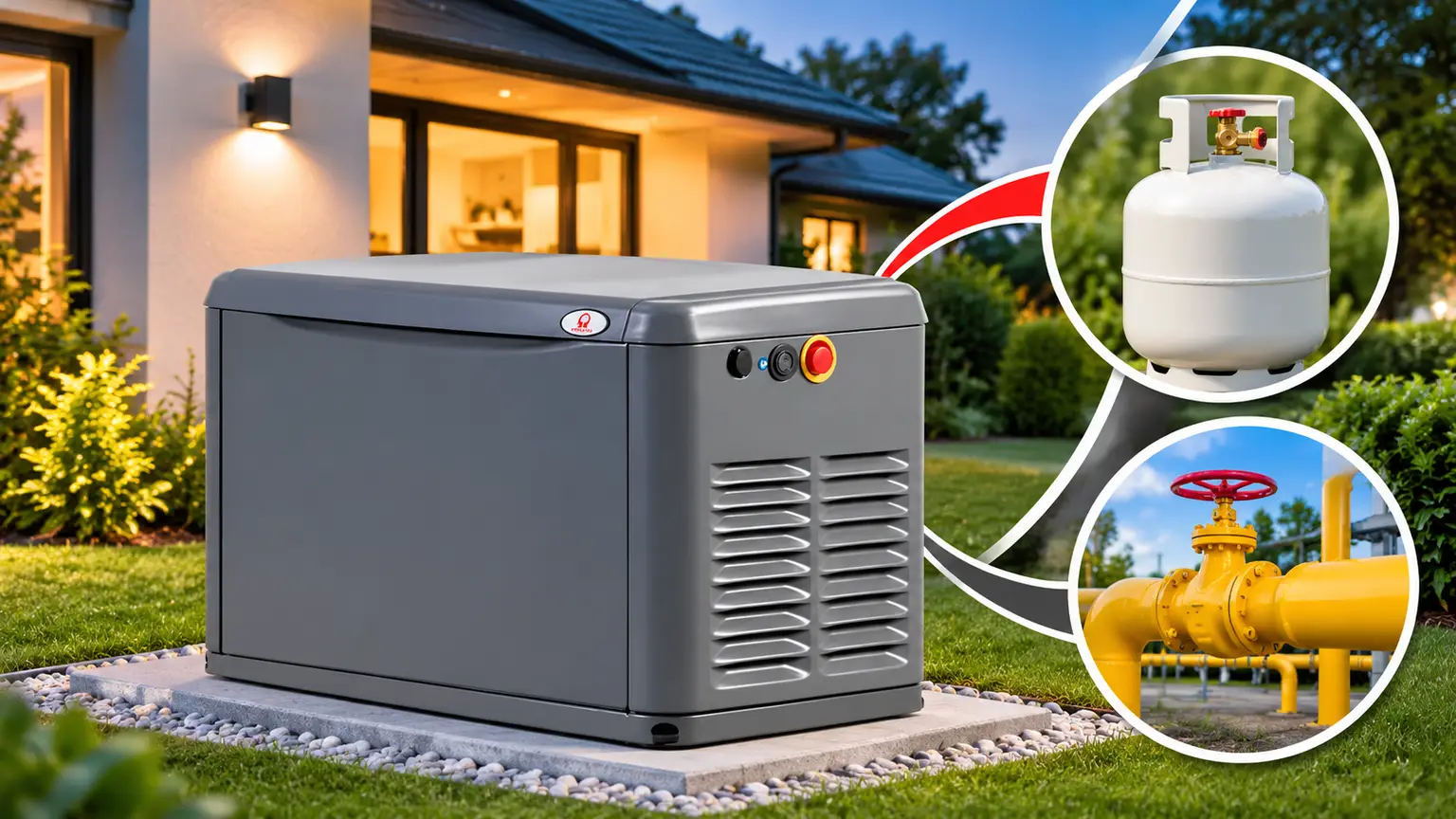
A gas generator for home backup runs on natural gas from the mains or on LPG from a tank, and starts automatically when the power fails. Natural gas suits homes with a mains connection, and LPG suits properties without one. Before you buy, check your gas supply: a standard UK domestic meter is rated at about 6 m³/h, and our Pramac GA13000 and GA20000 need 6.48 and 7.02 m³/h of natural gas at full load, while the GA10000 needs 5.30. Gas work must be done by a Gas Safe registered engineer, and the electrical connection by a qualified electrician. All three models are standby-rated only.
The decision is less about the generator than about your gas supply. This guide explains how these generators work, how to choose between LPG and natural gas, what the meter and pressure checks mean, and which of our three gas generators suits which home. It is general guidance, and a Gas Safe registered engineer must assess your own supply before you buy.
How a gas home backup generator works
The models in our range respond automatically to a power cut:
- The controller senses that the mains has failed and waits 5 seconds by default, to avoid starting for brief interruptions.
- The engine starts and warms up for around 5 seconds.
- A transfer switch moves your home onto generator power.
- When the mains returns, the switch moves your home back and the engine cools down for around 1 minute before stopping.
Automatic operation needs a compatible transfer switch. We supply the Pramac LTS and Cummins PowerCommand GTEC ATS panels, and both work with these generators. Our guides to automatic versus manual transfer switches and generator ATS installation explain the switching side.
Our three gas generators compared
All three are Pramac GA models with a Generac G-Force 1000 Series engine, an Evolution digital controller and a silent aluminium canopy.
| Model | Supply | LPG rating | Natural gas rating | Noise at 7 m |
|---|---|---|---|---|
| Pramac GA10000 | Single phase, 230 V | 10 kVA / 10 kW | 10 kVA / 10 kW | 67 dB(A) |
| Pramac GA13000 | Single phase, 230 V | 13 kVA / 13 kW | 13 kVA / 13 kW | 68 dB(A) |
| Pramac GA20000 | Three phase, 400 V | 20 kVA / 16 kW | 17 kVA / 13.6 kW | 67 dB(A) |
Three points matter when you compare them:
- The GA20000 has a different rating on each fuel. Only the LPG rating makes it a true 20 kVA set. For a mains gas supply, size it against 17 kVA / 13.6 kW.
- They are standby generators only. The ratings apply for the duration of a mains outage. There is no prime rating and no overload capability, so they are not intended as a main power source.
- Output falls in demanding conditions. The GA13000 datasheet indicates a reduction of around 3.5% for every 305 m above sea level and around 1% for every 6°C above 16°C.
For a fuller comparison of the single-phase and three-phase options, see our guide to single phase vs three phase, and browse our single phase generators and 3 phase generators.
LPG or natural gas?
| Natural gas | LPG (propane) | |
|---|---|---|
| Suits | Homes with a mains gas connection | Off-grid properties |
| Fuel supply | Piped in, so nothing to store or reorder | Stored in a bulk tank or cylinders |
| How long it runs | As long as the gas supply continues | Depends on how much is in the tank |
| Storage | None on site | Does not go off in storage like petrol or diesel can |
| Main check before buying | Meter capacity and supply pressure | Tank size and supply pressure |
Compared with diesel, gas means no liquid fuel tank to manage. Diesel generally suits long running hours and larger loads, so see our diesel generators if your needs are bigger than a home. For a real diesel home backup installation, see our 28 kVA Cummins home backup case study.
How much gas do they use?
The datasheet consumption figures at full standby load are:
| Model | Natural gas | LPG |
|---|---|---|
| GA10000 | 5.30 m³/h | 7.62 litres per hour |
| GA13000 | 6.48 m³/h | 8.86 litres per hour |
| GA20000 | 7.02 m³/h | 10.86 litres per hour |
At half load the GA13000 uses 4.02 m³/h of natural gas or 5.58 litres an hour of LPG, and the GA20000 uses 4.50 m³/h or 6.83 litres an hour.
For LPG run time, the product pages give around 18 hours at half load or 11 hours at full load from 100 litres of usable LPG on the GA13000, and around 15 hours at half load or 9 hours at full load on the GA20000. On the GA10000, 100 litres lasts about 13 hours at full load (calculated from its 7.62 litres an hour). Size an LPG tank with that in mind, because the generator draws from your tank, not from a base tank of its own.
Check your gas supply before you buy
This is the step that catches people out. Your standard UK domestic meter and supply may not be able to provide the capacity and pressure these generators need.
Meter capacity
A standard UK domestic U6 meter has a maximum flow of 6 m³/h. Compare that with the natural gas demand at full load:
| Model | Natural gas at full load | Against a 6 m³/h meter |
|---|---|---|
| GA10000 | 5.30 m³/h | 0.70 m³/h spare for the boiler and cooker |
| GA13000 | 6.48 m³/h | 0.48 m³/h over, before any other appliance |
| GA20000 | 7.02 m³/h | 1.02 m³/h over, before any other appliance |
These are full-load figures, and a generator does not always run at full load. But a standby set must be able to cope when you need it most, and your boiler and cooker draw from the same meter. A larger meter may be possible, so ask your gas supplier through your Gas Safe registered engineer.
Supply pressure
At the generator's fuel inlet, the supply must be 8.7 to 17.4 mbar on natural gas, or 24.9 to 29.9 mbar on LPG, at all loads. The pipework must be sized for full load. This can differ from what your supply delivers as standard, which is another reason to have an engineer assess it before you order.
Who can do the gas work
Gas work must be carried out by a Gas Safe registered engineer. HSE guidance says anyone employed to work on gas appliances in domestic premises must be Gas Safe registered and competent for that type of gas work, and the HSE gas safety FAQs set out the requirement. You can check an engineer's registration on the Gas Safe Register website.
Gas work on a standby generator differs from a boiler service, so ask any engineer whether they are competent to install and commission a gas-fuelled generator. If you use LPG with buried metal pipework, HSE also publishes guidance on inspecting and maintaining buried LPG pipework. Each generator is set up for one fuel at a time, and only a qualified engineer should change it.
What installation involves
| Job | Who does it |
|---|---|
| Gas connection, pipework and pressure checks | Gas Safe registered engineer |
| Transfer switch and wiring to your consumer unit | Qualified electrician |
| LPG tank and supply | Your LPG supplier or installer |
| Siting and base | Agree with your installer, following the manufacturer's instructions |
| Commissioning, controller settings and Wi-Fi monitoring | Installer or dealer |
The generator must always run outdoors, because its exhaust contains carbon monoxide. Position it with thought for bedrooms and neighbouring properties, because it is louder than normal conversation. Follow the manufacturer's instructions and local requirements, and ask your installer about anything that depends on your property.
Size, weight and noise
| Specification | GA10000 | GA13000 | GA20000 |
|---|---|---|---|
| Length × width × height | Same enclosure size as the GA13000 | 1,232 × 648 × 733 mm | 1,232 × 648 × 733 mm |
| Dry weight | See product page | 193 kg | 220 kg |
| Noise at 7 m | 67 dB(A) | 68 dB(A) | 67 dB(A) |
| Sound power level | See product page | 96 dB(A) | 95 dB(A) |
| Quiet-Test noise | See product page | 54 dB(A) | 59 dB(A) |
The aluminium enclosure is built to withstand winds of up to 240 km/h and has a locking hinged roof and a lift-out front panel. The noise figures are measured at 7 m, which is not the same as standing next to the set, so read our guide to how quiet a silent generator really is before choosing a position.
Which model suits which home?
Single-phase homes: GA10000 or GA13000
Most UK homes have a single-phase supply, and the GA10000 and GA13000 match it. Their output is rated at a power factor of 1, so the full kW is available through one phase with no need to balance loads. Typical running loads for a home:
| Appliance | Typical running load | Notes |
|---|---|---|
| Fridge-freezer | 100 to 300 W | Higher surge on start |
| Lighting (whole house) | 100 to 300 W | Very light load |
| Gas boiler, pump and controls | 100 to 250 W | Keeps heating running |
| TV, router, laptops | 200 to 400 W | Light load |
| Kettle | 2 to 3 kW | Short bursts |
| Electric oven | 2 to 3 kW | Cycles on and off |
| Washing machine | 0.5 to 2.2 kW | Peaks when heating water |
| Electric shower | 7.5 to 10.5 kW | Large single load |
A worked example. The essentials (fridge-freezer, lighting, boiler, TV and router, kettle) come to about 4.3 kW. Add a 3 kW oven and a 2 kW washing machine and the total is about 9.3 kW. That is 93% of the GA10000's 10 kW and 71% of the GA13000's 13 kW. An 8.5 kW electric shower on top would take the total to about 17.8 kW, beyond either set.
The GA13000 page notes that the extra capacity can help where a property has a heat pump, borehole pump or several high-demand appliances. Motors and compressors draw several times their running current as they start, so list both running and starting loads before choosing. Our generators for homes page covers sizing in more detail.
Three-phase homes: GA20000
The GA20000 suits properties with a three-phase supply, such as larger homes and rural estates. The output is shared across three phases, which works out at about 5.3 kW per phase on LPG or 4.5 kW per phase on natural gas. A high single-phase load, such as an electric shower, can be a problem even when the total load is well below the generator's rating, so ask a qualified electrician to review how your circuits are distributed.
Running and maintenance
- Exercise cycle. The GA20000's controller offers a programmable exercise cycle, weekly, every other week or monthly. Our guide to how often generators should be tested explains why regular running matters for standby sets.
- Oil changes. The engine's oil change interval can be as long as two years or 200 hours.
- Monitoring. Wi-Fi is standard, and the free Mobile Link app lets you check the generator remotely.
- Warranty. A five-year limited warranty comes as standard, with a ten-year extended warranty available.
Frequently asked questions
Will my gas meter cope with a gas generator?
Possibly not. A standard UK U6 meter is rated at about 6 m³/h. The GA13000 needs 6.48 m³/h and the GA20000 needs 7.02 m³/h of natural gas at full load, and the GA10000's 5.30 m³/h leaves little spare for your boiler and cooker. Have a Gas Safe registered engineer assess your meter, pipework and pressure before you buy.
How long can a gas generator run?
On mains natural gas, it can keep running for as long as the supply continues. On LPG it depends on your tank. From 100 litres of usable LPG, the GA13000 runs for about 18 hours at half load or 11 hours at full load.
Are gas generators loud?
The three models are rated at 67 to 68 dB(A) at 7 m, which is louder than normal conversation. Their Quiet-Test exercise mode is quieter, at 54 to 59 dB(A) on the models where it is listed. Position the set with bedrooms and neighbours in mind.
Are gas generators safe?
They are safe when installed and used correctly. The gas connection must be made by a Gas Safe registered engineer, the electrical connection by a qualified electrician, and the generator must always run outdoors because its exhaust contains carbon monoxide.
Do I need a transfer switch?
For automatic backup, yes. The generators need a compatible transfer switch to move your home onto generator power, connected by a qualified electrician. We supply the Pramac LTS and Cummins PowerCommand GTEC ATS panels.
Can I switch between LPG and natural gas myself?
No. Each generator is set up for one fuel at a time, and only a qualified engineer should change it. The GA20000's rating also differs by fuel, from 20 kVA / 16 kW on LPG to 17 kVA / 13.6 kW on natural gas.
Conclusion
A gas generator is a good fit for a home that wants automatic, hands-free backup without storing liquid fuel. The key decisions are the fuel (natural gas for a mains connection, LPG for off-grid), the phase of your supply, and whether your meter, pipework and pressure can feed the generator. Have a Gas Safe registered engineer assess your supply first, and use a qualified electrician for the transfer switch.
> Thinking about a gas generator for your home? Global Generators is an authorised Pramac dealer, with gas generators held in UK stock for fast delivery. Browse our Pramac generators or the stock list, then contact our team on +44 1302 700200 or at enquiries@global-generators.com with your property, supply type and gas connection, and we will help you choose a model and a transfer switch.