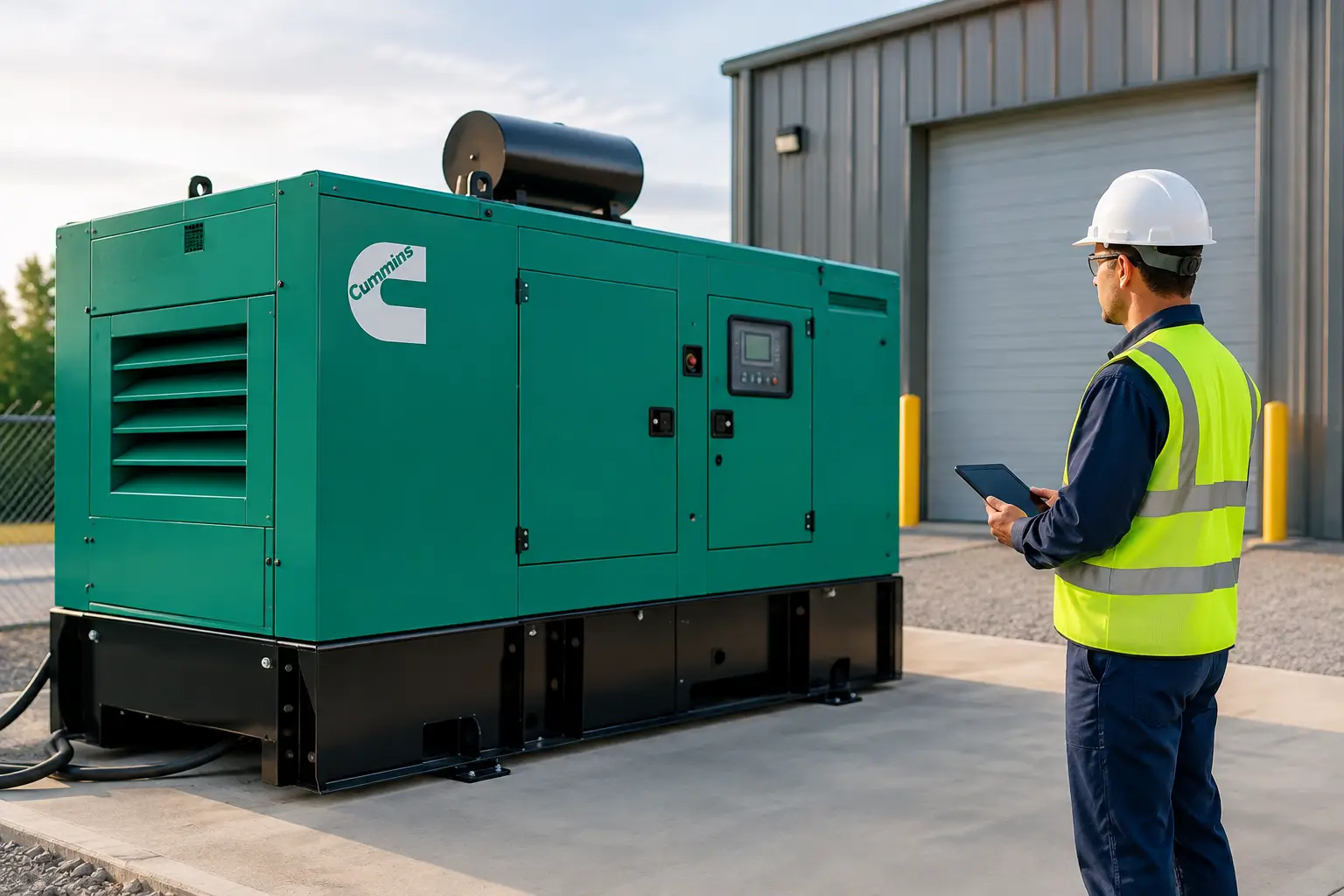
A generator can be correctly sized, delivered on time and connected by an experienced contractor, yet still fail when the mains supply drops if commissioning has been treated as a final formality. Knowing how to commission diesel generators properly means proving the complete standby or prime power system under controlled conditions, documenting its performance and resolving defects before the site depends on it.
For hospitals, data-critical operations, logistics facilities, manufacturing plants and infrastructure projects, commissioning is the point at which an installed asset becomes an operational power solution. It should be planned around the site load, control philosophy, fuel arrangement and safety requirements - not confined to starting the engine and observing that it runs.
Define the commissioning scope before energisation
Commissioning begins before the generator is started. The responsible contractor, generator supplier, electrical installer and site representative should agree who owns each task, what operating mode is required and which acceptance criteria apply. This prevents gaps between generator installation, automatic transfer switch installation, fuel-system completion and final handover.
Confirm whether the set is specified for standby power, prime power or continuous duty. A standby-rated generator is intended for emergency use during utility failure and normally operates for limited annual hours. A prime-rated set can support variable load over extended periods, subject to the manufacturer’s operating limits. Treating these ratings as interchangeable can lead to incorrect load expectations and warranty issues.
The scope should also identify the required voltage, frequency, phase arrangement, earthing system and automatic mains failure sequence. On a three-phase installation, phase rotation and load balance need particular attention. Where a silent generator is installed outdoors, enclosure clearances, ventilation paths and exhaust discharge are as important as the electrical checks. An open generator installed in a plant room requires a properly engineered room ventilation and heat-rejection arrangement.
Pre-start checks for diesel generator commissioning
Before starting, inspect the installation against the approved drawings, manufacturer instructions and applicable site standards. This is the time to identify straightforward but consequential errors, such as a restricted air intake, incorrectly supported exhaust, undersized fuel line or inaccessible emergency stop.
Check that the generator is level, securely mounted and free from transport restraints. Inspect for loose fittings, fluid leaks, damaged cables and foreign objects around rotating equipment. Verify oil and coolant levels, battery condition, battery charger operation and the correct grade and quantity of diesel fuel. Fuel tanks should be clean, vented and fitted with working supply and return connections. Water or contamination in stored diesel is a frequent cause of avoidable no-start events.
Electrical verification must be completed by competent personnel. Confirm cable size, termination torque, protective device settings and separation of power and control wiring. Test insulation resistance where appropriate, then confirm that earthing and bonding arrangements match the installation design. Do not rely on a visual inspection of an earth conductor alone.
The control panel requires equal scrutiny. Confirm that emergency stops are reset, alarms are enabled, timers are set to the agreed values and remote monitoring connections are correctly landed. If the generator uses an automatic transfer switch, establish that the mains sensing, generator sensing and interlocks operate as intended. A set that starts but does not transfer the building load is not a commissioned standby system.
Start the set and verify operating condition
Carry out the first start with the output breaker open unless the manufacturer’s procedure or site design requires otherwise. Observe the engine during warm-up and record oil pressure, coolant temperature, battery charging voltage, engine speed, frequency and output voltage. Check for abnormal vibration, exhaust leaks, fluid leaks, unusual noise and unstable governor response.
Allow the engine to reach normal operating temperature before drawing meaningful conclusions from readings. Cold operation can mask cooling issues, while an extended no-load run can be harmful to some diesel engines. Light loading for long periods may contribute to wet stacking, where unburnt fuel and carbon deposits accumulate in the exhaust system. The appropriate test profile depends on the engine, duty rating and manufacturer guidance.
At this stage, verify that the control system recognises normal and abnormal conditions. Simulate or test, where safe and approved, low fuel, high coolant temperature, low oil pressure, overspeed and emergency-stop functions. Protective shutdowns should be tested in a controlled manner, with a clear recovery procedure and competent personnel present. The objective is not simply to create alarms, but to confirm that the set responds correctly and that the alarms are visible to the people responsible for the site.
Test load transfer and generator performance
A meaningful commissioning test proves the generator with the electrical system it will support. For a standby installation, this usually includes simulating a utility failure, starting the generator automatically, transferring load through the automatic transfer switch and returning to mains after the programmed restoration delay.
Observe the sequence closely. Record start time, time to rated voltage and frequency, transfer time, voltage dip, frequency dip and recovery under load. Sensitive equipment may need additional analysis, particularly where large motors, pumps, lifts, compressors or non-linear loads are present. These loads can impose substantial starting currents or harmonic effects that are not apparent during a simple unloaded start.
Where the building load cannot provide a suitable test, a load bank may be required. Load-bank testing allows the set to be assessed at controlled load steps and can expose issues with cooling, fuel delivery, turbocharging, alternator response and controls. The test load should be agreed against the generator rating and site operating profile. Applying excessive load is not a demonstration of quality; it is a risk. Conversely, testing only at very low load provides limited evidence of real performance.
For generators operating in parallel, the commissioning requirement is more detailed. Synchronisation, load sharing, breaker logic, protection settings and failure modes must all be validated. This work should be planned by suitably qualified power-system specialists, as an error in paralleling controls can damage equipment and compromise site safety.
Check the systems around the generator
The generator set is only one part of the resilience chain. Commissioning should include the systems that allow it to operate for the required duration. Verify bulk fuel transfer, day tank controls, low-level alarms and fuel leak detection where fitted. Confirm the usable fuel volume rather than relying solely on nominal tank capacity, then calculate expected runtime at the anticipated load.
Inspect ventilation louvres, fan discharge routes and plant-room temperature controls. Recirculation of hot air can cause an otherwise healthy diesel generator to overheat under sustained load. Check that exhaust systems are adequately supported, insulated where necessary and routed to protect personnel and nearby air intakes from heat and fumes.
Remote communications should also be tested. A building management system or remote monitoring platform must receive the correct run, common alarm, fuel and mains-failure signals. More detailed telemetry can be valuable, but basic alarm visibility is essential for an unattended standby installation. Confirm who receives alarms out of hours and what response process applies.
Record results and complete the handover
A commissioning record is not paperwork for its own sake. It creates the baseline that future maintenance teams will use to identify deterioration, investigate faults and demonstrate compliance. Include generator serial numbers, engine and alternator details, controller settings, electrical test results, protective-device settings, fuel levels, observed readings and load-test data.
The handover pack should contain operating instructions, emergency procedures, maintenance schedules, wiring diagrams, warranty information and a clear list of outstanding items. Train site personnel on normal starting, automatic operation, emergency stopping, alarm acknowledgement and refuelling precautions. They do not need to become generator engineers, but they must know what they can safely do and when to call for support.
Before acceptance, agree a routine exercise regime. Weekly or monthly no-load exercising may confirm start readiness, but periodic on-load testing is needed to assess the system under conditions closer to a genuine outage. The interval and test method should reflect criticality, operational constraints and manufacturer recommendations.
For buyers procuring new capacity, commissioning requirements should be considered when selecting the set, not after delivery. Global Generators can help match Cummins-powered diesel generators, enclosure format and kVA rating to the intended standby or prime power application, while the installation team plans the controls, fuel autonomy and testing needed for dependable operation.
A completed commissioning certificate is valuable, but the real measure is simpler: when the mains fails, the generator starts, accepts the load and gives the site the time it needs to keep operating safely.