A generator that starts but cannot accept the required load, run for the required duration or integrate with the site transfer system is not a successful purchase. This industrial generator procurement guide is designed for buyers who need to turn an operational risk into a clear, buildable specification - before a power failure, project delay or production stoppage exposes a gap.
For critical sites, generator procurement is not simply a comparison of kVA figures and purchase prices. The decision affects continuity of operations, safety systems, contractual obligations, fuel costs and maintenance planning for years after delivery. The right set is the one sized and configured around the real duty, not the cheapest unit that appears to meet a headline rating.
Start with the operational duty
The first procurement question is what the generator must protect. Standby power is intended for infrequent emergency use following a mains failure. Prime power is for variable-load operation over extended periods where utility supply is unavailable or unreliable. Continuous-duty applications can demand a different specification again, particularly on remote industrial, utility and hire-based sites.
Do not treat standby and prime ratings as interchangeable. A generator may have different kVA outputs for each duty, and specifying against the wrong rating can leave insufficient capacity or create an unacceptable warranty and service position. State the anticipated annual running hours, expected load profile and whether mains supply will be present. This gives suppliers a sound basis for selecting the engine, alternator and control arrangement.
Also establish the consequence of failure. A logistics depot may need lighting, security and loading equipment. A manufacturing plant may need controlled shutdown of process lines, while a hospital, data facility or telecoms installation may require uninterrupted transition across several priority circuits. These requirements determine whether the project needs a standard automatic mains failure arrangement, synchronisation, load shedding, UPS support or redundant generating capacity.
Size the generator from measured load
A site load survey is the most useful document in the procurement process. It should identify existing and planned loads, voltage, phase arrangement, power factor, motor starting demands and the order in which equipment will be energised. Nameplate totals alone are often misleading because not every load runs at once, but a simple diversity assumption can be equally dangerous where several high-demand items start together.
Motor loads deserve particular attention. Pumps, compressors, conveyors and refrigeration equipment can draw high starting current, especially with direct-on-line starting. A set that appears adequate in steady-state operation may suffer excessive voltage dip when a motor starts, causing controls to trip or preventing the load from accelerating. Soft starters, variable speed drives and staged starting can reduce the issue, but they must be assessed as part of the complete electrical system.
Specify whether the site requires 400/230V three-phase power, a single-phase supply, 50Hz operation and the required earthing arrangement. UK installations commonly require careful coordination between the generator neutral, automatic transfer switch and site earthing system. This is a design matter for a competent electrical engineer, not a detail to leave until commissioning.
Allow prudent headroom for load growth and transient demand, but avoid excessive oversizing. Generators that operate persistently at very low load can experience poor combustion, wet stacking and unnecessary fuel use. The right margin depends on the application, load stability, future expansion and engine duty. It is not a fixed percentage that suits every site.
Industrial generator procurement guide: specify the set format
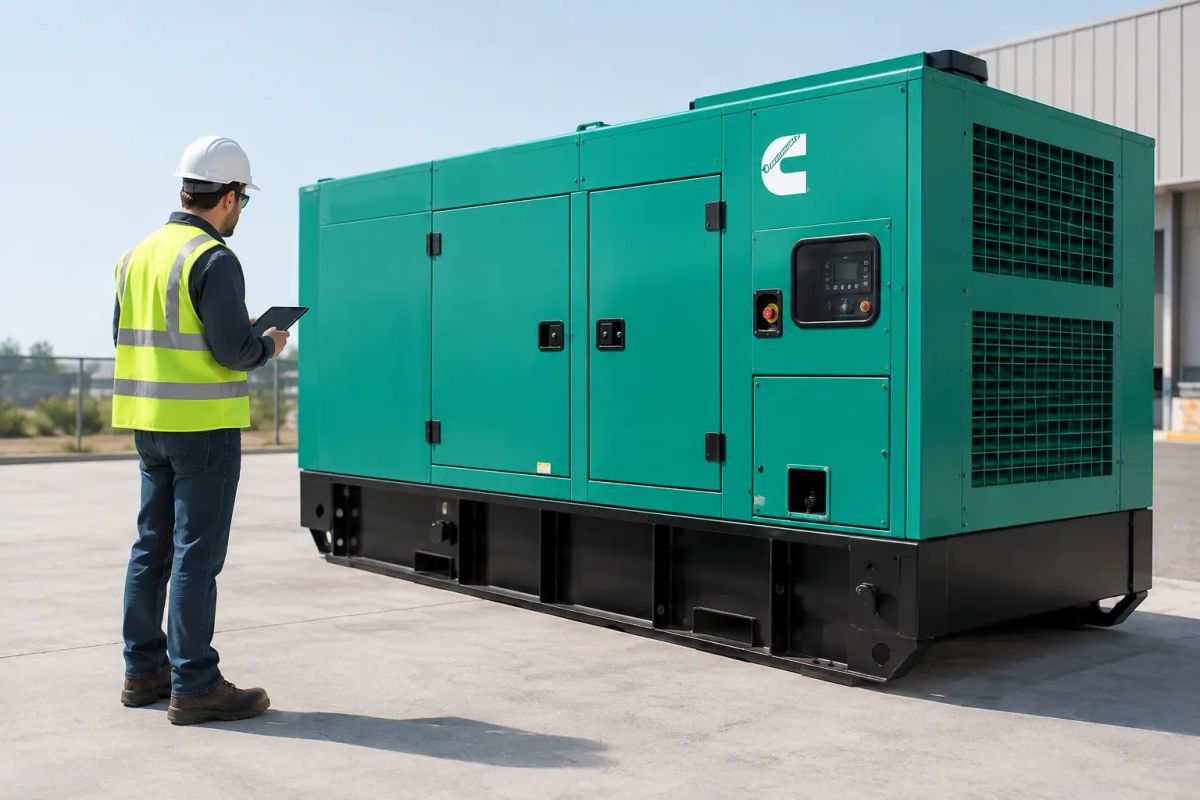
The generator enclosure is an operational choice, not a cosmetic one. A silent, weatherproof canopy is generally suited to external installations where noise, access protection and environmental exposure matter. Check the declared sound level at the relevant distance and operating condition, particularly near residential boundaries, hospitals, offices or planning-sensitive locations.
Open generators are often appropriate for plant rooms, acoustic enclosures or containerised installations designed by the project team. They can offer easier access and flexibility, but the surrounding installation must provide ventilation, exhaust routing, fire considerations, noise control and safe maintenance clearance. An open set placed outdoors without suitable protection is not an industrial installation solution.
Physical access should be confirmed early. Record delivery route restrictions, gates, slab loading, crane access, plant room openings and maintenance space around radiators, control panels and service points. A generator can be technically correct yet costly to install if the site cannot receive it without additional lifting works or enabling construction.
Match fuel autonomy to the risk profile
Diesel remains the practical choice for many standby and prime power applications because of its energy density, availability and established service infrastructure. The fuel tank capacity should be calculated against actual expected load and required run time, rather than a full-load estimate alone. A site with a 24-hour resilience requirement, for example, may need additional bulk storage, fuel polishing provisions, transfer pumps and a defined refuelling agreement.
Fuel quality and storage management matter on systems that may sit idle for long periods. Water ingress, microbial contamination and degraded fuel can prevent reliable starting when it is needed most. Procurement documentation should clarify tank construction, bunding, leak detection where required, fuel level monitoring and access for inspection and replenishment.
Where emissions, local fuel restrictions or extended prime operation are factors, discuss the application in detail. Exhaust after-treatment, load-bank testing requirements and operating environment can all affect the final generator specification.
Define controls, transfer and resilience
The generator controller should provide the protection and visibility required by the operating team. At a minimum, consider remote start, automatic mains failure operation, engine and alternator protection, event logging, alarms and communications capability. For unmanned or geographically dispersed sites, remote monitoring can materially reduce response time by reporting low fuel, battery issues, failed starts and abnormal operating conditions before they become outages.
The automatic transfer switch is just as critical as the generator set. Confirm the required current rating, switching duty, bypass and isolation needs, location, cable routes and whether transition must be open, closed or delayed. Closed-transition and synchronised systems require more engineering but can be appropriate where even a brief interruption is unacceptable.
For larger facilities, resilience may mean two or more generators operating in parallel. This can provide N+1 capacity, allow maintenance without total loss of backup and improve efficiency at lower demand. It also increases control complexity, space requirements and capital cost. The case for parallel operation should be based on a quantified availability requirement, not assumed because the site is large.
Compare suppliers beyond the headline price
A quotation should clearly state the engine manufacturer, alternator, standby and prime ratings, voltage, frequency, enclosure type, fuel tank capacity, controller, dimensions, weight and standard inclusions. Ask what is excluded. Delivery, installation, cabling, exhaust works, commissioning, load-bank testing, acoustic treatment and automatic transfer equipment can significantly change the delivered project cost.
Availability is commercially important when a replacement set is required quickly or a project programme is already fixed. Confirm whether the offered unit is in stock, its expected dispatch date and what documentation will be supplied. For projects outside the UK, establish export packing, shipping responsibilities, destination requirements and local support arrangements before placing an order.
Proven engine brands and readily available parts should carry weight in the evaluation. A lower initial price has limited value if filters, service expertise or critical components are difficult to obtain during an outage. Global Generators supplies Cummins-powered industrial sets across key power ranges, supporting buyers who need a clear equipment specification and prompt availability.
Put commissioning and service into the purchase order
The procurement process should end with an acceptance plan, not delivery to site. Define who installs and commissions the set, who verifies phase rotation and protection settings, and how the generator will be tested against representative load. A no-load start test does not prove that the installation will support the site during a genuine mains failure.
Require operating manuals, wiring diagrams, test records, warranty terms and a clear handover procedure. The facilities team should know how to inspect fuel and batteries, review alarms, initiate a safe test and escalate faults. Planned servicing, periodic loaded testing and fuel management should be budgeted from the outset.
A dependable generator purchase begins with accurate site information and ends with verified performance under load. Assemble the load data, operating duty and installation constraints before requesting quotations, then assess each offer against the uptime requirement your site cannot compromise.