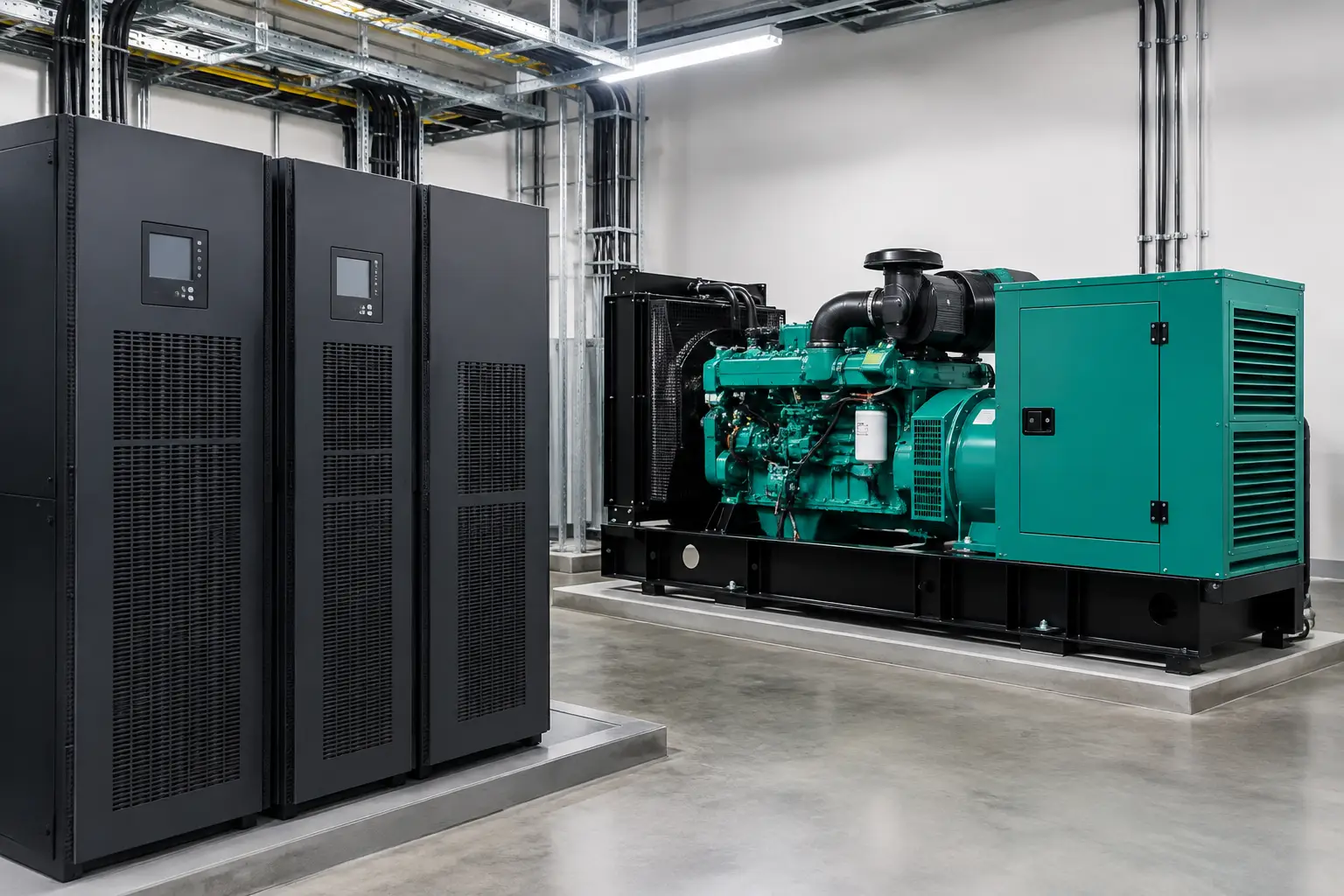
Quick answer
They do different jobs. A UPS (uninterruptible power supply) holds your critical load for seconds to minutes, with no break in supply, while a diesel generator provides power for hours or days but needs time to start. If your equipment cannot tolerate even a short interruption, such as servers, medical equipment or process controls, you usually need both: the UPS bridges the gap until the generator is running and takes the load. If your loads can tolerate a short outage, a generator alone is often enough. The design detail that matters most is sizing the generator for the UPS, which draws extra power while its batteries recharge.
This guide explains what each does, what happens second by second in an outage, how to size a standby generator when a UPS is on the system, and how to test the whole chain. It is general guidance. The exact figures for your site depend on your UPS, your generator and your loads, and your suppliers should confirm them.
What does a UPS do?
A UPS sits between your supply and your critical equipment. When the mains fails, it supplies the load from batteries, and the better types do so with no break in supply. UPS runtime is usually designed in minutes. Five to 15 minutes is a commonly quoted range, enough to cover the time the generator needs to start and take over, or to shut equipment down in a controlled way if it does not.
UPS types are described in the standard IEC 62040-3, which classifies output performance by how far the output depends on the mains:
| Class | Common name | How it behaves |
|---|---|---|
| VFD (voltage and frequency dependent) | Offline or standby | Output follows the mains, and the unit switches to battery in a few milliseconds when it fails |
| VI (voltage independent) | Line-interactive | Regulates voltage but not frequency, with a very short transfer time |
| VFI (voltage and frequency independent) | Online double conversion | Rebuilds the output continuously, so the load sees no transfer time |
Online double-conversion units are the usual choice for critical IT and sensitive equipment. A UPS also conditions power, protecting the load from sags, surges and other disturbances, which a generator does not do.
What does a generator do?
A generator supplies power for as long as it has fuel, which can be hours or days. It cannot respond instantly. The engine has to start, reach speed and stabilise before the load can be transferred, and an automatic mains failure panel and transfer switch control that sequence.
A generator also suits loads that can ride through a short break: lighting, pumps, ventilation, refrigeration, heating and the bulk of a building. Our guide to how generators work in critical power explains the basics.
What happens in an outage, step by step
Here is a typical sequence for a site with both. The timings vary by site and are set by the equipment and its configuration.
| Stage | What happens | Typical timing |
|---|---|---|
| 1. Mains fails | The UPS takes the load from its batteries | Immediate on an online UPS |
| 2. Mains failure confirmed | The automatic mains failure panel waits to confirm the failure is not a brief dip | Commonly a few seconds, often set between about 2 and 10 seconds |
| 3. Generator starts | The engine cranks, starts and comes up to speed | Published figures for start and load acceptance range from about 10 seconds to 60 seconds |
| 4. Transfer | The transfer switch connects the generator to the site | Seconds |
| 5. UPS recovers | The UPS rectifier takes the supply from the generator and recharges the batteries | Seconds, then a recharge period |
| 6. Mains returns | The panel waits to confirm the supply is stable, then transfers back | Commonly runs on for around two minutes or more |
| 7. Cooldown | The generator runs unloaded for a short period and stops | Short |
Two points in the table are worth knowing. First, the gap the UPS has to cover is the whole of stages 2 to 5, not just the cranking time. Second, if the first start attempt fails, the controller tries again. On the Cummins PowerStart 0600 controller fitted to many of our smaller sets, cycle cranking can be configured for between one and seven attempts, and the controller can also be set to delay the start after a remote start signal by up to 300 seconds, though the default delay is zero. Those settings lengthen the gap, so your UPS runtime must cover them, with a margin.
> Expert tip: Size the UPS runtime for the worst realistic case, not the best. That means the AMF delay, one or more failed start attempts and the transfer time, plus the time you would need for a controlled shutdown if the generator never starts.
Sizing the generator for a UPS
This is where UPS and generator projects most often go wrong. A UPS does not draw the same power from the generator that it delivers to the load. Three things add to it:
- Losses. An online UPS converts power twice, so its input is higher than its output.
- Battery recharge. As soon as the generator is running, the UPS recharges its batteries, which adds load.
- Input current distortion. The UPS rectifier is a non-linear load, so it can distort the generator's voltage unless its input distortion is low.
A data sheet for a 100 kVA online UPS shows how large the difference can be. It lists an input current of 152 A at rated load, and a maximum of 212 A at the minimum input voltage with the maximum battery recharging current. At 400 V three phase, 152 A is about 105 kVA, and 212 A is about 147 kVA (calculated). In the worst case, that UPS alone would draw about 47% more than its output rating. Against the 155 kVA prime rating of a Cummins C170D5Q, the UPS alone would take about 95%, before any other load on the generator.
That is a worst case, and real draw is usually lower, but it shows why you cannot size the generator from the UPS output rating alone. Ask the UPS supplier for:
- Input current at maximum recharge, at the minimum input voltage
- Input harmonic distortion (THDi) at each load level
- Rectifier walk-in time, which ramps the UPS up gradually when it moves onto the generator. Some data sheets give a programmable walk-in of 5 to 30 seconds, and another UPS range lists a soft start of up to 125 seconds
- Start delay options, which stagger restart where there are several UPS units
- Generator compatibility information, including any minimum generator size they recommend
Then give those figures to your generator supplier alongside the rest of the site load. Our guides to generator sizing methodology for critical loads and how to plan backup power for critical sites explain how to build the full load list.
What else needs backing up?
Servers and sensitive equipment are only part of the picture. In data rooms, cooling is often supplied by the generator only, not the UPS, so it has to restart after the transfer and can take several minutes to recover. Plan for the temperature rise in that time. Our guide to cold storage backup power in the first hour of an outage shows how to think about refrigeration and similar loads.
Do you need both?
| Your situation | Likely answer |
|---|---|
| Loads can tolerate a short break (lighting, pumps, heating, general power) | A generator, with an automatic mains failure panel and transfer switch |
| Loads cannot tolerate any break (servers, medical equipment, process controls) | A UPS for the sensitive loads and a generator for the long run |
| Only short interruptions are expected and a controlled shutdown is acceptable | A UPS may be enough |
| Outages may last hours or longer | A generator is needed, with a UPS if sensitive loads exist |
For a comparison with large battery systems rather than a UPS, see our guide to diesel generator vs battery backup for business power, and for a worked example in a data room setting, our data centre generator example and guide to diesel generators for data centres. Healthcare sites have their own requirements, covered in our guide to hospital generator requirements.
Generator features that help a UPS system
- An automatic mains failure controller and a properly specified transfer switch. Our guide to automatic versus manual transfer switches explains the options.
- A mains-powered engine heater and battery charger, which a UK engineering article recommends for a standby generator serving a UPS, so the set starts promptly and reliably.
- A run-on period after the mains returns, to avoid repeated starts and stops on short faults.
- Remote monitoring, so a flat battery, a failed charger or a fault is flagged before an outage. See our guide to generator remote monitoring systems.
- Stepped load acceptance, so the generator can take the UPS and other loads in stages. Our guide to generator load acceptance testing covers how this is proved.
Test the whole system, not just the parts
A UPS and a generator that each pass their own tests can still fail together. Test the full sequence: loss of mains, UPS on battery, generator start, transfer, UPS recovery, return to mains. Test on load, using real or simulated load, and record the times.
- Our guide to how often generators should be tested sets out a routine.
- Our guides to how to test generator transfer switches safely and generator load bank testing explain how to prove the transfer and the full load.
Safe testing means working within your site's procedures, and the HSE's electrical safety guidance covers the general principles of working safely with electricity.
> Planning a UPS and generator system? Tell us your critical load, your UPS details and how long you need to run, and we will help you choose a generator and check the sizing with your UPS supplier. Use the contact page or call +44 1302 700200.
Common mistakes
- Sizing the generator from the UPS output rating. Recharge current and losses add to it.
- A UPS runtime that only covers the best case. Failed starts and delays lengthen the gap.
- Ignoring input distortion and compatibility. Ask for THDi and walk-in data.
- Forgetting cooling. If cooling restarts only after the transfer, the room heats up in the meantime.
- Setting the start delay too long, or leaving a delay set after testing.
- No engine heater or battery charger, which makes starts less reliable.
- Testing the parts separately and never the whole sequence.
Frequently asked questions
Do I need a UPS if I have a generator?
If your equipment cannot tolerate even a short interruption, yes. A generator needs time to start and take the load, so servers and sensitive equipment will drop out without a UPS to cover the gap. If your loads can ride through a break of some seconds, a generator alone may be enough.
Do I need a generator if I have a UPS?
If outages may last longer than your UPS runtime, yes. A UPS typically covers minutes, while a generator keeps the site running for hours or days.
How long should a UPS last?
Long enough to cover the generator's start, any failed attempts, the transfer, and a controlled shutdown if the generator does not start. Five to 15 minutes is commonly quoted, but the right figure depends on your configuration, so calculate it from your own delay and start settings.
How long does a generator take to start and take the load?
Published figures range from about 10 to 60 seconds, depending on the set, the controller, the engine's condition and the transfer arrangement. Ask your supplier for the figure for your set, and test it.
Can a generator run a UPS?
Yes, and double-conversion online UPS units are normally designed for it. Check the UPS manufacturer's generator compatibility information, including input current at maximum recharge, input distortion and walk-in options, and size the generator accordingly.
Should the generator be bigger than the UPS?
Usually, yes, because the generator has to carry the UPS input, including recharge, plus the other site loads. How much bigger depends on the UPS data, so ask your suppliers for the figures and have them confirm the sizing.
Conclusion
A UPS and a generator solve different problems. The UPS gives you a seamless bridge for minutes, and the generator gives you endurance for hours or days. Where sensitive equipment is involved, plan the two as one system: size the UPS runtime for the whole start and transfer sequence, size the generator for the UPS input including recharge, and test the complete chain on load.
> Talk to a real person: Global Generators is an authorised Cummins reseller and an authorised Grupel and Pramac dealer, with new diesel generators in stock for UK delivery and export. Browse the stock list, then contact our team on +44 1302 700200 or at enquiries@global-generators.com and we will help you match a set to your site.