Quick Answer
A battery backup provides instant power during an outage, making it ideal for sensitive equipment and short-term backup. A diesel generator starts automatically after a power failure and delivers reliable, long-duration power, making it better for high-load applications and extended outages. For critical facilities, combining a UPS/battery system with a diesel generator offers the best balance of uninterrupted power and sustained operation.
A diesel generator vs battery backup decision is not simply a choice between old and new technology. It is a resilience decision: how long the site must operate without the grid, how much load must be carried, how quickly power must transfer, and what failure scenarios the system must withstand.
For many critical facilities, the strongest answer is not one technology in isolation. A battery system provides immediate ride-through, while a diesel generator supplies sustained power. The correct configuration depends on the operational consequence of a lost supply, not on headline equipment cost alone.
Diesel Generator vs Battery Backup - The Core Difference
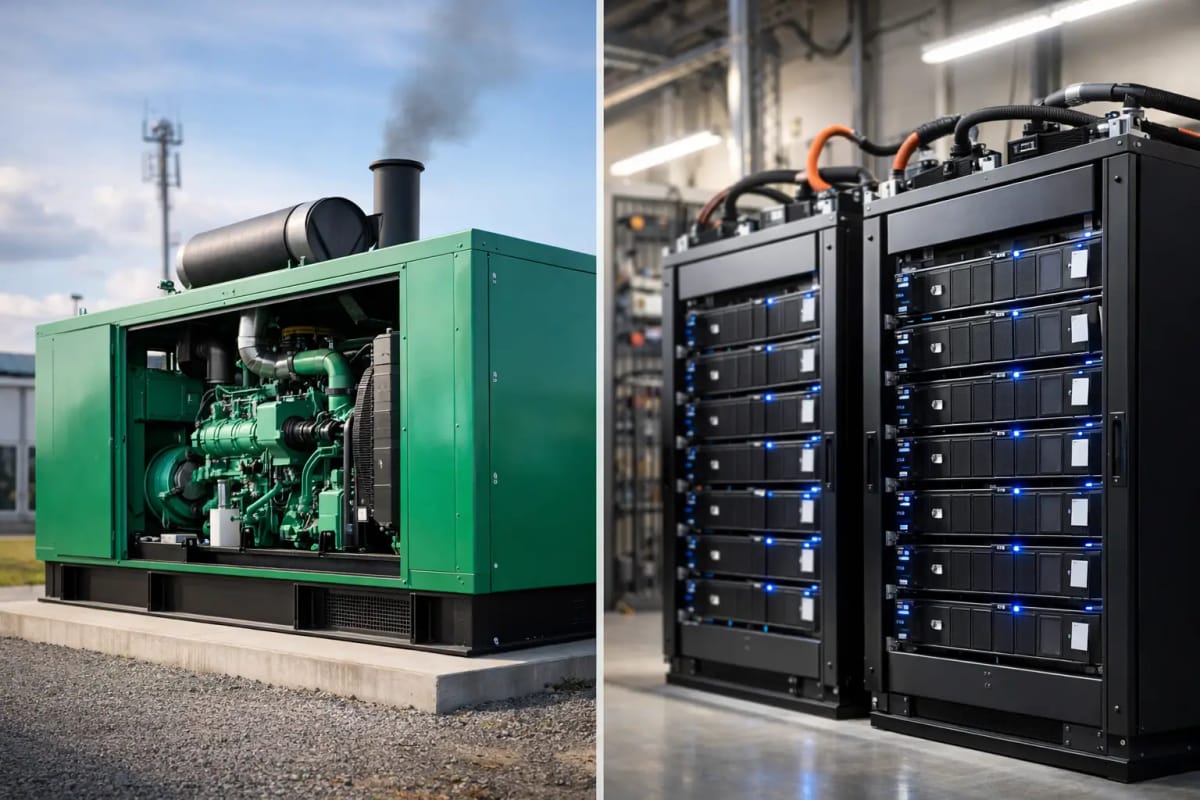
A battery backup stores electrical energy and discharges it through an inverter when the mains supply fails. It can respond almost instantaneously, making it well suited to sensitive loads that cannot tolerate even a short interruption. Typical examples include IT equipment, telecoms systems, control panels, security infrastructure and selected medical equipment.
A diesel generator converts stored fuel into electrical power. It normally starts automatically following a mains failure, then assumes the site load through an automatic transfer switch. Start and transfer times vary by system design, but a generator is not generally an instant, no-break power source without a UPS or battery bridge ahead of it.
That distinction matters. Batteries are defined principally by stored energy, usually expressed in kilowatt-hours, and by their discharge capability. Generators are defined by available output, commonly stated in kVA, and fuel endurance. A large battery can only support a substantial load for a limited period unless it is continually recharged. A correctly specified generator can continue operating for days, provided fuel, servicing and load management are in place.
Response Time and Power Quality
Battery backup has the advantage where uninterrupted transfer is essential. A UPS can maintain a clean, stable output while the incoming supply fails, protecting equipment from voltage dips, frequency variation and short outages. For a server room or process control system, this immediate support is often non-negotiable.
Diesel generation is designed for dependable standby or prime power rather than millisecond-level transfer. A generator set will start, stabilise and accept load according to its control system, engine performance and transfer arrangement. Where the load cannot see that gap, a UPS bridges it.
The generator must also be assessed for the load it will receive. Motors, pumps, compressors, lifts and refrigeration plant can impose high starting currents. Non-linear electronic loads can affect harmonic performance. A set sized only against a simple running-load total may suffer voltage dip, poor starting performance or nuisance trips during an outage.
The combined UPS and generator approach
For hospitals, data environments, telecoms, logistics hubs and industrial sites, the usual critical-power arrangement is layered. The UPS or battery system carries the load immediately. The diesel generator then starts and provides long-duration support. Once supply is stable, the battery recharges and remains ready for the next event.
This approach avoids asking a battery installation to provide multi-hour autonomy at a scale that can become expensive and space-intensive. It also avoids exposing sensitive equipment to the transfer period of a generator-only system.
Runtime: Where Diesel Has the Clear Advantage
Battery runtime falls as load increases. A battery system designed for 30 minutes at 100 kW will not provide the same duration if the real demand rises above that figure. Ambient temperature, battery age, inverter efficiency and discharge rate also affect usable autonomy.
Diesel sets are generally the more practical option for prolonged outages and high-load applications. A generator can be paired with an appropriately sized base tank, bunded external fuel tank or day tank arrangement to meet a required operating period. Refuelling plans can extend that endurance further, although they must account for site access, fuel quality and supplier availability during a wider grid event.
For a manufacturing facility operating critical machinery, a distribution centre with temperature-controlled storage, or an infrastructure site with essential pumping loads, a diesel generator provides a clearer route to sustained operation. Battery storage may still reduce generator starts, support load peaks or cover short interruptions, but it is rarely the sole answer where multi-day autonomy is required.
Capacity, Footprint and Site Conditions
The technology choice must reflect the actual load profile. A modest communications cabinet may be adequately supported by a battery system for several hours. A 500 kVA commercial building load, an industrial process line or a large construction compound presents a different requirement entirely.
Diesel generators are available across a wide power range, from smaller single-phase standby units to large three-phase installations for industrial and infrastructure duty. Enclosed silent generators are appropriate where noise control and weather protection are required. Open sets may suit plant rooms, containerised installations or sites where a bespoke acoustic enclosure is planned.
Battery installations can be compact at smaller capacities, but their physical footprint increases sharply when long duration and high output are combined. They also require suitable inverter equipment, ventilation or thermal management, fire safety planning, access for maintenance and a clear approach to end-of-life replacement.
Diesel installations have their own site requirements: exhaust routing, fresh-air ventilation, fuel containment, noise treatment, access for service and safe load-bank testing. Neither option is plug-and-play at critical scale. The design must work with the building, the electrical distribution system and local planning constraints.
Cost Should Be Measured Over the Required Duty
Battery backup often appears attractive because it has no routine fuel consumption when standing by and can reduce short generator run events. However, the capital cost rises with energy capacity. Replacing batteries over the life of the system must also be allowed for, particularly where high ambient temperatures or frequent cycling shorten service life.
A diesel generator has fuel, servicing and emissions considerations, but it can deliver high power for long periods without the cost of installing very large battery banks. For standby applications with infrequent outages, the generator may offer a more commercially proportionate resilience solution.
The comparison changes where a site has regular grid constraints, time-of-use tariffs or an established renewable generation strategy. Battery storage may then create operational value beyond backup, such as peak shaving or load shifting. That does not automatically remove the need for a generator. It means the system should be evaluated against both resilience and energy-management objectives.
Specify the Generator for Its Real Operating Rating
A common procurement error is selecting a generator from its standby kVA figure without considering how it will be used. Standby power is intended for emergency use during utility failure, with limited annual running hours. Prime power is relevant where the generator will operate for extended periods or where grid supply is unavailable or unreliable.
The selected rating must match the expected duty cycle, site load, future expansion allowance and operating environment. Derating may be necessary for altitude, high ambient temperatures or restrictive installation conditions. If the set will support variable loads, assess minimum loading as well as maximum demand, particularly where prolonged low-load running could affect engine performance.
A competent specification should establish the following before equipment is ordered:
- the maximum and essential load in kW and kVA, including motor starts and load sequence;
- the required autonomy period and fuel strategy;
- whether the set is standby-rated or prime-rated;
- voltage, frequency, phase arrangement and distribution compatibility;
- enclosure, noise, exhaust, ventilation and physical access requirements;
- the transfer system, UPS arrangement and testing regime.
These details determine whether a system will perform under pressure, rather than merely look adequate on a quotation.
When a Battery-Only System Makes Sense
Battery-only backup is a credible choice when the load is relatively low, the required runtime is short and zero interruption is the priority. It can suit edge IT, small telecoms sites, access control, security systems and selected office loads. It may also work where generators are restricted by noise, emissions, fuel storage or planning constraints.
The limitation is simple: the battery must contain enough usable energy for the full outage and the actual load. If outage duration is uncertain, or if the load is material, the required battery capacity can become difficult to justify commercially.
When a Diesel Generator Is the Better Fit
A diesel generator is usually the stronger option for high-demand sites, uncertain outage durations, remote locations and operations that need to continue for many hours or days. It is particularly suitable for construction, manufacturing, warehousing, water and utilities, healthcare support systems and large commercial buildings.
For critical applications, do not treat the generator as a commodity. Engine brand, alternator specification, control capability, fuel system, enclosure quality and after-sales support all affect availability. Global Generators supplies diesel generator sets across key power ratings, allowing buyers to match standby or prime power requirements to the installation rather than forcing the installation around an unsuitable unit.
The practical question is not whether diesel or battery is inherently better. It is whether the proposed system can maintain the essential load for the full required duration, transfer safely, start reliably and be maintained properly. Establish those conditions first, then select the technology - or combined system - that protects uptime when the grid does not.