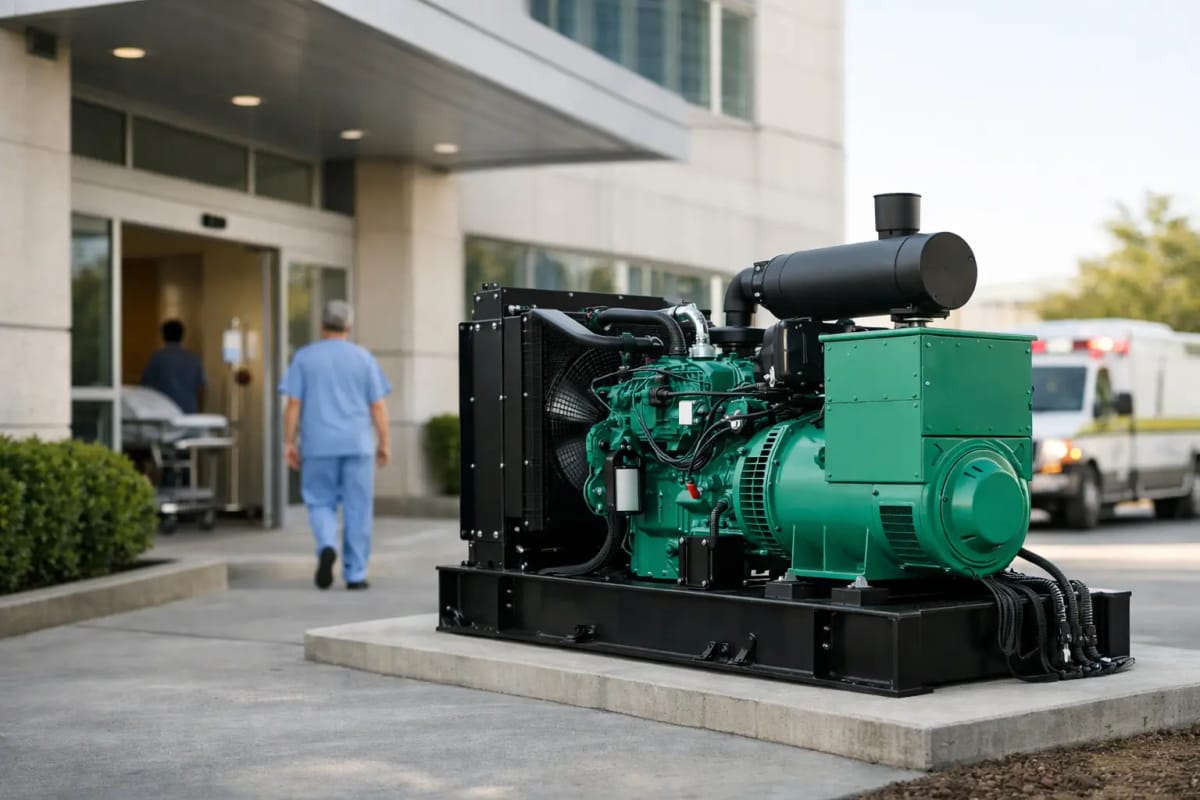
A mains failure in a hospital is not simply a facilities issue. It can affect ventilated patients, operating theatres, critical care, medical gas systems, IT infrastructure and site security within seconds. Hospital generator requirements therefore need to be defined around clinical risk, load priority and recovery time - not just the kVA rating printed on a genset data sheet.
For UK healthcare estates, the correct solution is an engineered standby power system: generator set, fuel installation, automatic transfer arrangement, distribution design, protection, controls and a test regime that proves the system will perform when required. The generator is central, but it is not the whole answer.
Hospital Generator Requirements Start With Critical Loads
The starting point is a verified essential-load schedule. Facilities teams should distinguish between loads that must continue without interruption, loads that can tolerate a short transfer period and loads that may remain off during an extended outage.
Life-safety and clinical loads commonly include critical care equipment, theatre systems, emergency lighting, fire detection, medical gas alarms, communications, security, selected lifts and essential heating, ventilation and cooling plant. The exact arrangement depends on the hospital’s clinical services, building layout and existing electrical infrastructure.
A common specification mistake is sizing a generator against the entire site’s maximum demand without considering realistic emergency operation. That can result in unnecessary capital cost, higher fuel consumption and lightly loaded running. The opposite error is more serious: selecting a set that cannot support starting currents, future clinical expansion or the loss of one generator in a parallel installation.
A properly developed load schedule records running kW, power factor, starting method, motor starting demand, diversity and whether each circuit is essential. It should also identify non-linear loads such as UPS systems, imaging equipment and modern variable-speed drives. These can affect alternator selection and harmonic performance even where the apparent kVA total appears acceptable.
Sizing the Standby Generator Set
Hospital generator requirements usually call for a standby-rated diesel generator, selected for emergency duty rather than routine continuous operation. Standby rating is intended for use during utility failure, whereas prime power rating is relevant where a generator will operate as the normal or regularly scheduled source of supply.
The required capacity should be calculated in kW as well as kVA. A nominal kVA figure alone does not establish whether the set can carry the required real power, reactive load or motor-starting event. Engineers must account for ambient temperature, altitude, enclosure losses, fuel quality, site conditions and any planned future load growth.
Motor starting is often decisive. Chillers, pumps, air-handling plant and certain lift systems can impose a short but substantial demand. Sequential starting, soft starters and variable-speed drives may reduce this burden, but they need to be assessed as part of the complete switching sequence. A generator that carries the steady-state load may still experience unacceptable voltage and frequency dip when major plant starts.
For larger hospitals, resilience commonly requires more than one generating set. Parallel generators can share essential demand, provide N+1 resilience and allow maintenance without removing all standby capacity. This arrangement adds cost and control complexity, but it may be justified where a single point of failure is unacceptable.
Transfer Time and Distribution Must Match Clinical Risk
A generator cannot provide zero-break power on its own. It starts after the loss of mains supply, reaches stable voltage and frequency, then the automatic transfer system connects the emergency source. Critical loads that cannot tolerate even that brief interruption normally require UPS support or another no-break arrangement upstream.
The transfer strategy should set clear priorities. Clinical and life-safety circuits should be restored first, with lower-priority plant added in stages once the generator is stable. Load shedding can prevent an overload condition if demand exceeds available capacity, while load acceptance sequencing limits the impact of large motor starts.
Automatic transfer switches, synchronisation panels, generator controllers and emergency distribution boards all need a defined fault philosophy. Consider what happens if a mains incomer fails, an automatic transfer switch does not operate, a generator fails to start, or one set in a parallel system is unavailable. Resilience on paper is not the same as resilience under fault conditions.
Fuel Storage Determines Real Outage Capability
Generator fuel autonomy should be based on the hospital’s risk assessment, location, operational plan and realistic refuelling arrangements. A day tank sized for a short interruption may be suitable for a smaller facility with reliable local fuel support. A major acute site may require bulk storage, duty and standby transfer pumps, fuel polishing provisions and a clear plan for tanker access during severe weather or regional disruption.
Diesel fuel must remain usable for the duration of an outage. Water ingress, microbial growth, sediment and ageing fuel can block filters or damage components precisely when the set is needed. Fuel sampling, treatment and periodic testing should be part of planned maintenance, not an emergency response.
Storage design must also address containment, fire precautions, ventilation, security and local environmental requirements. The practical question is not only how many hours of fuel the tank holds, but whether that fuel can be transferred, filtered and delivered to the engine reliably.
Compliance Must Be Applied to the Specific Site
UK hospital schemes are normally developed with reference to the applicable Health Technical Memoranda, including HTM 06-01 for electrical services supply and distribution, alongside BS 7671 and relevant fire, building and environmental requirements. Equipment performance may also be specified against appropriate generator standards, including ISO 8528.
The applicable requirements vary by project. New-build acute facilities, community hospitals, private clinics and refurbished departments do not necessarily have identical risk profiles or legacy constraints. The responsible electrical designer, healthcare engineering team and approving authorities should confirm the current standards and site-specific requirements before procurement.
Compliance should cover installation as well as equipment selection. This includes earthing arrangements, cable routing, fire-resisting systems where required, ventilation, exhaust discharge, acoustic control, access for service, safe isolation and emergency operating procedures. A silent enclosure reduces external noise, for example, but does not remove the need to assess airflow, heat rejection and maintenance clearance.
Testing Is a Core Generator Requirement
A hospital standby set that has not been tested on load is an unproven asset. Routine exercise is needed to confirm engine starting, battery condition, control operation, alarms, fuel transfer and automatic changeover. However, unloaded running alone may not expose cooling, fuel delivery or load-acceptance issues.
A planned programme should include regular functional tests, periodic on-load tests and controlled simulation of utility failure where operationally safe. Tests should verify the complete chain from mains loss to generator start, transfer, load restoration and return to normal supply. Results should be recorded, reviewed and used to correct defects before a real event occurs.
Maintenance intervals should reflect engine manufacturer guidance, operating hours, fuel condition and the critical nature of the application. Consumables such as filters, belts, coolant, batteries and starting components require attention even when the generator has accumulated few running hours.
Specifying the Right Generator Configuration
The right configuration depends on the site. An open generator may suit a purpose-built, ventilated plant room where acoustic treatment is designed into the building. A weatherproof silent generator can be the more practical choice for external installation near occupied areas, provided its enclosure, exhaust and air paths are correctly engineered.
Three-phase generation is standard for most hospital essential systems, but voltage, frequency, neutral arrangement and fault level must be compatible with the existing distribution network. Proven diesel engine platforms, correctly matched alternators and controllers with remote monitoring capability provide a dependable basis for critical standby applications.
Global Generators can support specification-led enquiries across a broad kVA range, helping buyers match standby capacity, enclosure format and engine configuration to the site’s defined emergency load.
The most useful next step is to review the essential-load schedule against the hospital’s actual outage plan. When the required loads, transfer priorities, fuel autonomy and maintenance responsibilities are clear, generator procurement becomes a controlled engineering decision rather than a response to a power failure.