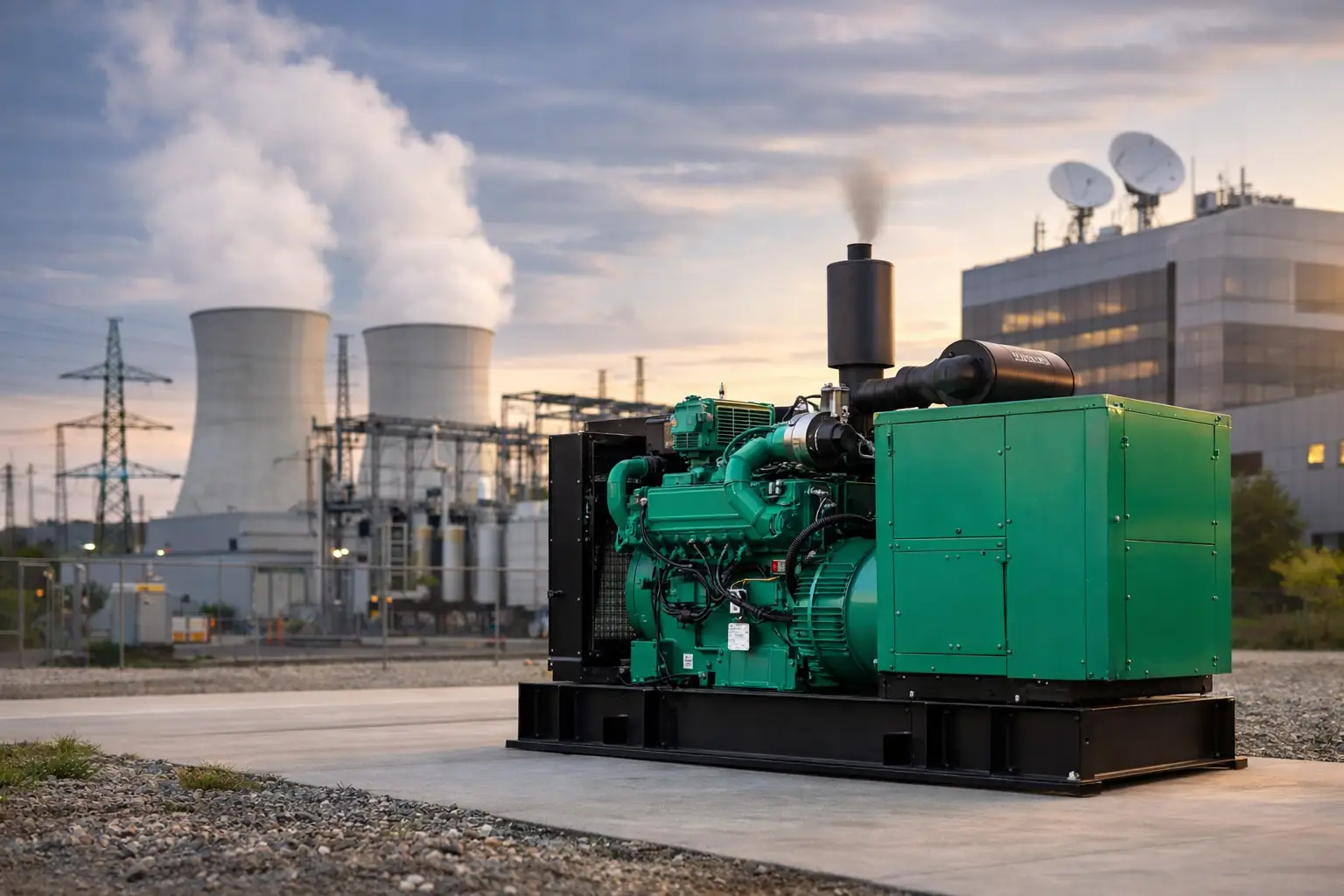
An industrial generator is not simply a reserve asset waiting for a mains failure. At a manufacturing plant, distribution hub, hospital, telecoms installation or active construction site, it is part of the operational continuity plan. The correct set protects production, safety systems, data, temperature-controlled stock and contractual commitments. The wrong set can trip under load, consume excessive fuel or leave essential circuits without power when they are needed most.
For buyers responsible for uptime, selection should start with the site duty and load profile, then move to rating, engine, alternator, enclosure, controls and installation requirements. Price matters, but the cost of an underspecified generator is usually measured in lost operating time rather than the purchase order value.
Start with the duty - standby or prime power
The first decision is whether the generator will operate as standby power, prime power or a more continuous source of electricity. These ratings are not interchangeable.
A standby-rated set is intended to support a site during a utility outage. It is suited to premises with a dependable mains supply where generator operation is occasional, although the duration and annual running hours must still be assessed. Standby capacity is commonly specified at a higher kVA figure than the prime rating, so comparing only the headline number can create a specification error.
Prime power is for applications where the generator may operate for extended periods at variable load, such as remote works, temporary infrastructure, quarries and sites with an unreliable grid connection. A prime-rated industrial generator must be selected at its prime rating, with appropriate allowance for expected load changes and service intervals. Where the set will run continuously at a near-constant load, a continuous-duty assessment may be required.
Do not assume that a set purchased for emergency use will be suitable for long-term site power. Engine loading, maintenance schedules, fuel autonomy and emissions requirements all change when runtime increases.
Size the industrial generator from real load data
Generator sizing is a technical exercise, not a guess based on the building’s incoming supply. Review actual demand, future expansion and the way connected equipment starts. A set that appears large enough in normal running may still struggle when motors, pumps, compressors, lifts or refrigeration plant start together.
The most useful starting point is a load schedule covering essential and non-essential circuits, each item’s running kW, starting method and expected coincidence. This should identify the largest motor start, harmonic-producing loads and any equipment that cannot tolerate a short voltage or frequency disturbance.
kVA is the standard generator rating, while kW reflects the real power consumed. Their relationship depends on power factor. At a 0.8 power factor, a 500 kVA generator provides 400 kW. However, this simple conversion should not replace a proper load review. Modern sites often include variable speed drives, UPS systems, battery chargers and other non-linear loads that affect alternator sizing and voltage regulation.
A sensible specification leaves operational headroom rather than running permanently at the edge of capacity. Yet excessive oversizing is also a concern, particularly with diesel generators operating at light load for long periods. Low loading can contribute to poor combustion and wet stacking. The target operating range depends on the engine, application and duty cycle, so it should be agreed during procurement rather than treated as a fixed rule.
Account for motor starting and load steps
Direct-on-line motor starting can demand several times the running current for a short period. If a generator cannot accept that demand, voltage may dip sharply and controls may reset or protective devices may operate. Soft starters and variable speed drives can reduce the starting impact, but they introduce their own considerations, including harmonics.
Large step loads matter too. A site may be comfortable at a steady 60 per cent load but experience instability if a major pump or process line is switched on abruptly. Specify acceptable voltage and frequency recovery, not merely total kVA. This is particularly relevant for healthcare, data, telecommunications and process environments where control equipment has tight tolerances.
Choose a configuration that suits the installation
Generator format affects noise, protection, access and deployment speed. The correct choice depends on where the set will operate and who will maintain it.
A silent generator is normally the practical option for commercial premises, populated areas and sites with planning or occupational noise constraints. Its acoustic enclosure provides weather protection and attenuates sound, but the enclosure must still allow sufficient airflow, safe exhaust discharge and full maintenance access. Noise figures should be compared at the stated distance and operating condition, not taken at face value.
An open generator is often specified for plant rooms or containerised installations where the building or acoustic treatment provides the necessary protection. It can offer straightforward access and may suit a bespoke power package, but it requires a properly engineered environment. Ventilation, fire separation, exhaust routing, fuel containment and lifting access must be resolved before delivery.
Single phase generators suit smaller and specific 230 V loads. For most commercial and industrial applications, a 3 phase generator provides the flexibility and capacity required for 400 V distribution and motor-driven plant. Phase loading must be balanced as far as possible. A heavily loaded phase can limit usable output even when the overall site load appears acceptable.
Specify the equipment around the generator set
A generator does not secure uptime in isolation. The transfer arrangement, fuel system and controls determine whether power reaches critical loads reliably.
An automatic transfer switch, or ATS, monitors the incoming supply and starts the generator when mains power fails. It then transfers the load once voltage and frequency are stable. The ATS must be correctly rated for the duty, fault level and switching arrangement. For sites requiring no-break performance, an ATS alone may not be enough. A UPS, battery system or other bridging arrangement may be needed to carry sensitive loads through the transfer period.
Fuel storage should be sized for the required autonomy at realistic loading, with a clear plan for refuelling during an extended outage. Bunded tanks, fuel polishing, water management and remote level monitoring become more significant where diesel is held for long periods or the site cannot accept a delivery interruption.
Remote monitoring provides early warning of low fuel, battery faults, abnormal temperatures, failed starts and alarm conditions. It is especially valuable for unmanned assets and multi-site estates, but it does not replace routine inspection and load testing. Control panels should also provide the operating modes, protection settings and communications integration required by the site team.
Plan installation before placing the order
Delivery access is frequently underestimated. Check vehicle approach, turning space, gate width, ground bearing capacity, crane requirements and the route from delivery point to final position. A large generator may be technically suitable yet impossible to place without temporary works or a revised layout.
The installation design should address concrete basework, anti-vibration mounts, cable sizing, earthing, exhaust back pressure, ventilation air paths and safe access for servicing. External sets require weather-resilient cable routes and consideration of flood risk. Internal installations need particular care around heat rejection, combustion air and fire safety.
For projects with planning conditions, confirm acoustic limits, operating hours, exhaust requirements and fuel tank restrictions early. Retrofitting additional attenuation or changing an exhaust system after installation is more costly than specifying it correctly at the outset.
Select for serviceability as well as output
A dependable industrial generator is one that can be maintained without unnecessary delay. Review service access for filters, belts, batteries, coolant points and control panels. Confirm the availability of routine consumables and engine support, particularly for installations outside the UK or in remote locations.
Recognised engine platforms, including Cummins-powered generator sets, are often selected because buyers value established parts support, familiar service requirements and proven performance across demanding duties. The generator’s alternator, controller and switchgear should receive the same scrutiny. A quality engine cannot compensate for an unsuitable alternator or poorly configured protection system.
Planned Maintenance around both calendar time and running hours. Regular exercising under meaningful load helps identify starting, charging and control faults before an emergency exposes them. Periodic load-bank testing is useful where the site cannot safely apply sufficient real load during a test.
Make the enquiry specification-led
A clear enquiry produces a faster and more accurate quotation. State the required standby or prime rating, voltage, frequency, phase, target load, site location, runtime expectation, enclosure preference and intended transfer arrangement. Include the largest motor or load step, any sensitive electronic loads, noise limits and access constraints.
Global Generators can then match the required capacity and configuration from available stock, rather than offering a headline kVA figure without the operational context. Fast delivery is valuable, but specification discipline is what ensures the delivered set will perform when the mains supply does not.
The best time to test an emergency power strategy is before the outage, with the generator installed, fuelled, exercised and maintained for the duty it is expected to carry.