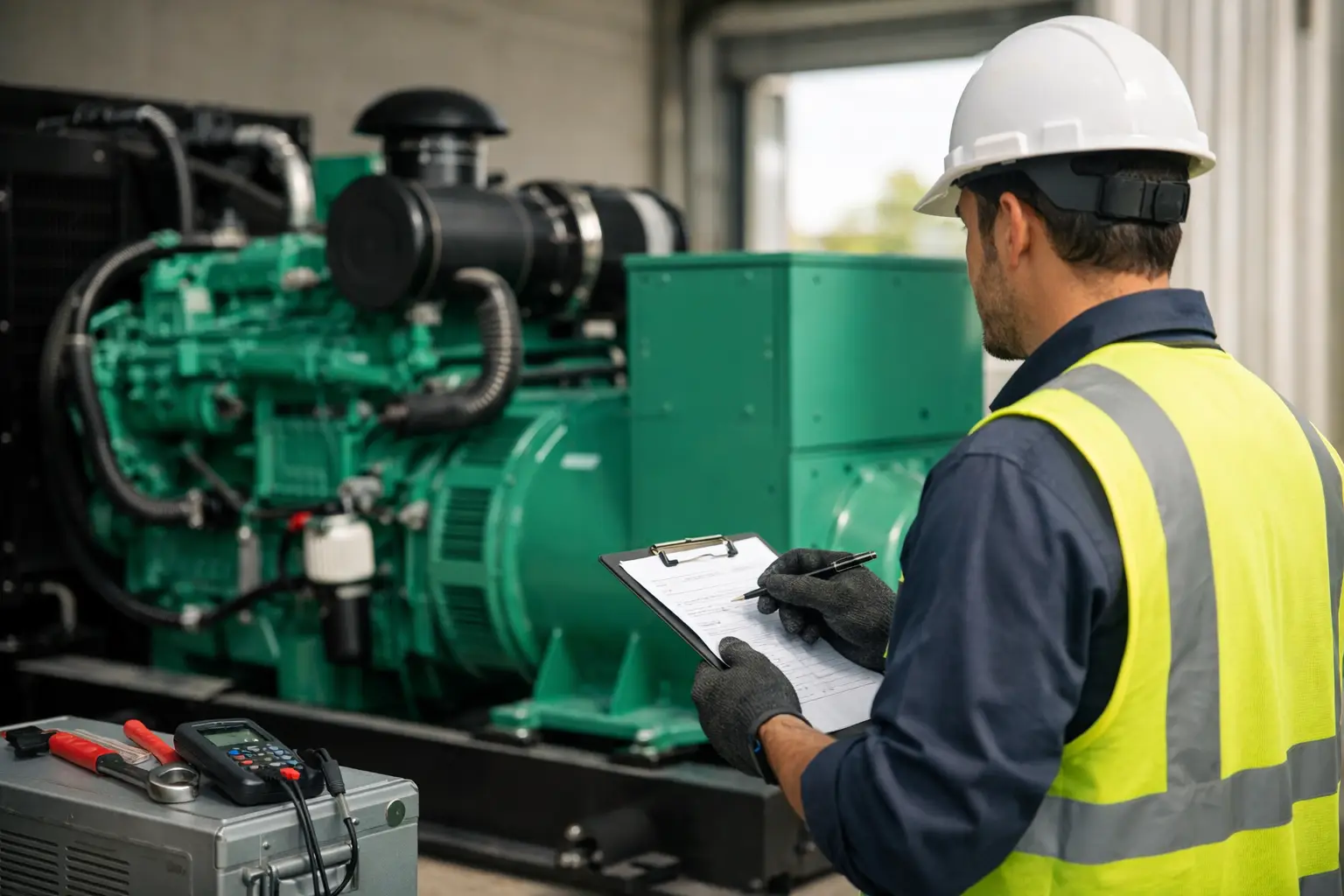
A standby generator rarely fails because of one dramatic fault. More often, it is taken out of service by a missed inspection, stale fuel, an overdue battery replacement, or a service interval that looked manageable until site pressures took priority. That is why a generator maintenance planning guide matters. For any facility where loss of power means lost production, safety exposure, or contractual penalties, maintenance has to be planned as an operational control, not treated as an occasional engineering task.
The quality of the plan should reflect the role of the set. A generator supporting a warehouse office does not carry the same risk profile as one backing a hospital plant room, telecoms site, data-led operation, or manufacturing process line. The maintenance framework must match the duty. That means looking at runtime expectations, environmental conditions, fuel storage duration, transfer arrangements, and the cost of failure before setting service intervals.
What a generator maintenance planning guide should cover
A useful plan starts with asset definition. Record the generator model, serial number, engine type, alternator specification, standby and prime ratings, fuel tank arrangement, control panel details, and any associated automatic transfer switch. If the site operates multiple sets, identify which units are duty, standby, rental backup, or part of a synchronised system. Maintenance becomes harder to manage when technical records are incomplete.
From there, the plan should set out what is checked, when it is checked, who is responsible, and what evidence is retained. Manufacturers provide baseline service schedules, but real operating conditions often justify adjustment. A dusty construction site, a coastal installation, or a set exposed to frequent short run cycles may need more attention than the standard handbook suggests. The opposite is also true. Low-hour units can be damaged by neglect just as easily as high-hour machines can be worn by use.
The strongest plans separate routine operator inspections from specialist service work. Daily or weekly checks can often be handled on site if the team is trained and the process is documented. More technical work, including valve adjustment, controller diagnostics, injector issues, or alternator testing, should sit with competent service engineers. The objective is not to create paperwork. It is to reduce the chance of latent faults going unnoticed.
Build the maintenance schedule around risk and runtime
Service planning should be based on both calendar time and engine hours. If a generator only runs during monthly test exercises, calendar-based maintenance may trigger first. If it is carrying regular load in a prime power role, hour-based intervals will likely drive the schedule. Relying on only one measure creates gaps.
In practice, most commercial and industrial operators work from a layered schedule. Visual inspections and housekeeping are frequent. Fluid checks, battery checks, and alarm reviews happen at short intervals. Oil, coolant, filters, belts, and more detailed inspections are planned at manufacturer-recommended hour or time thresholds. Annual servicing remains common, but annual alone is not enough where run hours are material.
It also helps to plan around seasons and business cycles. Sites with higher winter demand, storm exposure, or known peak production periods should not be trying to fit overdue maintenance into the highest-risk part of the year. Schedule service before the point of maximum dependence. For construction and temporary power applications, this can mean reviewing maintenance around mobilisation dates, relocation, and changing load conditions rather than by the calendar alone.
The checks that protect uptime
Good maintenance planning gives proper weight to the components most likely to affect starting, stability, and sustained operation. Batteries remain one of the most common points of failure. A generator that is mechanically sound but cannot crank under emergency conditions is still unavailable. Battery voltage, charger condition, terminals, electrolyte where relevant, and replacement age all need planned attention.
Fuel quality is another frequent weakness. Diesel degrades over time, especially where storage conditions are poor or tanks are partially filled for long periods. Water ingress, microbial growth, and sediment can compromise injectors, filters, and combustion performance. Sites with low run hours often assume their fuel is safe because usage is limited. In reality, low turnover can increase the risk. A proper plan includes fuel sampling, tank inspection, filter changes, and fuel polishing where storage periods are extended.
Cooling systems also deserve more discipline than they often get. Coolant condition, hose integrity, radiator cleanliness, leaks, and fan performance all affect reliability under load. A set may start and idle correctly while still carrying a hidden cooling issue that only appears during an extended outage. The same principle applies to lubrication. Oil analysis is not essential for every installation, but for high-value or critical assets it can provide early warning of contamination, wear metals, and abnormal engine condition.
Air intake and exhaust systems should not be treated as minor items. Restricted airflow, degraded ducting, or poor exhaust integrity affects performance and can create safety problems. Enclosed and silent generators may be particularly exposed to airflow issues if acoustic packaging is modified, obstructed, or poorly maintained.
Testing matters as much as servicing
A generator can appear healthy on paper and still underperform in service. That is why maintenance planning should include structured testing. Basic no-load exercising confirms start function and control response, but it does not prove the set can carry the required site demand. Where practical, load testing is essential.
The right test regime depends on the installation. Some sites can test against actual building load. Others need a resistive or reactive load bank. What matters is that testing reflects the duty the generator may be asked to perform. Running for short periods at very light load may not be enough for diesel engines, particularly if this contributes to wet stacking and carbon build-up. In those cases, the maintenance plan should include periodic higher-load operation to maintain engine condition.
Testing should also cover the wider system. Automatic start signals, transfer switch operation, breaker response, alarms, remote monitoring, and shutdown logic all need verification. A generator is only one part of the resilience chain. If the set starts but the load does not transfer, the site still loses power.
Compliance, records and contractor control
Maintenance planning is not complete without record discipline. Service sheets, inspection logs, test results, alarm histories, fuel records, and parts changes should be retained in a format the site can retrieve quickly. This supports compliance, warranty positions, fault diagnosis, and asset replacement decisions. It also helps procurement and operations teams justify budget where ageing equipment is becoming more expensive to maintain.
For regulated or high-consequence environments, record quality matters as much as the physical work. Auditors, insurers, and internal governance teams will often look for evidence that maintenance is planned, completed, and reviewed. A missed service may be manageable. A missed service with no traceable decision-making is harder to defend.
If maintenance is outsourced, contractor scope needs to be precise. Define response times, service exclusions, consumables responsibility, emergency call-out arrangements, and reporting standards. Too many service agreements look comprehensive until a fault occurs outside standard hours or a major component issue sits outside the quoted works. Commercial clarity reduces operational surprises.
Spares planning and when replacement is the better decision
One of the practical weaknesses in many generator maintenance plans is spares availability. Consumables such as filters, belts, coolant, and batteries are obvious. Less obvious are sensors, relays, control modules, chargers, and alternator-related components that can create long lead times. Critical sites should assess which spare parts are worth holding locally based on failure consequence and supply risk.
There is also a point where maintenance planning becomes replacement planning. If the set is increasingly unreliable, parts are becoming difficult to source, emissions expectations have changed, or the duty has grown beyond the original specification, continued servicing may not be the most commercial option. This is especially relevant where a standby unit has gradually become more load-critical over time.
A structured review should compare service cost, downtime risk, fuel efficiency, and suitability of the existing set against current site requirements. In some cases, changing from an open set to a silent generator, or reassessing single phase versus 3 phase demand, is part of the maintenance conversation because application fit directly affects operating stress and future reliability. For buyers managing mixed estates or expanding operations, this is where a stock-led supplier such as Global Generators can support faster replacement planning around the required kVA, enclosure type, and duty rating.
Generator maintenance planning guide for serious sites
The best generator maintenance planning guide is not the longest one. It is the one the site can follow under pressure. It sets intervals that reflect actual runtime, defines who does what, includes proper testing, keeps records in order, and accepts that some risks need more than a basic annual service. Where power continuity is commercially critical, maintenance should be treated as part of production assurance.
If your generator exists to protect operations, plan maintenance as if the mains failure will happen at the worst possible moment. Sooner or later, it usually does.