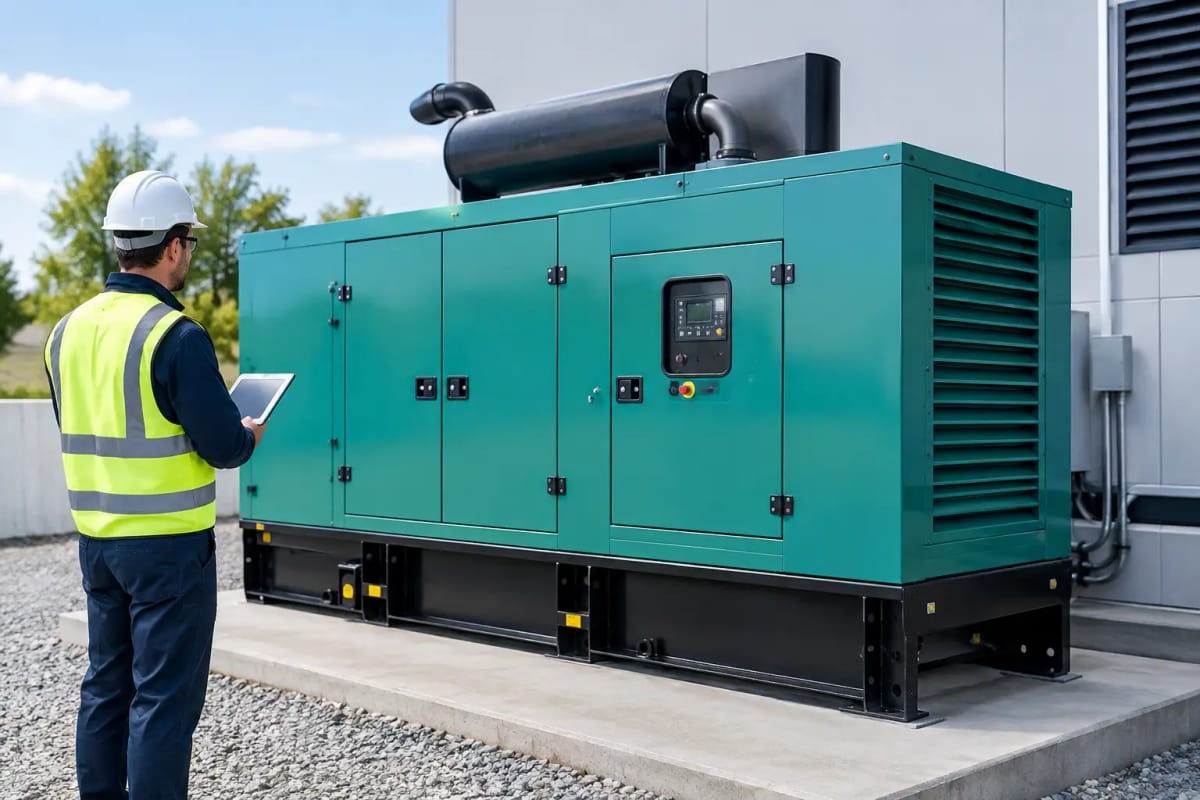
A mains failure at a distribution depot, production line or healthcare facility is not simply an inconvenience. It can stop operations, compromise safety systems and create immediate commercial loss. A 250 kVA generator is a common choice for medium-sized critical loads, but it is only the right choice when its rating, starting capability and site configuration match the real demand.
For procurement teams and engineers, the headline kVA figure is the beginning of the specification, not the end. The generator must support the intended duty cycle, tolerate transient loads and integrate properly with the electrical installation.
What a 250 kVA Generator Can Supply
At a typical power factor of 0.8, a 250 kVA set equates to approximately 200 kW of usable active power. In most commercial and industrial applications, it will be supplied as a 400/230 V, 50 Hz, three-phase diesel generator. This makes it suitable for sites with a mixture of three-phase plant and single-phase ancillary loads.
That 200 kW figure should not be treated as a guaranteed operating target in every situation. Generator loading is affected by the load power factor, harmonic content, ambient temperature, altitude and the type of equipment being started. A set serving largely resistive loads, such as heating or conventional lighting, behaves very differently from one carrying variable speed drives, pumps, compressors and refrigeration plant.
A 250 kVA generator can be a practical fit for a warehouse, workshop, medium commercial building, construction compound, telecom installation or production area. It may also support part of a larger facility through a defined essential-load scheme. The key question is not whether the set can cover the site’s total connected load, but whether it can reliably carry the loads that must remain live during an outage.
Standby and Prime Ratings Must Be Specified Correctly
Duty rating has direct implications for engine selection, alternator specification, fuel planning and expected service life. It must be agreed before the generator is purchased.
A standby-rated set is intended for emergency use during utility failure. It is typically selected where mains power is the normal source and the generator runs only for periodic testing and outages. This is the usual arrangement for offices, care facilities, retail premises and many commercial sites with an automatic transfer switch.
Prime power is different. A prime-rated generator is designed to operate as the main supply where utility power is unavailable, unreliable or intentionally not used. Typical applications include remote construction projects, temporary works, quarries and isolated industrial operations. It can operate for extended periods with variable load, subject to the manufacturer’s stated operating conditions and maintenance schedule.
Do not assume that standby and prime ratings are identical. A generator marketed around a 250 kVA standby output may have a lower prime power rating. Comparing proposals on the largest headline number alone can leave a site underspecified for continuous use. The correct approach is to state the required duty clearly: standby, prime or, where applicable, continuous operation.
Size the Set for the Load Profile, Not the Meter Reading
A recent electricity bill provides useful context, but it does not show how the site behaves when the generator starts. Proper selection begins with an essential-load schedule, ideally supported by half-hourly demand data, load monitoring or a site survey.
The schedule should identify running power, starting current, duty pattern and the order in which loads will be restored. Motors are particularly significant. A direct-on-line motor can demand several times its running current during start-up, causing a temporary voltage and frequency dip. Pumps, compressors, cranes, lifts and large ventilation equipment therefore need individual assessment.
Soft starters and variable speed drives can reduce starting demand, but they introduce another consideration: harmonic distortion. Sites with large quantities of electronic loads, UPS systems, rectifiers or drives may require alternator sizing and control settings that differ from a straightforward kW calculation. Sensitive IT, medical or communications equipment may also require tighter voltage regulation and a considered switching strategy.
Load steps matter as much as the final running load. If a 250 kVA set must accept a major pump start immediately after transfer, it may need more capacity than a set serving the same load after staged restoration. Conversely, a larger generator that spends most of its time at very low load can suffer from inefficient operation and, on some diesel applications, wet stacking or carbon build-up. A realistic target load and a staged start sequence produce a more dependable installation.
Enclosure, Cooling and Fuel Arrangement
The physical format of the generator should reflect where and how it will operate. A silent, weatherproof canopy is normally the right choice for external commercial sites, built-up areas and locations with noise limits. It provides acoustic attenuation and weather protection while allowing service access. Sound performance should be checked at the stated measurement distance and operating condition, rather than judged by a broad description such as “quiet”.
An open generator may be appropriate inside a purpose-built plant room, container or acoustic enclosure. It is often more economical at purchase, but the project must then provide ventilation, exhaust routing, fire protection, noise control and safe access. Inadequate air movement is a frequent cause of high operating temperatures and reduced output.
Fuel autonomy needs the same level of attention. A standard base tank may provide several hours of operation, but actual runtime depends on the load percentage and fuel tank capacity. Sites exposed to prolonged outages may require an extended-run tank, bulk fuel storage or a managed refuelling arrangement. Fuel polishing, water separation and regular inspection are relevant where diesel is stored for long periods.
For most 250 kVA applications, the installation also needs a correctly rated automatic transfer switch, protected distribution equipment, earthing arrangement and suitably sized cabling. These items should be considered as one power system. A capable generator will not protect uptime if the transfer equipment is incorrectly specified or the fuel supply cannot support the required outage duration.
Consider the Site Conditions Before Ordering
Engine output reduces at higher ambient temperatures and altitudes. If the generator will operate in a hot plant area, an enclosed compound or an elevated location, the supplier should confirm any derating before finalising the size. Likewise, extreme cold can affect starting performance, fuel condition and battery reliability.
Access is another practical issue that should be resolved early. Confirm delivery route dimensions, lifting points, final position, service clearances and exhaust discharge location. A 250 kVA enclosed set is substantial equipment; placing it where technicians cannot safely reach filters, batteries or control panels turns routine maintenance into an avoidable operational risk.
For sites with a future expansion plan, it may be sensible to allow capacity for a known additional load or to consider synchronised generator arrangements. Oversizing solely for an uncertain possibility is not always economical. The decision depends on the cost of later replacement, the expected load growth and the consequences of insufficient power.
What to Confirm on a 250 kVA Generator Specification
A clear procurement specification reduces comparison errors between quotations. Confirm the standby and prime ratings, engine and alternator make, voltage, frequency, phase configuration, controller type, canopy or open-set format, fuel tank size and expected runtime. Also establish the sound level, dimensions, weight, warranty terms, delivery requirement and whether an automatic transfer switch is included.
Cummins-powered generator sets are widely selected for industrial duty because buyers value proven engine platforms, established parts support and performance data that can be assessed against the operating requirement. However, the engine badge should not replace a full review of the package. Alternator capacity, control system, enclosure quality and the supplier’s ability to provide the required configuration are equally relevant to dependable operation.
Global Generators can support specification-led enquiries for 250 kVA units, including silent and open configurations for standby and prime power applications. Providing a load schedule, duty requirement, installation location and required delivery timescale at the enquiry stage will lead to a faster, more accurate recommendation.
The most effective 250 kVA generator is the one sized around the loads that genuinely matter, installed for the environment it will face and maintained as part of the site’s wider continuity plan.