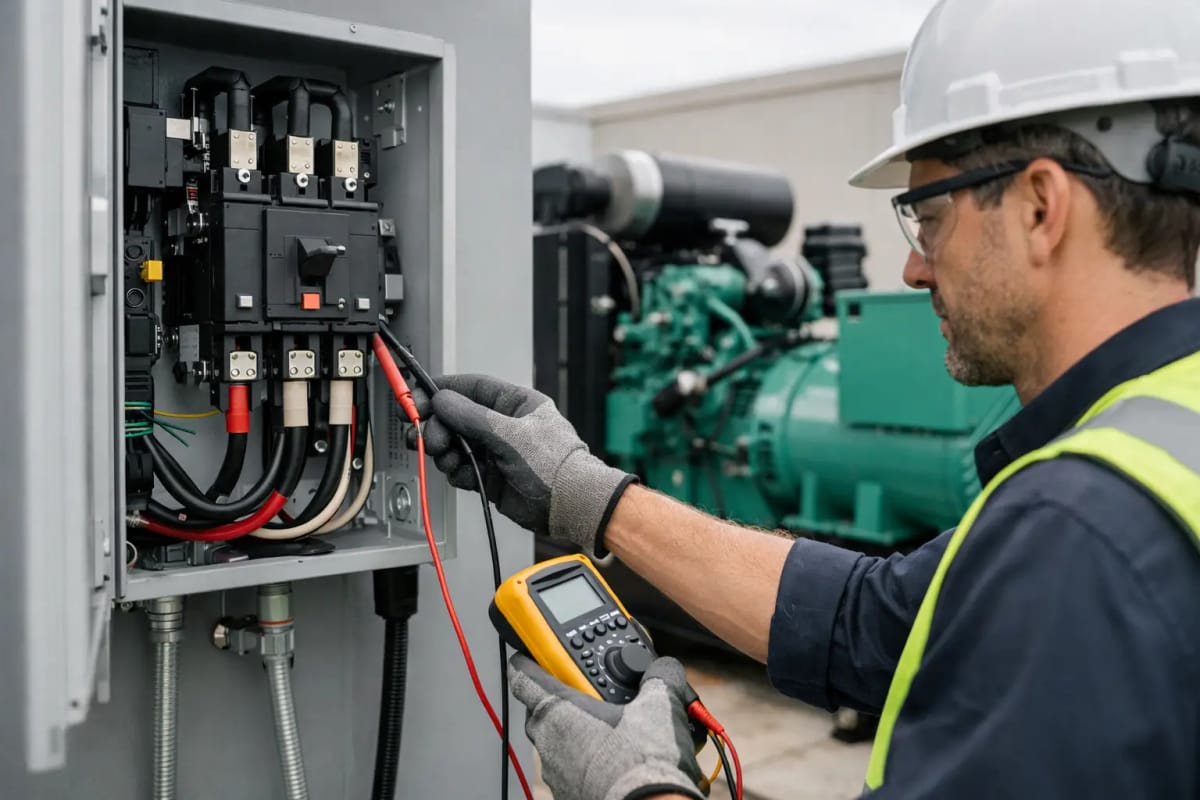
A generator can start cleanly and still fail to protect the site if the transfer system does not respond correctly. Knowing how to test generator transfer is therefore not simply a generator exercise. It is a controlled test of the generator set, automatic transfer switch (ATS), control settings, distribution system and the essential loads they support.
For hospitals, logistics facilities, telecoms sites, manufacturing plants and other critical operations, the test must prove that standby power transfers when required, carries the intended load and returns to mains supply without creating a second outage. It should be planned, recorded and carried out by competent personnel who understand the site electrical arrangement.
Start with the right type of generator transfer test
Not every transfer test proves the same thing. A weekly automatic start test may confirm that the engine starts and reaches running speed, but it does not prove that the ATS will transfer the building load. Likewise, a no-load transfer test can demonstrate switch operation without revealing whether the generator can accept the real site demand.
The appropriate method depends on the risk profile of the facility, the available shutdown window and whether the generator is rated for standby or prime power operation. The three common approaches are a simulated mains-failure test, a live-load test and a load-bank test.
A simulated mains-failure test causes the ATS to recognise loss of the normal utility source. The generator starts, stabilises and the switch transfers selected loads to the emergency source. This is often the most useful functional test for a standby installation, provided the affected equipment can tolerate the interruption.
A live-load test places actual building load onto the generator. It confirms transfer operation and shows how the engine, alternator and controls behave under the loads that matter at the site. It also carries more operational risk, particularly where non-essential loads are not properly segregated or large motors start at the same time.
A load-bank test applies a controlled artificial load instead of the building load. It is valuable for exercising a generator at a known percentage of its rating, but it may not test every element of the building distribution or the ATS transfer path. For many critical installations, both load-bank testing and periodic live transfer testing are justified.
Plan the test before operating the transfer switch
A transfer test should begin with the site single-line diagram, ATS operating manual and generator control documentation. Confirm which circuits are supplied by the emergency board, whether there are multiple generator sets or synchronising controls, and whether the arrangement includes a bypass-isolation ATS. Never assume that every load downstream of an emergency board is suitable for interruption.
Notify affected departments, security, IT teams, building management and any external monitoring provider. Where fire alarms, lifts, medical equipment, data systems or process plant are involved, agree the test window and contingency arrangements in advance. A planned transfer can still trip sensitive equipment if its ride-through settings, uninterruptible power supply condition or changeover sequence are not understood.
Before testing, inspect the generator set. Check fuel level and fuel supply valves, coolant level, engine oil, battery charger status, starting batteries, control-panel alarms and emergency stop condition. Inspect for fluid leaks, loose terminals, damaged cables, blocked ventilation and any exhaust restrictions. Confirm that the generator is in automatic mode if the ATS is expected to initiate the start signal.
The electrical side needs the same discipline. Confirm the normal supply is healthy, phase rotation is correct where relevant, breaker positions are known and the ATS has no active fault indication. Verify the generator rating, voltage and frequency match the site requirements. On a three-phase installation, assess expected phase loading rather than relying only on the total kW figure.
Use an approved risk assessment and method statement. Lock-out and isolation procedures apply whenever panels are opened or maintenance work is needed. Generator and ATS terminals can remain live from more than one source. Backfeeding utility equipment is a serious hazard and must be prevented by correctly installed, maintained transfer equipment.
How to test generator transfer under controlled conditions
1. Establish a baseline on normal supply
With the site on mains power, record normal voltage, frequency, current and load where metering is available. Note the ATS position, generator run hours, fuel level and any existing alarms. This creates a useful reference when reviewing the results.
If the site has a building management system or remote monitoring platform, verify that normal-source status, generator availability and alarm communications are visible before the test starts. There is little value in a successful local test if the remote alarm path is not working.
2. Initiate the approved loss-of-mains simulation
Use the ATS test function or the approved normal-source isolation method specified for the installation. Do not operate an upstream breaker merely because it appears to be the quickest option. The correct method depends on the switchgear design, site operating procedure and whether other loads share that supply.
Observe the ATS sequence. It should detect normal-source failure, allow the programmed start delay, send the start signal to the generator and wait for acceptable generator voltage and frequency. Record the elapsed time. If the generator starts but the transfer does not occur, investigate the ATS settings, generator available signal, sensing circuits and interlocks rather than repeatedly cycling the equipment.
3. Confirm generator acceptance and load transfer
Once the generator has stabilised, the ATS should transfer the emergency circuits to the generator source. Check the position indication locally and, where fitted, at the monitoring system. Verify that the essential loads are operating as expected.
Monitor generator oil pressure, coolant temperature, voltage, frequency, kW, kVA, power factor and phase currents throughout the run. The readings should remain within the manufacturer’s permitted operating range. Sudden frequency dip, low voltage, black exhaust smoke or repeated overload alarms can indicate that the generator is undersized, poorly maintained or facing an excessive starting load.
Pay particular attention to motor loads such as pumps, compressors and air-handling plant. Their starting current can be several times their running current. A generator that supports steady-state load may still struggle if multiple motors restart together after transfer. Staggered-start controls, soft starters or revised load priorities may be needed.
4. Check alarms, interlocks and priority loads
A worthwhile test confirms more than power availability. Check that generator running, mains failure, low fuel and common fault signals report correctly at the required locations. Confirm that non-essential load-shedding operates where fitted and that priority circuits remain supplied.
For facilities with parallel generators, synchronising panels or closed-transition transfer systems, testing should follow the manufacturer’s procedures and the site’s switching plan. These arrangements require additional checks for synchronisation, breaker interlocking, load sharing and protection settings. They are not suitable for improvised testing.
5. Restore mains supply and observe retransfer
Return the normal source using the agreed procedure. The ATS should recognise that utility voltage and frequency have returned within tolerance, observe its programmed retransfer delay and switch the load back to mains. That delay prevents unnecessary transfer cycling during a brief or unstable utility restoration.
After retransfer, the generator should run unloaded for its configured cool-down period before stopping. Verify that it returns to automatic standby mode, with no lockout alarm present. Record final engine readings, run hours, fuel use, load values, transfer timings and any abnormal events.
Common transfer-test failures and what they indicate
A generator that does not start on demand commonly points to battery, charger, fuel, control-mode or start-circuit issues. If the set starts but never transfers, the fault may sit with ATS sensing, generator voltage availability, time delays or an interlock. If transfer occurs but protected loads fail, investigate downstream breakers, UPS systems, distribution boards and load prioritisation.
Nuisance alarms during transfer should not be dismissed as a normal part of testing. High coolant temperature, low oil pressure, low generator frequency and overload trips are protective functions. Repeatedly resetting them without establishing the cause turns a maintenance issue into an availability risk.
Poor test results can also expose a specification problem rather than a maintenance fault. A site may have added refrigeration, process equipment, IT load or motor-driven plant since the generator was selected. Review both the standby kVA rating and transient performance against the current load profile before assuming that a larger transfer delay will solve the issue.
Set a test frequency that reflects the site risk
Routine exercise intervals should follow the generator manufacturer’s recommendations, the ATS supplier guidance, insurer requirements and the site’s own resilience policy. High-consequence sites generally need more than occasional no-load runs. They need scheduled load testing, documented ATS functional tests and regular review of fuel quality, battery condition and alarm communications.
Keep a clear test record with dates, personnel, transfer times, load readings, alarms, corrective actions and supporting photographs where useful. Trend data makes it easier to identify declining battery performance, rising engine temperatures or growing load demand before a real utility outage exposes the problem.
A transfer test is successful only when the site can show, with evidence, that power moved to the generator safely and that essential operations remained protected. If test results show limited capacity, poor load acceptance or an unsuitable ATS arrangement, address the design issue before the next outage makes the decision for you.