A mains failure is rarely just an inconvenience on a working site. It can stop production lines, compromise temperature-controlled stock, disrupt communications and leave safety systems without support. The question, “how do generators work”, therefore matters well beyond basic engineering theory. A generator set is a controlled power plant designed to start, stabilise and carry a defined electrical load when the normal supply is unavailable - or where no grid connection exists.
For facilities managers, contractors and procurement teams, understanding the process makes it easier to specify the correct kVA rating, fuel arrangement, enclosure and control system. It also helps prevent a common and costly mistake: buying a generator that can run, but cannot reliably support the site’s actual load profile.
How Do Generators Work? The Core Principle
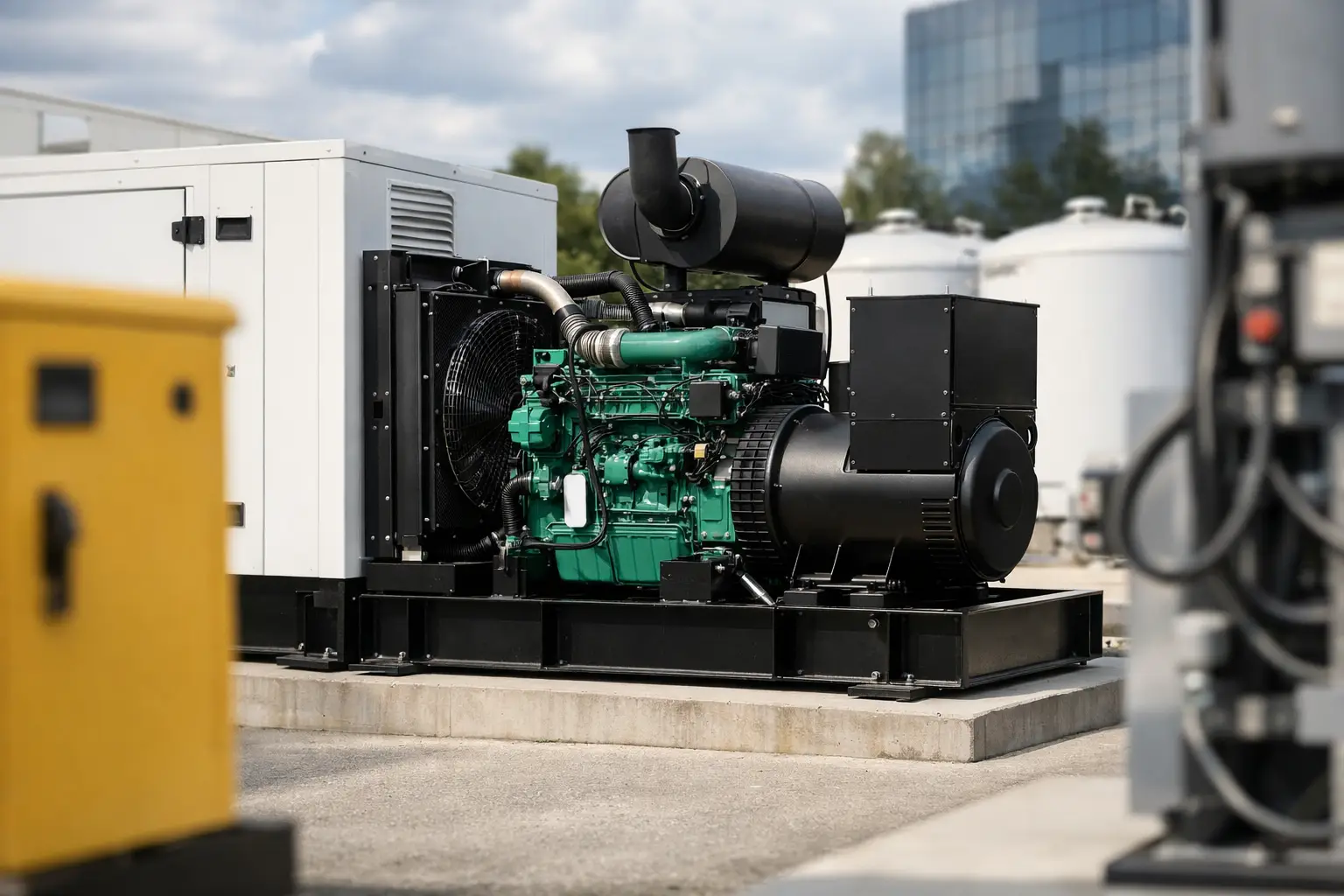
Despite the name, a generator does not create electricity from nothing. It converts mechanical energy into electrical energy through electromagnetic induction. In a diesel generator, the engine burns fuel to turn a crankshaft. That rotating force drives the alternator, where a magnetic field moving relative to electrical windings produces alternating current, or AC power.
The principal components work as one system. The diesel engine supplies mechanical power. The alternator converts that power to electricity. A governor controls engine speed, while an automatic voltage regulator, commonly called an AVR, controls voltage output. The controller monitors operating conditions, starts and stops the set, displays alarms and can communicate with remote monitoring equipment. Circuit breakers and protective devices then allow the output to be connected to the installation safely.
For a standard UK 50 Hz supply, the engine must maintain the correct speed for the alternator design. A typical four-pole generator set operates at 1,500 rpm. If engine speed falls materially when load is applied, frequency can fall with it. If the speed rises, frequency rises. This is why engine governing is central to power quality, particularly where a site operates motors, drives, controls or sensitive electronic equipment.
From Mains Failure to Available Power
On a standby installation, the generator does not normally run continuously. It waits for the mains supply to fail or move outside acceptable voltage and frequency limits. An automatic transfer switch, or ATS, detects that condition and sends a start command to the generator control panel.
The starting batteries energise the starter motor. Once the diesel engine is running, the controller checks for stable oil pressure, coolant temperature, speed, voltage and frequency. The alternator then builds to its required output. When the set is stable, the ATS disconnects the mains supply and transfers the building or designated essential load to generator power.
This sequence usually takes seconds rather than being instantaneous. The exact transfer time depends on the controls, the generator, the ATS arrangement and whether the system has any no-break equipment such as a UPS. Hospitals, data environments and certain process applications may use UPS systems to bridge the short gap between a mains failure and generator availability.
When the utility supply returns and remains stable for a programmed period, the ATS transfers the load back to mains power. The generator continues without load during a cool-down period, allowing temperatures to reduce before shutdown. It then returns to automatic standby, ready for the next event.
A prime power generator works differently in one key respect: it may operate as the main power source for extended periods, such as on a remote construction project, temporary utility installation or off-grid industrial site. The conversion process is the same, but the loading, maintenance regime and fuel logistics are more demanding.
Controlling Voltage, Frequency and Load
A generator’s usefulness depends on more than whether it starts. It must produce power within the limits that connected equipment can tolerate. The AVR adjusts excitation to help maintain voltage as the electrical load changes. The governor meters fuel to maintain engine speed and frequency as load rises or falls.
A sudden motor start can impose a substantial short-duration demand. Large pumps, compressors, cranes and fans may need several times their normal running current while accelerating. If the set is undersized, voltage and frequency can dip sharply. This can trip protection, prevent the motor from starting or disturb other equipment on the same supply.
Non-linear loads also need consideration. Variable speed drives, UPS systems, battery chargers and some IT equipment can introduce harmonics that affect alternator performance and heat generation. A suitable alternator specification, load assessment and, where necessary, harmonic mitigation are preferable to treating the nameplate kVA figure as the whole answer.
Standby and Prime Ratings Are Not Interchangeable
Generator ratings define the duty the set is designed to perform. They are not simply alternative descriptions of the same output.
Standby power is intended for emergency use during a mains outage. It generally permits a higher output for limited annual operating hours and does not normally allow sustained overload. It is appropriate for a factory, office, healthcare facility or logistics site with a dependable grid supply but a low tolerance for interruption.
Prime power is designed for variable load operation over unlimited annual hours within the manufacturer’s specified conditions. It is used where the generator is the principal source of electricity, or where grid availability is poor. Prime-rated operation requires more careful attention to average load, service intervals and fuel supply.
The distinction affects engine selection, expected lifecycle cost and warranty conditions. A standby-rated generator used as a daily power source may appear economical at purchase, but it is the wrong duty classification and can create reliability and support issues. The operating profile should always be established before the rating is selected.
kVA, kW and Phase Configuration
Generators are commonly specified in kVA because alternators must supply both real power and reactive power. The relationship to kW depends on power factor. At a 0.8 power factor, a 100 kVA generator provides 80 kW of real power. However, a site’s actual power factor, motor content and electrical design may differ, so this conversion should not be used as a substitute for a load study.
Three-phase generators are generally the practical choice for industrial and commercial installations. They support three-phase machinery and can also supply balanced single-phase loads. Single-phase sets suit smaller loads and domestic or light commercial applications, but they are not a direct replacement for a three-phase supply.
Voltage must also match the installation. In the UK, many commercial generator sets are configured for 400/230 V, three-phase, 50 Hz output. Export projects may require different voltages or frequencies. Connection equipment, earthing arrangements and distribution boards must be designed for the selected output, not adapted casually after delivery.
Fuel, Cooling and Exhaust Keep the Set Operating
The engine requires more than diesel fuel to deliver dependable power. Fuel is stored in an integral or external tank, filtered before injection and often managed through day tanks or bulk storage on larger installations. Fuel quality matters. Water contamination, microbial growth and aged diesel can block filters, damage components and stop an otherwise serviceable set from starting.
The cooling system removes engine heat through a radiator, coolant circuit and fan. Open generator sets are suitable for plant rooms or protected installations where ventilation and exhaust routing have been engineered properly. Silent, weatherproof canopy sets provide acoustic attenuation and environmental protection for external locations, but they still require clear airflow around the enclosure.
Exhaust gases must be discharged safely, with appropriate pipework, silencing and heat management. A generator cannot simply be placed in a confined space because it is compact or enclosed. Ventilation, fire safety, access for maintenance, fuel containment and noise limits should be resolved during the installation design.
Sizing a Generator for the Real Site Load
The correct generator capacity is based on the load that must run during an outage, not necessarily the building’s full connected load. Identify essential and non-essential circuits, establish running demand, then assess the starting requirement of the largest motors and the way loads will be introduced.
Load diversity can reduce the required capacity where equipment does not operate simultaneously. Conversely, future expansion, high ambient temperature, altitude, enclosure restrictions and poor power factor can require additional margin. Oversizing also has a trade-off. Diesel engines operating at very low load for prolonged periods can suffer from inefficient combustion and carbon build-up, often referred to as wet stacking.
A well-specified set should normally operate within a healthy load range for its expected duty while retaining enough capacity for transient demand and planned growth. The answer may be a single larger set, staged load control, or multiple generators operating in parallel. Parallel systems can provide redundancy and improve efficiency across changing loads, but they add control complexity and require a properly engineered synchronisation scheme.
Reliability Is Built Before the Outage
A generator is only dependable if the whole standby system is maintained. Regular exercising confirms that batteries, starter circuits, controls and engine systems are functioning. Yet an unloaded test alone cannot prove that the alternator, fuel system and cooling system will perform at site demand. Periodic on-load testing is essential, whether using the building load or a suitably rated load bank.
Maintenance should include fluid and filter changes at the required intervals, battery inspection, fuel sampling, coolant checks, belt and hose condition, and review of controller alarms. Transfer switch testing is equally important. A perfectly maintained generator is of little value if the ATS fails to send the start signal or transfer the load.
For sites where interruption has operational or safety consequences, generator procurement should begin with the load, duty and installation conditions rather than a headline kVA figure. Global Generators can help match standby or prime power requirements with the appropriate diesel generator configuration, from compact single-phase units to large three-phase industrial sets.
The most dependable power solution is the one that has been specified for the real load, installed correctly and tested before the mains supply is lost.