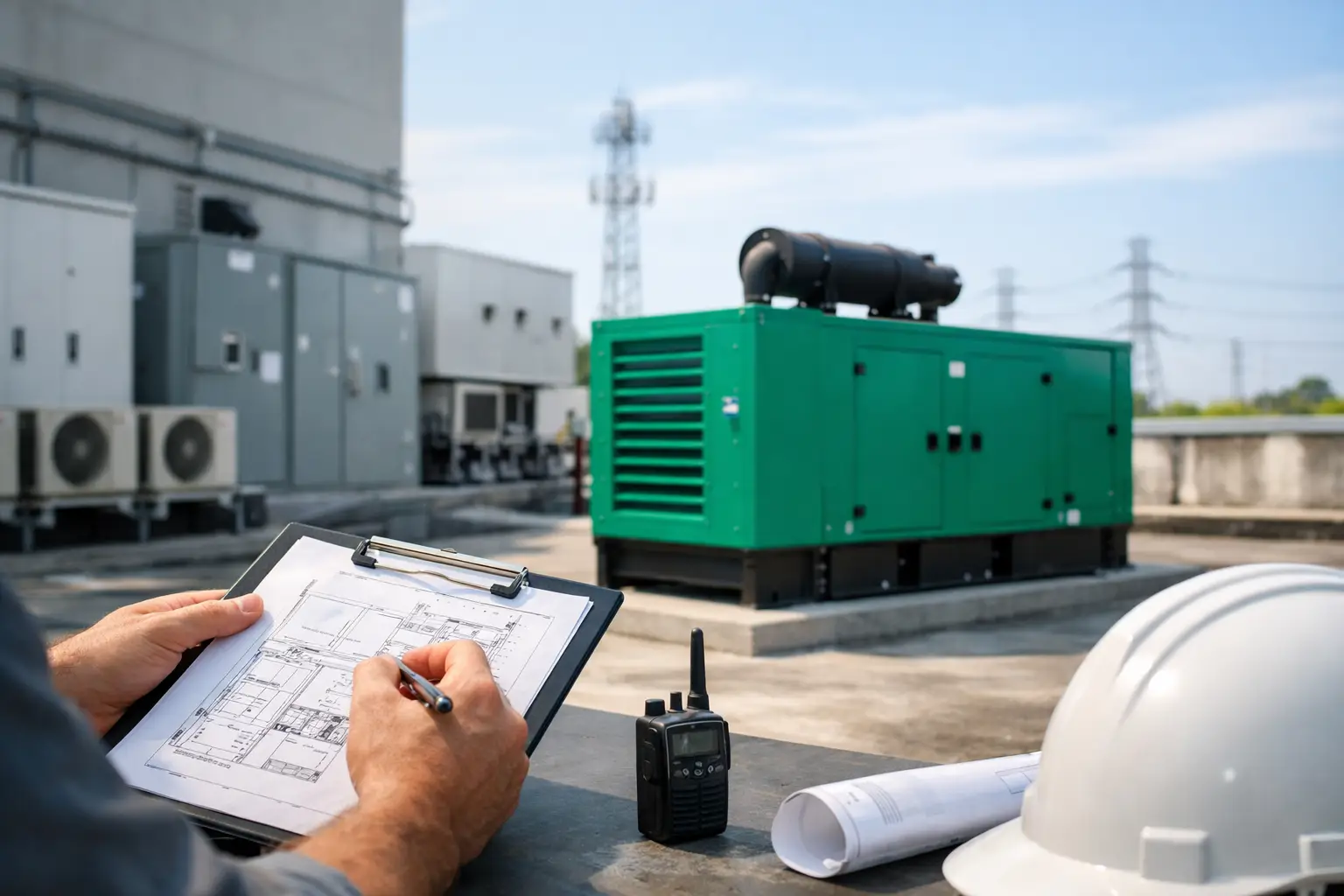
A power cut at a critical site is rarely just an inconvenience. It can stop production lines mid-cycle, interrupt refrigeration, take communications offline, compromise safety systems or leave a facility unable to trade. Knowing how to plan backup power begins with defining what must remain operational, for how long, and under what conditions.
The correct solution is not always the largest generator available. It is a properly specified standby power system with sufficient capacity, suitable starting performance, reliable fuel provision and a transfer arrangement that responds when the mains supply fails. For sites with frequent outages or no dependable utility connection, the requirement may instead be prime power.
Start with the consequence of failure
Before calculating kVA, identify the operational impact of a mains failure. A warehouse may need emergency lighting, security, IT equipment, loading systems and selected refrigeration circuits. A manufacturing plant may require a controlled shutdown rather than full production. A healthcare, telecoms or utility site may need every essential system to continue without interruption.
Separate loads into three groups: life safety and statutory systems, business-critical systems, and loads that can be shed during an outage. This is the basis of an economical specification. Supplying every circuit may be necessary, but it often adds considerable generator capacity, fuel use and installation cost without improving resilience where it matters most.
The required run time should be equally clear. A short-duration standby set may bridge typical network faults, while a remote site, major logistics operation or exposed industrial facility may need fuel autonomy for 24, 48 or 72 hours. Longer operating periods affect fuel tank size, refuelling access, maintenance arrangements and whether a standby-rated generator is appropriate.
How to plan backup power from the load profile
A load schedule is the foundation of generator sizing. It should record each item or distribution board that will be supplied, its running load in kW or kVA, voltage, phase, power factor and expected operating pattern. Include equipment that may start automatically when the generator takes the load, such as pumps, compressors, extraction systems and refrigeration plant.
Do not size solely from a site’s utility incomer rating. The incomer may be substantially larger than the actual demand, or it may conceal individual motor loads that create high starting currents. A generator must handle both the steady running load and the most demanding load step without unacceptable voltage or frequency dip.
Account for motor starting and non-linear loads
Motors are a common source of undersizing. A direct-on-line motor can draw several times its full-load current at start-up. If multiple motors attempt to start together, the alternator and engine can be subjected to a substantial transient demand. Soft starters, variable-speed drives and staged sequencing can reduce this, but each must be reviewed as part of the actual installation rather than assumed from nameplate ratings.
Modern sites also carry non-linear loads, including UPS systems, IT hardware, LED lighting and variable-speed drives. These can introduce harmonic distortion and may require careful alternator selection or additional capacity. A generator that appears adequate on a simple total-kW calculation may perform poorly when the real load profile is applied.
A competent specification considers the largest starting load, simultaneous demand, load step acceptance and future growth. Allowing sensible capacity for expansion is prudent. Oversizing by an excessive margin, however, can create low-load operating issues for diesel engines, including wet stacking and inefficient fuel consumption.
Choose standby or prime power correctly
The duty classification is as important as the headline kVA rating. Standby power is intended for emergency use during utility failure. Prime power is designed for variable load operation where the generator is the main source of electricity, subject to the manufacturer’s defined operating conditions.
A construction site running a generator throughout the working day, an off-grid facility and a temporary utility replacement normally require prime-rated equipment. A commercial building that only starts its generator during a mains failure will generally require a standby-rated set. Using the wrong rating can affect operating life, service intervals, warranty position and expected performance.
Review the intended annual running hours, average load factor and expected outage pattern before procurement. If the site occasionally uses the generator for planned load testing, that does not automatically make it a prime power application. The decision rests on its actual duty.
Specify the generator configuration around the site
Generator format should follow the environment, access constraints and noise requirements. A silent, weatherproof canopy is usually the practical choice for external installations near offices, residential boundaries or operational work areas. It provides acoustic attenuation and protects the equipment from weather, while still requiring adequate ventilation and service access.
Open generator sets can be suitable within a purpose-built plant room or containerised installation, where ventilation, exhaust routing, fire precautions and acoustic treatment are managed as part of the project. They are not simply lower-cost alternatives to enclosed sets. The building must perform the functions that the canopy would otherwise provide.
Voltage and phase must match the distribution system. Many industrial and commercial sites require 400V three-phase supply, while smaller applications may require single-phase power. Check the earthing arrangement, neutral requirements and whether the generator needs a switched neutral. These details affect the automatic transfer switch design and the protection strategy.
Engine and alternator selection also matters. Proven diesel engine platforms, such as Cummins-powered generator sets, are widely specified where serviceability, parts support and dependable output are priorities. The selected package should state its standby and prime ratings clearly, rather than relying on a single generic power figure.
Design the transfer system, not just the generator
A generator does not provide automatic resilience unless it is connected through a correctly specified changeover system. An automatic transfer switch, or ATS, monitors the mains supply, starts the generator after a defined failure condition and transfers essential loads when voltage and frequency are stable. Once the mains has returned and stabilised, it transfers the load back and allows the generator to cool down.
The transfer sequence must be coordinated with the site’s operational requirements. Some loads can tolerate a short interruption while the generator starts. Others require an uninterruptible power supply to bridge the transfer period. Fire systems, lifts, data equipment and process controls may each have different requirements, so the ATS should not be treated as a standard add-on.
For larger sites, sectionalised distribution and load prioritisation may be preferable to one large transfer switch. This allows non-essential circuits to remain disconnected and enables staged loading, reducing the required generator capacity and improving recovery after an outage.
Plan fuel, location and installation conditions
Fuel resilience determines whether the set can deliver its rated purpose. Calculate consumption at realistic load levels, not only at full load, then size the base tank or bulk fuel tank around the required autonomy. Consider fuel polishing, water contamination prevention, bunding, fire safety, delivery access and the ability to refuel during an extended incident.
Location affects performance and compliance. Generators need a stable foundation, clear air intake and discharge paths, safe exhaust routing and sufficient space for maintenance. Hot exhaust air recirculating into the radiator can cause overheating even when the generator has been sized correctly. Plant room installations require particular attention to ventilation airflow and louvre sizing.
Noise limits, local planning conditions, emissions requirements and fuel storage regulations should be checked early. Retrofitting acoustic treatment, ventilation changes or a larger fuel system after delivery is slower and more expensive than specifying them at the outset.
Build testing and maintenance into the plan
Backup power only protects the site if it starts and accepts load when required. A regular exercise programme should test automatic start, transfer operation, alarms, battery condition, fuel levels and load response. Brief no-load starts are useful, but they do not prove that the generator can support the critical load.
Planned load-bank testing may be needed where site load is too low or cannot be safely used for testing. It helps confirm engine performance and prevents prolonged low-load running. Maintenance should follow the engine manufacturer’s schedule, with particular attention to filters, coolant, batteries, belts, fuel quality and control-panel alarms.
Keep current single-line diagrams, operating instructions and escalation contacts at the site. Facilities teams should know how to isolate non-essential loads, respond to alarms and arrange refuelling. A resilience plan that depends on one unavailable person is not a dependable plan.
Turn the assessment into a procurement specification
A clear enquiry should state the required standby or prime rating, voltage and phase, load profile, motor starting method, runtime, enclosure requirement, fuel autonomy, ATS requirement, site location and delivery constraints. It should also identify whether installation, commissioning and ongoing maintenance are included in the scope.
Global Generators can support this process by matching a generator set to the required kVA, duty rating and configuration, from smaller commercial sets through to high-capacity industrial packages. Accurate information at the enquiry stage produces a faster, more reliable recommendation.
The most effective backup power plan is one tested against the site’s real failure scenario, not a theoretical maximum. Define the loads that matter, specify the system around their behaviour, and make routine proving part of normal operations. That is how standby power becomes dependable uptime rather than equipment waiting silently for a problem.