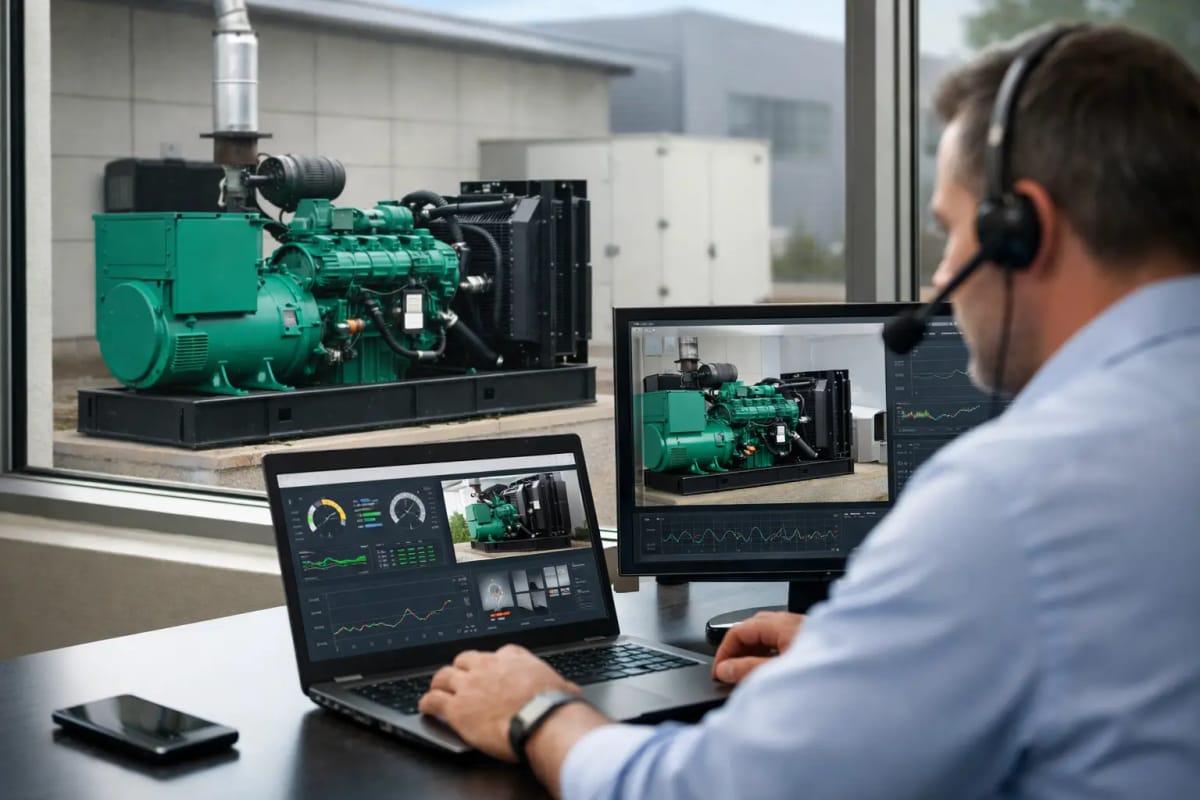
A generator that fails to start is rarely the real problem. The real problem is discovering it after a mains outage has already stopped production, affected patient care, interrupted a telecoms service or left a critical building without power. Generator remote monitoring systems give operations teams early visibility of generator condition, controller alarms and site power events without waiting for a routine visit.
For standby and prime power installations, remote monitoring is not a replacement for planned maintenance or proper load testing. It is a practical layer of operational control. It helps responsible teams see what the set is doing, respond to abnormal conditions sooner and give service engineers useful information before they arrive on site.
What generator remote monitoring systems do
A remote monitoring system collects information from the generator controller and sends it to an authorised platform, typically through a mobile network, Ethernet connection or site network. Users can then view operating data through a web portal, desktop software or mobile application.
The quality of information depends on the generator controller, installed sensors and communications hardware. A modern industrial set can provide considerably more than a simple running indication. It may report mains availability, generator running status, battery voltage, engine speed, coolant temperature, oil pressure, fuel level, output voltage, frequency, load percentage and accumulated run hours.
When a parameter moves outside its permitted range, the system can issue an alarm by email, text message or application notification. This allows the duty holder to decide whether the event requires immediate attendance, a planned engineering visit or further investigation from the control room.
For a facilities manager overseeing several locations, the value is clear: one view can show which sites are on mains, which sets are running and which assets need attention. For a single high-risk site, it provides assurance that the standby system remains in a serviceable state between inspections.
Why remote visibility matters to uptime
Many generator faults develop gradually. A weakening starter battery, falling fuel level, high coolant temperature or repeated low-load running may not prevent the generator operating today. Left unresolved, however, each can compromise the next start sequence or shorten component life.
Remote monitoring changes the response from reactive to planned. If battery voltage is trending down, it can be investigated during normal working hours rather than during an outage. If a fuel tank level falls unexpectedly, the site can check for increased consumption, a delivery issue or a possible leak. If a set is running more often than expected, the team can investigate mains instability before it becomes a wider facilities issue.
It also improves the quality of escalation. Instead of reporting that “the generator has an alarm”, the site team can provide the alarm code, engine parameters, run history and current operating state. Engineers can arrive with a clearer understanding of the fault and, where appropriate, the right parts.
This matters particularly where access is difficult or costly. Unmanned infrastructure, temporary construction power, logistics facilities and distributed telecoms estates can all incur significant costs from unnecessary call-outs. Monitoring does not eliminate site visits, but it helps ensure that visits are justified and correctly prioritised.
The data that should be monitored
The required data set depends on whether the generator is specified for standby duty, regular prime power operation or a remote, lightly attended site. A basic installation may only need status, alarm and run-hour reporting. A mission-critical installation will normally require wider visibility.
Electrical and mains status
The system should show whether utility power is available, whether the generator is supplying the load and the position of the automatic transfer switch where integration allows. Generator output voltage, frequency, current and load should also be visible. These readings help identify overload risk, phase imbalance and poor power quality conditions.
For three phase generators, phase-by-phase readings are particularly useful. A healthy total load figure can conceal a significant imbalance across individual phases, which can affect alternator performance and connected equipment.
Engine condition and starting readiness
Engine oil pressure, coolant temperature, engine speed and battery voltage are core indicators. The controller should also record shutdown and warning alarms, rather than simply showing a current fault condition. Historical alarms often reveal recurring issues that a single site inspection may miss.
Starting readiness deserves particular attention. Standby generators can spend most of their lives waiting, so battery charger performance, battery condition, fuel availability and pre-start alarm status must be checked consistently. A set that looks clean and well maintained can still fail to start if these fundamentals are neglected.
Fuel and runtime information
Fuel monitoring is useful for both resilience and cost control. Tank level, low-fuel alarms, consumption trends and run hours allow teams to plan deliveries around real demand. On prime power sites, fuel data can also support operating cost analysis and identify unusual consumption.
Fuel level sensors must be selected and calibrated properly. Tank geometry, sender accuracy and fuel movement can affect readings, so a displayed percentage should not be treated as an exact measurement unless the system has been verified against the physical tank.
Selecting the right communications approach
There is no single best communications method. The site environment, security policy, existing infrastructure and required response time all affect the decision.
Mobile connectivity is often the most practical option for temporary sites, remote compounds and locations without dependable fixed broadband. It is quick to deploy and independent of the customer’s IT network, although signal strength, SIM management and recurring data charges need consideration.
Ethernet or secure site-network connectivity may suit hospitals, data-sensitive facilities and large commercial buildings. This can provide stable communication but usually requires engagement with the customer’s IT and cyber-security teams. That approval process should be considered early, not after the generator has been commissioned.
Hard-wired systems can be appropriate where a permanent site has established control infrastructure. They can be highly dependable, but cable routes, installation cost and changes to the building layout may make them less flexible than cellular options.
Whichever route is chosen, remote monitoring hardware should continue recording local alarms if communications are lost. Loss of connection is itself an alarm condition. A monitoring system that quietly stops reporting creates false confidence.
Integration with the generator and transfer system
The monitoring platform should be compatible with the generator controller and any automatic transfer switch or synchronising equipment. Compatibility is not only about whether values appear on a screen. It affects which parameters can be read, whether alarms are translated accurately and whether historical records are retained.
For new generator procurement, specify monitoring requirements at the same time as kVA rating, standby or prime duty, enclosure type, fuel autonomy and voltage. Retrofitting is possible on many existing sets, but it may need additional modules, sensors or controller upgrades. Older equipment may provide limited data, and adding remote capability should not compromise the original control or safety circuits.
Remote start and stop functions require particular caution. They can be useful on managed prime power applications, but they must be engineered around site safety procedures, load conditions and personnel access. For many standby installations, read-only monitoring and alarm notification offer the operational benefits without introducing unnecessary control risk.
Alarm management is where value is won or lost
A portal full of data does not protect uptime if nobody knows what requires action. Alarm rules should reflect the site’s actual operating priorities. A low-warning fuel level may be suitable for a depot with daily access, while a remote resilience site may need a higher threshold to allow time for fuel planning.
Avoid sending every warning to every recipient. Excessive notifications create alarm fatigue and increase the risk that a critical shutdown is missed. Establish clear escalation routes for urgent engine alarms, failed weekly exercise runs, low battery voltage, loss of mains where the set has not started, and loss of communications.
The team should also agree who owns each action. Facilities staff may verify site access and fuel status, while a generator service provider investigates engine alarms. Procurement teams may need visibility of runtime and fuel use, but they are not necessarily the right first contact at 02:00. Defined responsibilities turn data into a reliable response process.
Remote monitoring does not replace maintenance
Monitoring can show that an alarm occurred. It cannot change filters, test fuel quality, inspect belts, confirm exhaust integrity or prove that the set will accept its full design load. Planned maintenance remains essential, alongside regular exercise under suitable load and periodic load-bank testing where the application requires it.
There are also limits to sensor data. An apparently normal coolant temperature does not confirm every hose, clamp and pump is sound. A satisfactory voltage reading does not prove every downstream switchgear connection is secure. Monitoring should support the maintenance regime, not be used to reduce it without an engineering review.
For standby power, the strongest approach combines correctly sized equipment, a quality controller, planned servicing, documented testing and remote oversight. Each element covers a different failure mode.
Specify monitoring around the operational risk
The most suitable system is determined by the consequence of losing power, not by the number of data points on a dashboard. A small commercial standby set may need straightforward start, alarm and fuel-level reporting. A hospital, utility asset or multi-site industrial estate may need controller integration, transfer-switch status, detailed event logs and escalation to a 24-hour response team.
When specifying a generator, establish who will monitor it, what response is expected, how the site communicates and which alarms must trigger action. Global Generators can help align these requirements with generator capacity, duty rating and configuration, whether the requirement is for a silent enclosed set, an open set or a larger prime power installation.
The useful test is simple: when mains power fails at an inconvenient hour, will the responsible person know what happened, what the generator is doing and what needs to happen next? A well-specified monitoring system makes that answer clear before downtime becomes the next call-out.