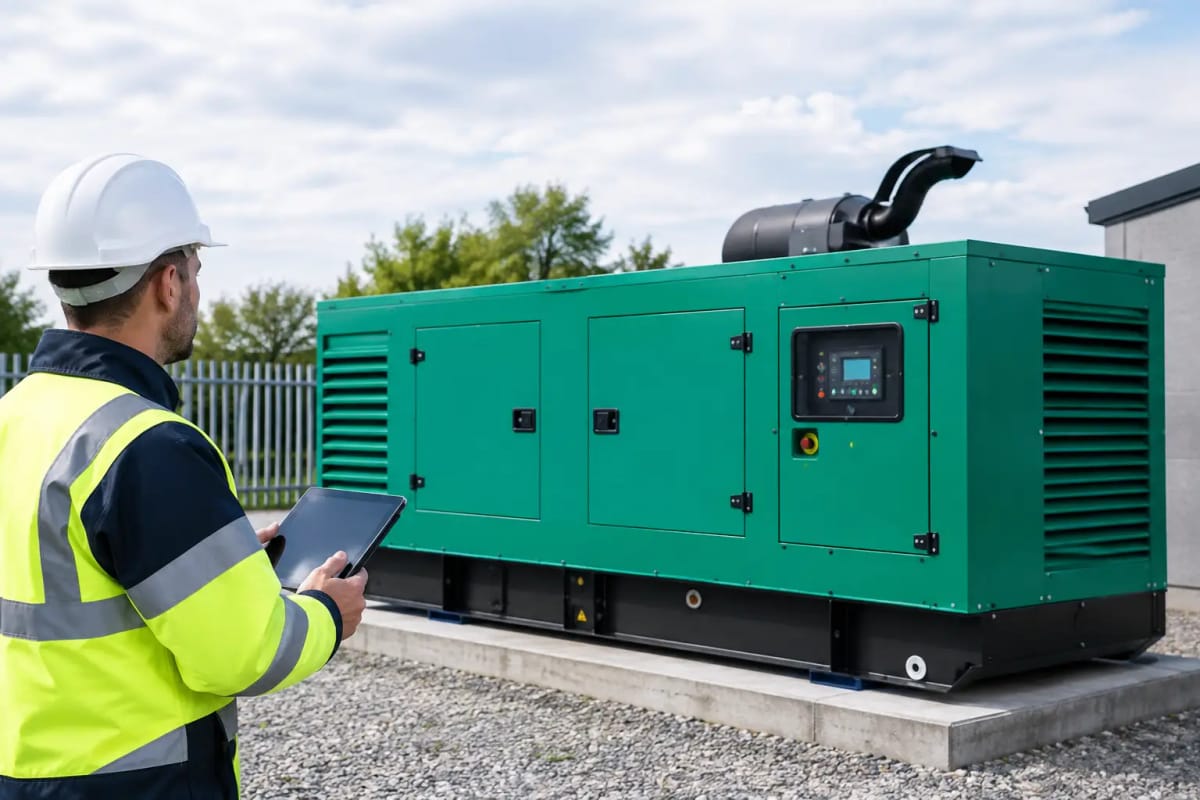
A diesel generator can protect a site from costly downtime, but it also creates an emissions obligation that must be addressed before delivery, installation and operation. This generator emissions compliance guide sets out the practical decisions UK facilities, contractors and procurement teams need to make when specifying standby or prime power equipment.
Compliance is not determined by the generator alone. Engine rating, annual running hours, fuel type, installation location, stack design, control strategy and local air quality all affect the route a project must take. A correctly sized, well-maintained set with an appropriate exhaust arrangement is easier to permit, operate and defend than a last-minute replacement selected only on kVA.
Start with the operating duty
The first question is whether the generator is genuinely standby equipment or will provide regular prime power. Standby sets support an intermittent load during a mains failure and normally run for limited hours. Prime-rated generators are designed for variable-load operation where utility power is unavailable or unreliable. This distinction affects the engine selection, fuel consumption, maintenance schedule and emissions profile.
Do not assume that low expected run hours remove all regulatory duties. A standby generator may still require assessment where it is located in an air quality management area, close to sensitive receptors such as housing, schools or hospitals, or forms part of a larger installation. Routine load testing also counts as operation and should be planned, recorded and controlled.
For purchasing purposes, establish the required electrical duty before discussing emissions controls. Confirm the site load, starting currents, voltage, frequency, phase arrangement, expected annual hours and whether the unit will run in parallel with the mains or other generators. An oversized generator that repeatedly operates at very low load can create inefficient combustion, wet stacking and unnecessary particulate emissions. An undersized set can overload, trip or fail to support critical equipment.
Understand the UK compliance framework
There is no single approval that covers every generator installation. The applicable requirements depend on the jurisdiction, plant capacity, use case and location. In England and Wales, controls for medium combustion plant and specified generators may be administered through environmental permitting arrangements, with the Environment Agency or local authority acting as the regulator depending on the installation.
The Medium Combustion Plant Directive framework is relevant to many combustion plants with a rated thermal input from 1 MWth up to 50 MWth. Generator sets can fall within this scope, particularly where multiple units are installed at one site. Separate requirements can apply to specified generators used for electricity production, including limits, registration or permitting obligations that vary according to the plant and its operating pattern.
Scotland and Northern Ireland operate under their own environmental regulatory regimes. Planning conditions, building control requirements, local authority air quality policies and site-specific environmental permits may add further controls across the UK. A project team should therefore confirm the regulatory position with the relevant authority or a competent environmental adviser before the generator is ordered or commissioned.
The practical point is simple: assess the installation, not just the individual set. Several smaller generators may be treated collectively where they share a site, stack, fuel supply or operating purpose. Splitting capacity across units is not a substitute for a proper compliance assessment.
Generator emissions compliance guide: the information regulators need
A regulator, planning authority or environmental consultant will need accurate technical data. Procurement teams should obtain this early, rather than attempting to reconstruct specifications once the set is on site.
The core information includes the generator’s standby and prime ratings, engine make and model, fuel type, rated thermal input, emissions certification, exhaust mass flow, exhaust temperature and expected operating hours. Also document the proposed stack height, stack exit location, building layout, nearby receptors and whether the set will be tested under load.
Where an emissions assessment is required, the consultant may model nitrogen oxides, particulate matter and other pollutants at nearby receptors. Stack height is often a critical variable. Discharging at roof level may not be sufficient if surrounding buildings create downwash, or if exhaust is close to air intakes, pedestrian areas or neighbouring properties. A taller stack can improve dispersion, but it must be designed for structural loading, back pressure, noise and safe maintenance access.
Engine emissions data must match the actual duty and fuel. Do not rely on a generic brochure figure where the project requires a permit submission or detailed dispersion model. Ask for the engine-specific data, applicable reference conditions and the basis on which any quoted emission value has been measured or certified.
Specify the right equipment and controls
For many standby applications, a modern diesel generator with a correctly designed exhaust system provides the required balance of resilience, running cost and compliance. However, the lowest purchase price is rarely the lowest project cost if the unit needs retrofit abatement, a revised stack or additional acoustic treatment after installation.
Engine selection should consider more than kVA. Cummins-powered generator sets, for example, are available across a broad range of standby and prime ratings, allowing duty, physical footprint and performance requirements to be aligned. The preferred engine and alternator combination must still be checked against the site’s emissions, fuel and operating-hour assumptions.
Exhaust after-treatment may be required or commercially sensible on constrained sites. Selective catalytic reduction can reduce nitrogen oxide emissions, while diesel particulate filters can reduce particulate emissions. These systems add capital cost, space requirements and maintenance obligations. SCR requires a managed supply of urea-based reagent, while filters need suitable exhaust temperatures and regeneration planning. They are effective tools, but they are not fit-and-forget additions.
Fuel quality also matters. Contaminated or degraded diesel can increase emissions, damage injectors and compromise reliability when the set is needed most. Establish fuel testing, polishing and replenishment procedures, particularly where large volumes are stored for extended standby periods.
Installation decisions that affect compliance
An enclosed silent generator may be appropriate where noise and weather protection are priorities, while an open set can suit a purpose-built plant room. Neither format is automatically compliant. The enclosure, ventilation louvres, exhaust routing and cooling-air discharge all need to work together without creating excessive heat, noise or recirculation.
Place the generator where maintenance teams can safely access filters, batteries, control panels and the exhaust system. Keep exhaust outlets away from fresh-air intakes, opening windows and areas where people regularly work. If the site contains hospitals, care settings, laboratories or food production, involve the facilities and health-and-safety teams early because a poorly located exhaust can create a wider operational risk.
For multi-set installations, decide how the control system will sequence generators. Load sharing can reduce unnecessary running and avoid operating a large set at inefficient low load. At the same time, resilience may require redundant capacity and routine exercise of every unit. The operating philosophy should record which sets run, when they run and under what conditions.
Commission, test and maintain with evidence
A generator that is compliant at handover can fall out of compliance through poor maintenance or undocumented changes. Keep a site file containing the technical specification, drawings, permitting correspondence, emissions information, commissioning records and maintenance history.
Routine exercise should be proportionate to the site risk and manufacturer recommendations. No-load tests confirm basic starting and control functions, but they do not prove that the generator will carry its required electrical load. Periodic on-load testing is necessary for critical systems, though it should be scheduled to limit local impact and avoid avoidable emissions. Where testing uses a load bank, record the date, duration, load applied, fuel consumed and any alarms or observations.
Maintenance should cover air filters, fuel filters, injectors, turbochargers, cooling systems, exhaust integrity and control settings. Watch for black smoke, unusual exhaust noise, rising fuel consumption, repeated alarms or a change in load acceptance. These can indicate combustion or mechanical issues that affect both reliability and emissions.
Any significant change should trigger a compliance review. Examples include increasing generator capacity, adding another set, changing from standby to regular operation, relocating the exhaust, altering fuel type or changing the surrounding building layout. The original permit or assessment may no longer reflect the installed plant.
Build compliance into the procurement programme
The most reliable route is to treat emissions as a design input, not a final approval task. Confirm duty, power requirement and local constraints first. Then select the generator, enclosure, exhaust and controls as one engineered package. This reduces redesign, protects programme dates and gives the site a clearer operating record from day one.
For mission-critical facilities, the objective is not simply to meet an emissions threshold on paper. It is to secure dependable power that can be tested, maintained and operated without creating avoidable environmental or planning risk. When the specification is based on real operating conditions, compliance and uptime reinforce each other rather than compete.