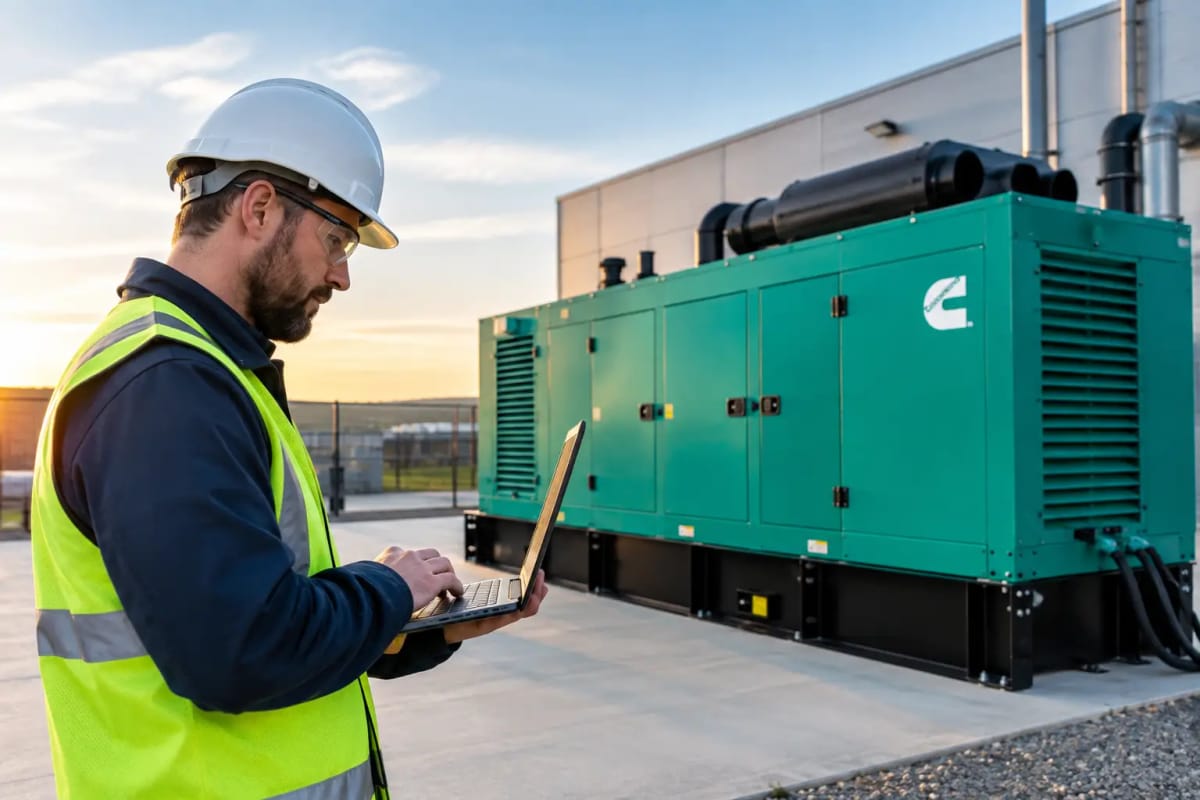
A generator can meet its kVA specification and still perform poorly if the site load is misunderstood. Optimising generator load profiles means matching the generator’s operating range to the way demand actually rises, falls and changes over time. For standby and prime power sites, this directly affects fuel consumption, engine condition, service intervals and, most importantly, confidence that power will be available when required.
The objective is not simply to select the largest available set. It is to specify a generator that carries the expected load efficiently, accepts transient demand without unacceptable voltage or frequency disturbance, and retains enough capacity for genuine operational growth.
What a generator load profile should show
A load profile records electrical demand across a defined period. On a critical facility, it should distinguish between normal running demand, peak demand, motor starting requirements and the loads that must remain live during an outage. A single maximum kW figure rarely provides enough information for a sound generator selection.
For most commercial and industrial applications, the assessment should establish four practical values: minimum demand, typical running demand, maximum coincident demand and the largest step load. It should also record the power factor, whether loads are single or three phase, and whether demand includes non-linear equipment such as variable speed drives, UPS systems, battery chargers or IT power supplies.
A manufacturing line may have a relatively stable base load but substantial motor starts. A logistics site may peak around conveyor operation and charging periods. A healthcare or telecoms installation may have a modest steady demand but strict limits on voltage dip during a transfer to generator power. These are different load profiles, even where the headline kVA requirement appears similar.
Measure real demand, not assumed demand
Site surveys and temporary power analysers provide a more reliable basis than equipment nameplates alone. Nameplate ratings are frequently added together, despite the fact that many items do not run simultaneously or operate at full output. Conversely, a seemingly small motor can create a significant starting demand if it is started direct-on-line.
Monitoring should cover representative operating conditions. For a 24-hour operation, this normally means several days or weeks rather than a single shift. Seasonal demand also matters. Cooling, heating, process plant and construction equipment may materially alter the profile at different times of year.
Why low-load running causes problems
Diesel generators are designed to work. Where a set runs for extended periods at very light load, combustion temperatures can remain too low for clean operation. This can lead to wet stacking, carbon deposits, cylinder glazing, increased oil consumption and exhaust contamination. The immediate symptoms may be black residue around the exhaust, unburnt fuel deposits or poor load response. The longer-term cost can be reduced engine life and avoidable maintenance work.
There is no universal minimum loading figure that applies to every engine and duty cycle. Manufacturer guidance, engine model, ambient conditions and operating hours all matter. As a general engineering principle, sustained low-load operation should be avoided, and the set should be periodically exercised at an appropriate load in line with the manufacturer’s instructions.
Oversizing is often the cause. A large standby generator may appear prudent, but if the essential load is only a small fraction of its rating, the set can spend its operating life outside an efficient working range. The correct approach is to separate essential and non-essential circuits, define what must run during an outage, then size capacity around that requirement and the expected starting duties.
Size for running load and transient performance
Generator sizing is a balance between continuous demand and the short-duration events that occur when equipment starts or changes state. A set must have sufficient engine power to sustain the load and sufficient alternator performance to manage the transient without excessive voltage dip.
Motor starting remains one of the most common reasons for incorrect selection. Direct-on-line starting can require several times a motor’s running current for a short period. Star-delta starters, soft starters and variable speed drives can reduce the starting impact, but each arrangement has different implications for harmonics, power factor and generator response.
The duty classification matters as well. A standby-rated generator is intended for emergency use during a mains failure, subject to the applicable rating conditions. A prime-rated generator is selected for variable load operation over extended hours, such as construction, remote operations or temporary utility support. Applying a standby rating to a continuous duty can create an expensive reliability issue, regardless of how accurately the kVA appears to match.
Allow a controlled margin
Capacity margin is necessary, but it should be justified. It may cover future expansion, degradation in high ambient temperatures, altitude effects, or planned additional plant. It should not be a substitute for understanding the load profile.
For example, a site with a 350 kW measured running demand may need considerably more than 350 kW of generating capacity if a major motor starts while other essential loads are connected. Equally, choosing a far larger set solely for a rare motor start may be unnecessary if the starting sequence can be controlled or the motor starter can be changed. Engineering controls can be more economical than excessive generator capacity.
Manage the sequence of loads after transfer
The period immediately after a mains failure is often the most demanding point in the profile. Automatic transfer switches can restore generator-backed circuits quickly, but connecting every circuit at once creates a substantial step load. A staged restoration strategy reduces the stress on the engine and alternator.
Priority loads should connect first. Life safety systems, critical controls, communications, server rooms, process protection and essential pumps may need immediate restoration. Less critical HVAC, compressors, electric heating and non-essential production equipment can be delayed until frequency and voltage have stabilised.
This approach also protects the generator from repeated overload events. A well-configured control system can use load shedding to disconnect non-essential circuits when demand exceeds an agreed threshold, then reconnect them in sequence once capacity is available. For facilities with variable demand, this is often more effective than buying capacity that is rarely required.
Consider load banks and parallel operation
A load bank is not only a commissioning tool. It gives standby generators a controlled means of proving performance and, where appropriate, operating at a meaningful load when site demand is too low. Regular testing under real site load remains valuable, but it may not reveal full-load cooling, exhaust or control issues if the building’s essential demand is limited.
Where demand varies widely, parallel generators can offer a more efficient solution than one large set. Sets can be brought online as demand increases and removed as demand falls, allowing each running unit to operate closer to its preferred load range. Parallel systems add capital cost, controls complexity, synchronisation requirements and a more demanding maintenance regime. They are most appropriate where resilience, scalability or prime power efficiency justifies that investment.
Account for power quality and non-linear loads
Modern sites increasingly contain UPS systems, switch-mode power supplies, variable speed drives and electronic controls. These can introduce harmonic currents that heat alternator windings and affect voltage waveform quality. A generator selected only on kVA may therefore be inadequate for the actual electrical environment.
The specification should identify harmonic content, expected power factor and the behaviour of UPS rectifiers during recharge following an outage. Alternator sizing, reactance, control settings and the compatibility of the generator with the intended UPS or drive equipment should be reviewed before procurement. This is particularly relevant in data, healthcare, telecoms and automated manufacturing applications, where a poor power-quality decision can affect systems that have little tolerance for disturbance.
Turn operating data into a maintenance plan
Load optimisation continues after installation. Generator controllers and building management systems can record kW, kVA, power factor, frequency, run hours, alarms and peak demand. Reviewing this information after monthly tests and real outages identifies whether the set is routinely underloaded, approaching its operating limit or experiencing repeated step-load events.
Maintenance teams should investigate changes rather than treat them as background data. A falling power factor, rising harmonic distortion, unusually light exercise load or frequent load-shed events can indicate that the site has changed since the generator was specified. New plant, altered operating hours or added IT equipment may require control adjustments, a revised test programme or additional capacity.
For a new installation or replacement project, provide measured demand data, motor schedules, essential-load priorities and the intended duty cycle at the enquiry stage. Global Generators can then match the generator rating, engine, alternator, enclosure and control arrangement to the site’s real operating profile - not an assumed maximum. The right set is the one that starts cleanly, carries the required load confidently and remains ready for the next interruption.