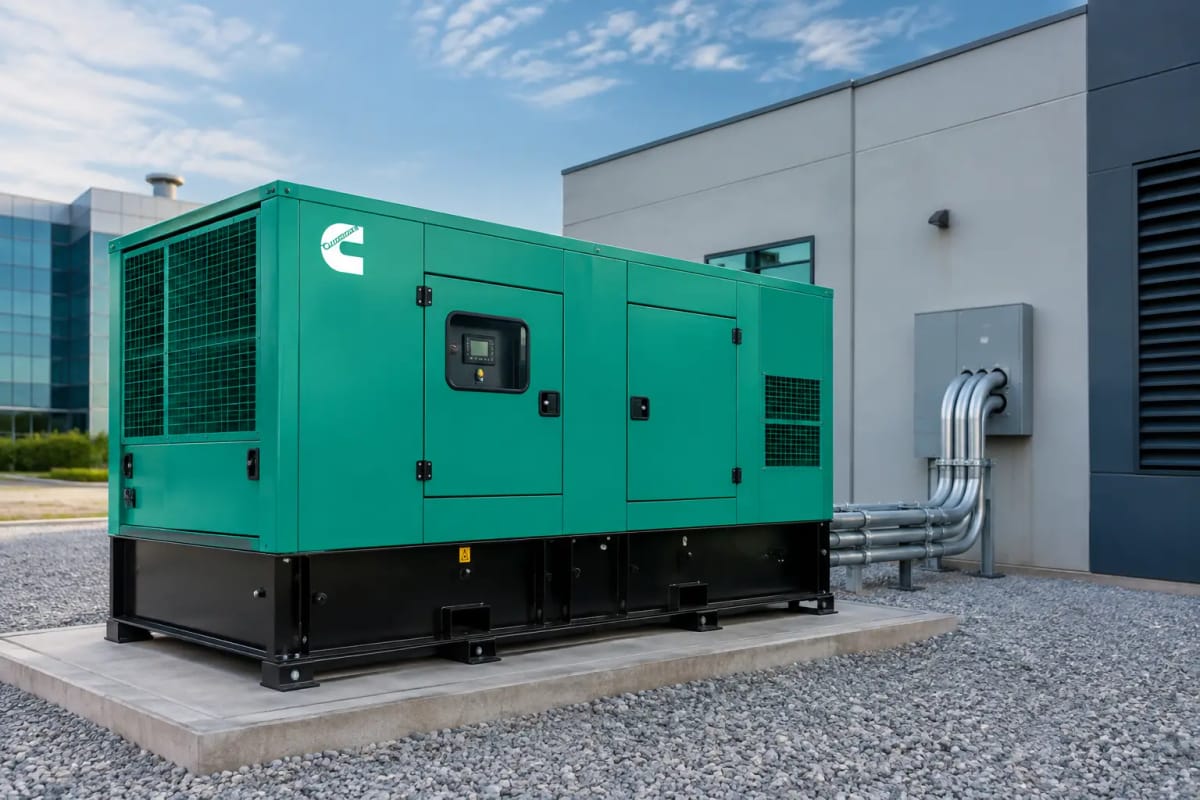
A generator that starts during a mains failure is not automatically suitable for running a site for days, weeks or around the clock. Continuous generator operation places sustained demands on the engine, alternator, cooling system, fuel supply and maintenance regime. For facilities where utility power is unavailable, unstable or deliberately bypassed, the generator must be selected as a working asset, not simply an emergency safeguard.
This distinction matters on construction compounds, remote pumping stations, telecoms sites, manufacturing lines, temporary healthcare facilities and logistics operations. An incorrectly rated set may perform well during initial testing yet suffer excess wear, overheating, poor fuel economy or unplanned shutdown when held under load for extended periods.
Continuous generator operation starts with the correct rating
The first specification question is whether the set will operate on standby, prime or continuous duty. These terms are often used loosely, but they have direct implications for equipment selection and permissible loading.
Standby power is intended for use during a utility outage. It commonly permits higher output for limited emergency periods and should not be treated as an unrestricted 24-hour operating rating. A standby-rated generator can be the right solution for a well-supported commercial building, but it is rarely the correct basis for a site expected to generate for long periods.
Prime power is generally appropriate where the generator is the main source of electricity and load varies over time. It allows extended operation, subject to the manufacturer’s stated duty conditions and maintenance requirements. Many off-grid industrial and commercial installations fall into this category.
Continuous power is for constant, sustained output under defined conditions. It suits applications with a stable base load, such as certain utility, process and remote infrastructure duties. The available rating is normally lower than a comparable standby figure because the engine is expected to carry that load without regular relief.
The rating plate, data sheet and engine manufacturer guidance must govern the decision. Do not size a generator using its headline standby kVA if the operating plan requires permanent or near-permanent generation.
Establish the real load profile
A site’s total connected load is not its actual generator load. Motors, compressors, pumps, heaters, variable-speed drives, battery chargers and non-linear electronic loads all behave differently. The correct capacity calculation needs both the running demand and the starting or transient demand.
For continuous operation, a generator should normally work within a sensible operating band rather than at either extreme. Sustained low loading can lead to incomplete combustion, cylinder glazing, carbon build-up and wet stacking in diesel engines. Sustained operation near maximum output leaves little allowance for ambient temperature, equipment ageing, step loads or a new circuit being added later.
A practical assessment should establish the expected minimum, normal and peak demand over a full operating cycle. It should also identify large motor starts and whether they occur while other major loads are already online. Soft starters, variable-speed drives and staged loading can reduce starting demand, but they may introduce harmonics that require alternator and control-system consideration.
Power factor also matters. Generator sets are commonly rated in kVA, while site equipment may be described in kW. A poor or changing power factor affects the usable capacity of the set. Procurement teams should provide the load schedule to the generator supplier rather than relying on an estimate based solely on the previous mains supply.
Allow for future load without excessive oversizing
Capacity headroom is necessary, but indiscriminate oversizing creates its own operating problem. A 500 kVA set continuously supplying a 60 kVA load is unlikely to be an efficient or healthy long-term arrangement. Where demand varies significantly, options may include a smaller lead generator with a larger set for peak periods, or multiple synchronised sets that can be brought online as demand rises.
The right approach depends on duty pattern, fuel availability, criticality and the cost of downtime. A simple single-set design can be appropriate for stable loads. For high-consequence sites, redundancy and load-sharing may justify the additional capital cost.
Fuel resilience is part of the generating system
A diesel generator is only as dependable as its fuel supply. Continuous running turns fuel from a procurement detail into an operational control. Consumption changes materially with load, so tank size should be based on anticipated duty, not a nominal litres-per-hour figure taken at an unsuitable load point.
The required autonomy period should reflect the site’s risk profile. Some installations need enough fuel for a working shift; others require several days of independent operation while fuel deliveries are disrupted. Tank capacity, bunding, transfer pumps, filtration, day tanks and delivery access must all be considered during design.
Fuel quality requires equal attention. Water ingress, microbial growth and sediment can block filters and damage injection components. This risk increases where fuel is stored for long periods or where tanks experience wide temperature changes. Planned testing, tank housekeeping and fuel polishing where appropriate are prudent controls for critical installations.
For remote or high-load sites, ensure a fuel delivery vehicle can reach the tank safely during poor weather, restricted access or normal site activity. There is little value in specifying 72 hours of autonomy if the refuelling arrangement cannot support the generator’s actual consumption.
Cooling, ventilation and enclosure design cannot be secondary
A generator can be correctly sized electrically and still fail because its installation cannot reject heat. The radiator needs a clean airflow path, and the enclosure or generator room needs sufficient ventilation to prevent recirculation of hot discharge air. High ambient temperatures reduce available performance and increase stress on the cooling system.
Silent canopy generators are often preferred where noise control, weather protection and security are required. However, the acoustic enclosure must be installed with the manufacturer’s clearance requirements intact. Restricting inlet or outlet airflow to solve a noise or security issue can create a more serious reliability problem.
Open generators can be suitable in plant rooms or purpose-built enclosures, provided ventilation, exhaust routing, fire protection and access for servicing are properly engineered. Exhaust systems must be sized to control back pressure, and personnel must be protected from hot surfaces and exhaust gases.
Altitude, ambient temperature and humidity should be declared at the enquiry stage. These conditions can affect engine and alternator output. A set that appears adequate at standard reference conditions may need derating on a hot, elevated or poorly ventilated site.
Maintenance must follow running hours, not the calendar
A generator operating continuously accumulates service hours quickly. Oil, filters and inspections must be scheduled around the engine manufacturer’s running-hour intervals. Waiting for an annual service date is not an acceptable strategy for a set operating hundreds of hours each month.
Operators should record daily running hours, load, fuel use, oil pressure, coolant temperature, battery condition and alarm events. These records reveal changes before they become failures. Rising coolant temperature, increasing fuel consumption or repeated low-load operation are operational signals that require investigation.
A suitable maintenance plan should include regular checks of belts, hoses, battery charging, air intake restriction, coolant condition and fuel filters. Planned shutdowns should also be agreed in advance where the application permits them. If the site cannot tolerate a maintenance outage, the system may require a second generator, bypass capability or temporary generation cover.
Control systems protect uptime, but they need commissioning
Modern generator controllers provide alarm monitoring, automatic start functions, remote communications and protective shutdowns. For continuous duty, these functions must be commissioned against the actual site operating philosophy. A low-fuel alarm is useful, but its value depends on the alert level, response ownership and fuel delivery process that follows.
Automatic transfer switches, synchronising panels and load-sharing controls should be tested under realistic conditions. Testing should include load acceptance, loss of a generating set where redundancy is installed, return-to-mains behaviour and alarm escalation. A no-load start test confirms that the engine starts. It does not prove that the site can carry its critical load.
Before placing a continuous-duty installation into service, confirm the following:
- The selected prime or continuous rating matches the expected operating duty.
- Load studies account for motor starting, harmonics and future demand.
- Fuel storage and delivery arrangements meet the required autonomy period.
- Ventilation, exhaust routing and clearances meet the installation specification.
- Service intervals, spares holdings and response responsibilities are documented.
Specify for the duty you actually have
Continuous generator operation is a system responsibility. Generator size, duty rating, fuel infrastructure, environmental conditions, controls and maintenance must work together. Focusing only on the purchase price or highest available kVA figure can create costly operating risk later.
Global Generators supplies diesel generator sets across a broad kVA range for standby, prime and demanding operational duties. For critical sites, the most useful starting point is a clear load profile and an honest assessment of how long the set must run without interruption. That information allows the generator, configuration and supporting infrastructure to be specified for dependable service rather than hopeful operation.