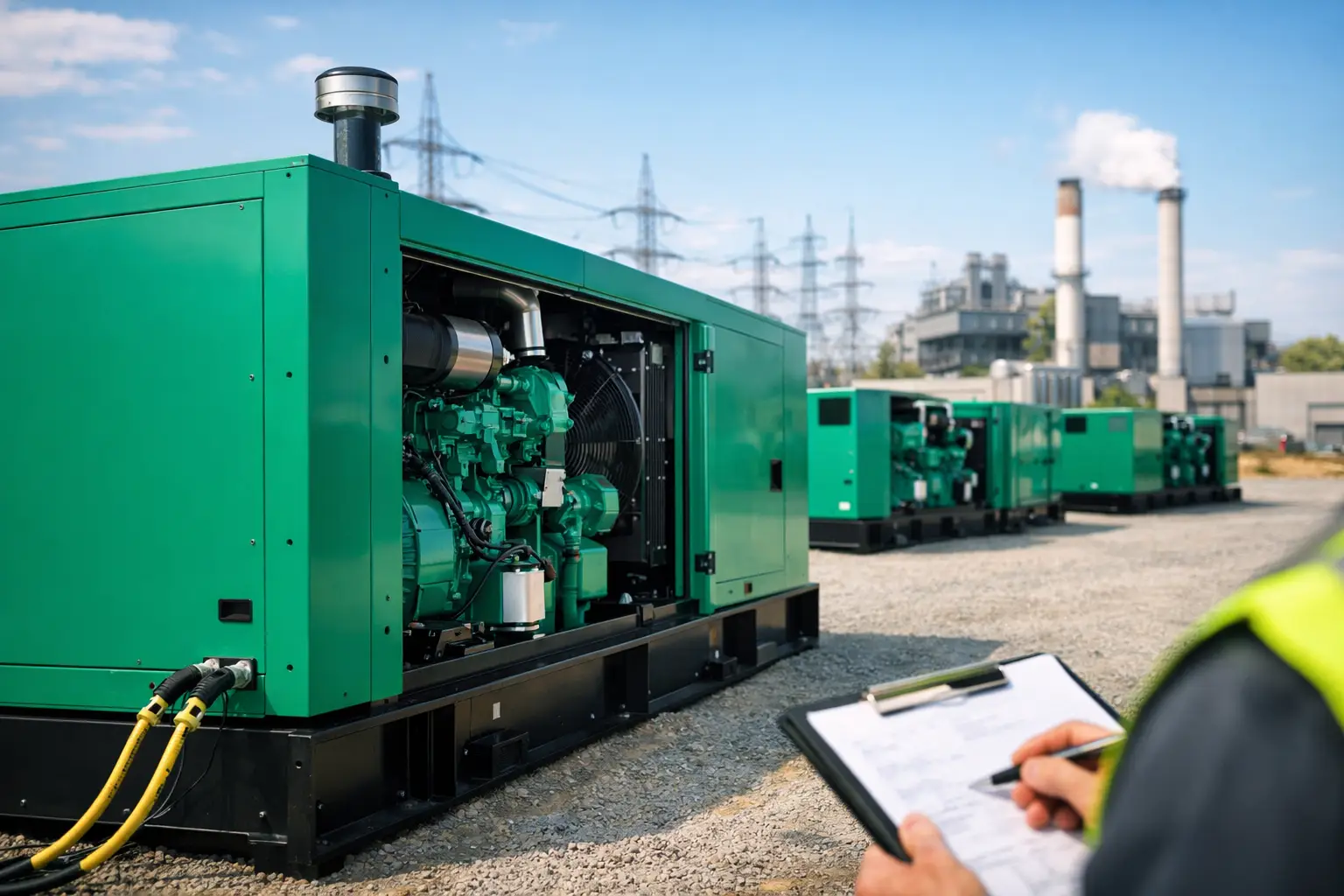
A generator that looks right on paper can still be wrong for the job if the kVA rating is misunderstood. If you are asking what is kVA, you are really asking how generator capacity is measured, how much load a set can carry, and whether it will support your site reliably under real operating conditions.
For commercial and industrial buyers, that question is not academic. A generator that is undersized may struggle at start-up, trip under load, or run under sustained stress. A set that is oversized can increase capital cost, affect loading performance, and complicate project planning. kVA sits at the centre of that decision.
What is kVA?
kVA stands for kilovolt-amps. It is a unit of apparent power and is widely used to define the electrical output capacity of generators, transformers and UPS systems.
In practical terms, kVA tells you the total power available from a generator before allowing for power factor. That is why generator sets are commonly marketed by kVA rating. It gives a consistent basis for equipment classification across different applications and load types.
A simple way to read it is this: the higher the kVA rating, the greater the generator's overall load carrying capacity. A 100 kVA generator can support a larger electrical demand than a 60 kVA generator, provided the connected load and site conditions are suitable.
Why kVA is used instead of kW
This is where many buying decisions become confused. kW measures real power - the power that actually performs useful work. Motors turning, pumps running, lighting operating and plant equipment producing output are all using real power.
kVA measures apparent power - the combination of real power and reactive power in the electrical system. Reactive power is common in equipment with inductive loads such as motors, compressors and HVAC systems. It does not produce useful output directly, but it still has to be supplied by the generator.
Because generators often serve mixed loads, the kVA figure provides the broader capacity measure. It reflects what the alternator must deliver to support the full electrical demand, not just the useful work portion.
For this reason, kVA is the standard reference point when comparing generator sizes. It is especially relevant in industrial and site power applications where load composition is rarely purely resistive.
The relationship between kVA, kW and power factor
To understand what is kVA in practical specification terms, you need to understand power factor.
Power factor is the ratio between real power and apparent power. In generator sizing, the standard assumed power factor is often 0.8 for three-phase applications.
The basic formula is:
kW = kVA x power factor
So if a generator is rated at 100 kVA with a power factor of 0.8, its real power output is 80 kW.
This matters because two sites with the same kW demand may not require the same generator capacity in kVA. If one site has a poorer power factor due to motor-heavy loads, the generator may need a higher kVA rating to support it properly.
That is why relying on kW alone can lead to under-specification. In many installations, especially those with high motor starting currents or reactive loads, apparent power is the more useful starting point.
What is kVA in generator sizing decisions?
In generator procurement, kVA is the headline figure used to segment product ranges and shortlist suitable sets. It helps buyers identify whether a unit is appropriate for standby duty, prime power, or continuous operation within a given load profile.
However, the rated kVA is not the only number that matters. You also need to consider whether that rating refers to standby power or prime power. A standby-rated generator is designed for emergency use during mains failure and usually permits a higher maximum output for limited hours. A prime-rated generator is intended for longer and more regular operation where utility power is unavailable or unreliable.
This distinction affects how the kVA figure should be interpreted. A 200 kVA standby generator is not the same proposition as a 200 kVA prime-rated set in terms of operating duty and permissible load profile.
Ambient conditions also affect usable output. High altitude, elevated temperature and poor ventilation can reduce performance. On a tightly engineered site, those derating factors need to be considered early, not after the order is placed.
Why the wrong kVA causes problems
An undersized generator often fails long before it fails completely. It may start and run, but voltage stability can suffer, frequency can dip under load acceptance, and motor starting can become unreliable. Sensitive equipment may trip. Protective devices may operate more often than expected. Fuel consumption may increase because the set is being pushed harder than it should be.
Oversizing is not automatically safer. A set running consistently at very light load can present its own issues, particularly on diesel generators. Poor loading can affect combustion efficiency and long-term engine condition. It can also mean spending more than necessary on capital equipment, transport, installation and ancillary components.
The correct kVA selection is therefore a balance. You need enough capacity for present demand, start-up characteristics and sensible future headroom, but not so much excess that the installation becomes inefficient or commercially weak.
How to work out the right kVA requirement
The starting point is the site load, but not just the nameplate total. Real generator sizing requires a proper view of how the load behaves.
First, establish the total running load in kW and identify whether the load is single phase or three phase. Then review the power factor of the connected equipment, especially where motors, pumps, refrigeration systems or compressors are involved. After that, consider start-up current. Some loads draw significantly more power at start than during normal running, and that short-duration demand can dictate the generator size.
Load sequencing also matters. If all major loads start together, the required kVA may be materially higher than on a site where loads are staggered through automatic controls.
You should also account for operating duty. A hospital backup set, a telecom resilience installation, and a prime power generator for a remote industrial site may all have similar running loads but different sizing priorities because the duty profile and consequence of failure are different.
For that reason, the right answer to what is kVA is not just a textbook definition. In practice, it is the framework used to match generator output to real site demand.
What is kVA for single-phase and three-phase generators?
The term is used across both single-phase and three-phase generator ranges, but the application differs.
Single-phase generators are generally used for smaller loads or where the site supply arrangement requires them. Three-phase generators are more common in commercial and industrial settings because they support larger and more complex equipment loads efficiently.
When comparing units, the kVA rating helps classify capacity, but phase configuration still matters. A generator with the correct kVA but the wrong phase arrangement is not correctly specified. Likewise, load balance across phases is critical on three-phase installations. Poor phase balance can impair performance even where the headline kVA appears adequate.
Why buyers should treat kVA as a specification tool, not a sales label
Many generator listings are arranged by kVA band because it is the fastest way to navigate a broad product range. That is useful, but serious buyers should not stop there.
The kVA figure needs to be read alongside engine brand, alternator quality, standby or prime rating, voltage, enclosure type, fuel tank arrangement, acoustic requirements and control system capability. On mission-critical sites, those details are often as important as the top-line capacity number.
A 500 kVA open set for a plant room application is a different commercial and operational fit from a 500 kVA silent generator intended for a noise-sensitive site. The same applies to export projects, temporary power packages and installations with strict access constraints.
This is where a consultative approach matters. Suppliers such as Global Generators structure ranges by kVA because buyers need quick visibility, but correct specification still depends on duty, load type and site conditions.
Common misunderstanding around kVA
A frequent mistake is to assume that kVA is simply another way of saying kW. It is not. The two are related, but they are not interchangeable.
Another mistake is to treat the generator nameplate rating as fully usable in every environment and for every load type. It depends on power factor, duty rating, transient performance and installation conditions.
There is also a tendency to add up equipment ratings without considering diversity. Some loads do not run continuously, others cycle, and some start only occasionally. Equally, some sites expand quickly, so zero headroom can be just as risky as excessive oversizing. Sound specification sits between those extremes.
If you are evaluating generator capacity, kVA should be the first number you understand and not the last question you ask. The most reliable power solution is rarely chosen by headline rating alone. It comes from matching kVA, duty, load characteristics and site realities with enough precision to protect uptime when the mains supply is no longer there.