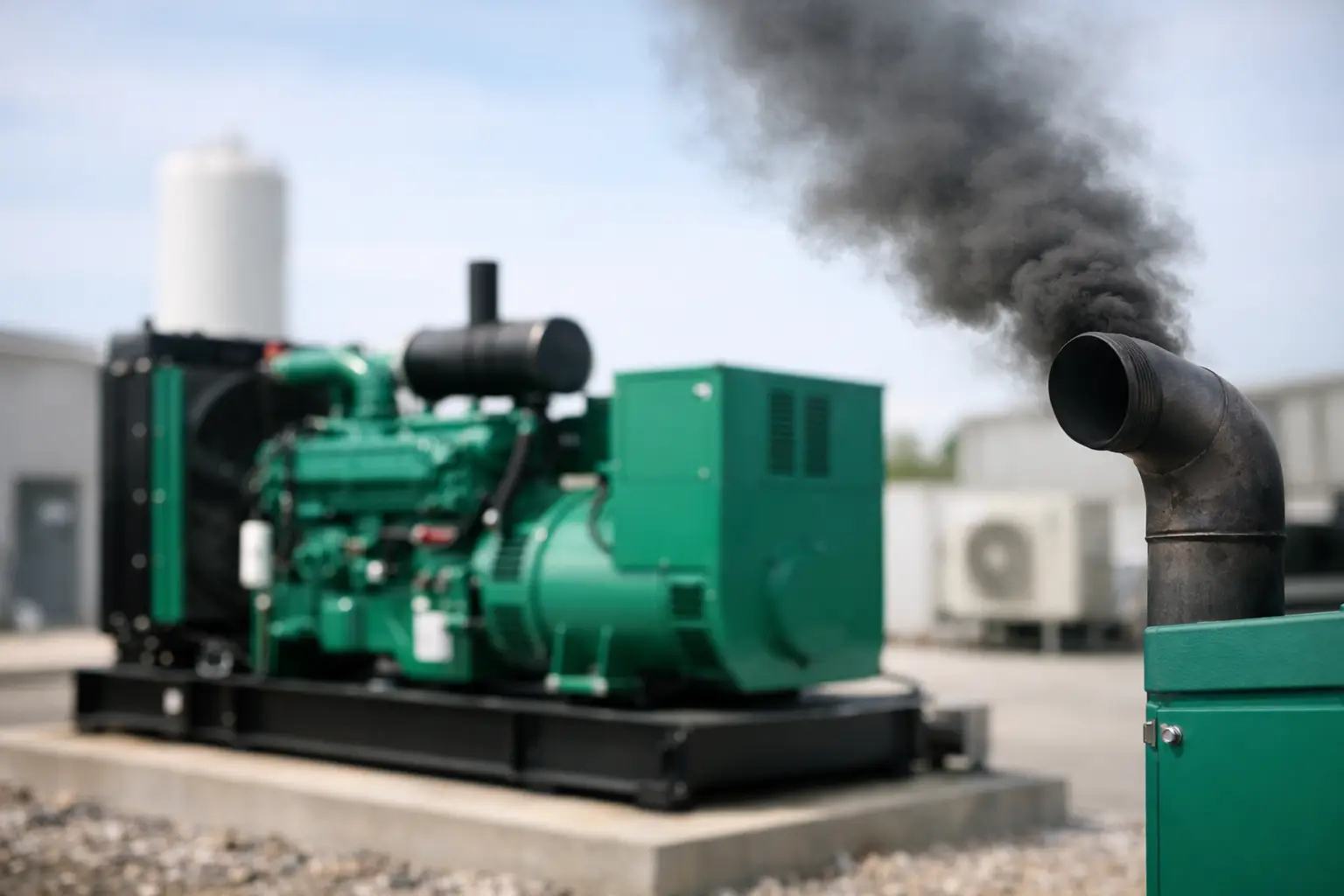
A standby generator that starts reliably but spends most of its running time below its intended load can develop a costly problem that is often missed during routine checks. To prevent diesel generator wet stacking, operators must manage loading, exercise the set properly and ensure the generator has been specified for the actual site demand rather than an assumed worst case.
Wet stacking is not simply an exhaust issue. It is evidence that the engine is not reaching the operating conditions needed to burn fuel efficiently. Left unresolved, it can affect fuel consumption, emissions, service intervals and, ultimately, the dependability of the power system when it is needed most.
What diesel generator wet stacking looks like
Wet stacking occurs when a diesel engine runs too lightly loaded for prolonged periods. Cylinder temperatures remain too low for complete combustion, allowing unburnt fuel, soot, carbon and oil residues to pass through the engine and exhaust system. The term comes from the dark, wet residue that may appear around the exhaust outlet.
Other signs can include black smoke, carbon deposits in the exhaust, rising lubricating oil levels, poor response to load changes and increased fuel consumption. In enclosed sets, residue may also become apparent around the silencer or within parts of the exhaust path. These signs should not be treated as cosmetic. They warrant investigation before the generator is relied upon for an extended outage.
The risk is highest where a large standby generator supports a relatively small permanent load, or where a set is routinely run during weekly checks with little or no building load connected. It can also occur on prime power installations where site demand varies sharply and the generator spends long periods idling or operating at a low percentage of its rated output.
Why low-load running damages reliability
Diesel engines are designed to work. At a suitable load, combustion temperatures and cylinder pressures support efficient fuel burn, clean exhaust flow and proper seating of piston rings. At insufficient load, those conditions deteriorate.
Over time, carbon can accumulate on injectors, valves, pistons and turbocharger components. Cylinder bore glazing may develop, making it harder for piston rings to seal correctly. Fuel dilution of lubricating oil can reduce its protective qualities, increasing wear across internal engine parts. Exhaust systems can also become fouled, while after-treatment equipment on newer emissions-compliant engines may be affected by unsuitable operating conditions.
The commercial consequence is clear. A generator may pass a brief no-load test yet perform poorly when a genuine mains failure demands sustained output. Corrective work can range from controlled loading and servicing to component replacement, depending on how long the condition has been allowed to continue.
Prevent diesel generator wet stacking through correct sizing
The most effective control begins before purchase. Generator capacity should be based on a measured load assessment, not just the largest theoretical connected load. Facilities with a 1,000 kVA generator and a normal emergency demand of 100 kVA will face a different operating challenge from a site where the same set carries 600 kVA during an outage.
Assess the essential load, starting currents, motor loads, power factor, load sequence and any planned expansion. The required rating must also match the intended duty. Standby power and prime power ratings are not interchangeable: a set used for occasional emergency operation can be specified differently from one expected to carry variable loads for extended periods.
Avoid oversizing purely for comfort. Extra capacity can be necessary where large motors, pumps, compressors or future phases must be supported, but it needs to be justified. An oversized set costs more to buy, occupies more space and is more likely to operate inefficiently at low load.
For sites with a widely fluctuating demand, consider whether staged generation is more suitable. Two smaller generator sets operating in parallel may provide better load matching, operational resilience and maintenance flexibility than one large set. This arrangement is not always the lowest-cost option, as it requires suitable controls, switchgear and commissioning, but it can be the right engineering decision for variable critical loads.
Establish a realistic minimum operating load
There is no single loading figure that applies to every diesel generator. Engine design, emissions equipment, duty cycle and manufacturer guidance all matter. As a working principle, diesel sets should not be allowed to run for extended periods at very low load. Many applications aim for a minimum operating load around 30 per cent of rated capacity, subject to the engine manufacturer's requirements.
The key is duration as well as percentage. A brief period below the preferred level during load transitions is normally different from weeks of lightly loaded testing or overnight operation. Record actual running load during tests and outages so that decisions are based on evidence rather than assumptions.
Use load banks as part of the maintenance plan
A load bank provides a controlled electrical load, allowing the generator to run at a meaningful percentage of its rating when the site cannot provide enough demand. This is particularly valuable for standby sets in healthcare, telecoms, logistics and commercial facilities, where routine test runs may otherwise be almost unloaded.
A planned load-bank test raises engine temperature, confirms the alternator and cooling system can support output, and helps burn off accumulated deposits. It also tests the generator in conditions closer to a real outage. The test should be carried out by competent personnel, with appropriate ventilation, fuel availability, exhaust arrangements and monitoring in place.
Testing frequency and load level should follow the engine and generator manufacturer recommendations, site risk assessment and maintenance contract requirements. A common mistake is treating a short monthly start test as proof of readiness. Starting is only one part of generator performance. The set must also accept, sustain and recover from the loads it has been purchased to protect.
Where the generator supplies life-safety or mission-critical systems, load-bank testing should be coordinated with transfer switch operation and site procedures. A test that bypasses the normal control sequence may confirm engine output but fail to reveal a problem with automatic transfer, protection settings or load acceptance.
Maintain the engine for its real duty cycle
Maintenance intervals should reflect both running hours and operating pattern. A low-hour standby generator is not automatically low risk if those hours have been spent at light load. Service teams should inspect exhaust condition, lubricating oil quality, air intake components, fuel filters, injectors and turbocharger condition as part of diagnosis.
Oil analysis can be useful where fuel dilution or excessive soot is suspected. It gives maintenance teams a clearer basis for deciding whether an oil change alone is sufficient or whether further investigation is needed. Do not assume that adding fresh oil corrects the cause. Unless the low-load operating pattern changes, the condition is likely to return.
Fuel quality also matters. Water contamination, ageing fuel and blocked filters can compound poor combustion symptoms, although they are separate faults. Maintain fuel storage, carry out regular checks and ensure the day tank, transfer system and filters are suitable for the generator's duty and expected runtime.
Check controls, not just the engine
Automatic controls can unintentionally encourage low-load running. Review programmed exercise schedules, remote start signals and load-shedding arrangements. A generator that starts whenever a non-critical demand appears may run for long periods with negligible site load.
Where practical, configure the system so that exercise runs transfer an appropriate load or use a load bank. For parallel systems, review generator sequencing so that unnecessary sets are not brought online too early. Good control logic should protect redundancy without leaving multiple engines sharing an insignificant load.
Act early when symptoms appear
If wet exhaust residue, smoke or fouling is identified, first confirm the generator is not being overloaded, undercooled or affected by a fuel-system fault. Then review recorded load data and maintenance history. A controlled period at the manufacturer-approved load may help clear light deposits, but severe symptoms should be assessed by a qualified generator engineer before the set is returned to critical duty.
For new installations, the practical decision is often made at specification stage: match the kVA rating, standby or prime duty, enclosure format and control system to the site's genuine operating profile. Global Generators can assist buyers in assessing available generator configurations against required load and uptime objectives. A correctly specified set, regularly exercised under meaningful load, is the most dependable way to keep wet stacking from becoming an avoidable outage risk.