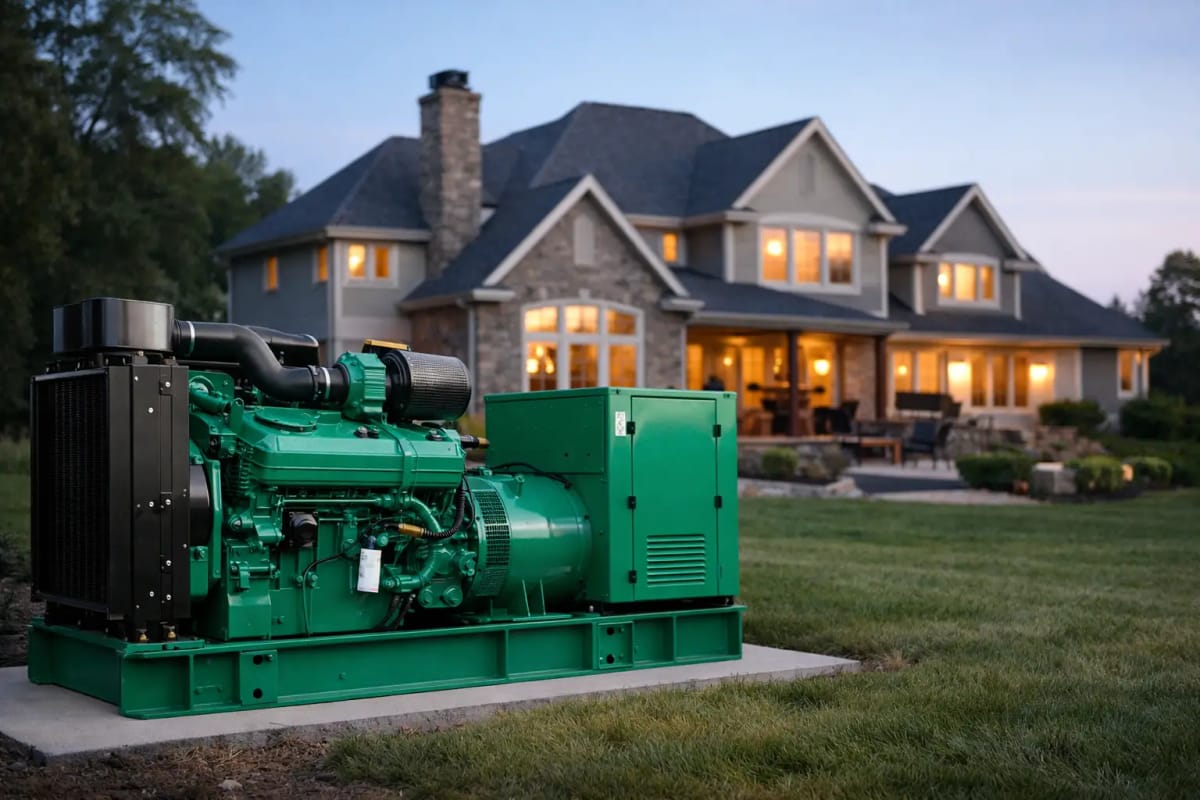
When a large house loses power, the problem is rarely limited to lighting. Heating systems, borehole pumps, gates, lifts, security, refrigeration, home offices and plant rooms can all go down at once. That is why choosing The best Diesel generator for a large house is not simply a question of buying the biggest set available. It is a specification exercise based on load profile, starting currents, site constraints and the level of resilience required.
For larger residential properties, diesel remains a serious backup power option because it offers strong load handling, dependable standby performance and long service life when correctly specified. It is especially relevant where the property has three-phase services, extensive mechanical and electrical systems, or a requirement to maintain comfort and security through prolonged outages.
What actually makes the best Diesel generator for a large house?
The right generator is the one that starts, carries the full essential load without instability, and integrates properly with the property. In practice, that means the best unit is not defined by brand name alone. It is defined by whether the set has enough standby capacity, the correct voltage and phase, suitable acoustic control, and the right switching arrangement.
A large house can mean very different things in generator terms. One property may need backup only for lighting, refrigeration, alarm systems and a few comfort loads. Another may need to support air conditioning, electric gates, pool plant, sewage pumps, catering equipment, EV charging management and full-house continuity. Those are completely different generator selections.
That is why oversimplified buying advice tends to be expensive. If the generator is too small, motor starting can drag voltage down and trip equipment. If it is significantly oversized, you can end up with higher capital cost, poor load factor and unnecessary fuel consumption. The best result comes from matching the set to the real duty.
Start with load sizing, not product browsing
The first step is to establish what the house must run during a mains failure. For most large domestic properties, there is a difference between whole-house backup and essential-load backup. Whole-house backup is more convenient, but it usually drives a larger capital cost and may require a higher-rated automatic transfer arrangement. Essential-load backup is often more efficient because it prioritises critical circuits and excludes discretionary loads.
Load assessment should include both running load and starting load. This matters because many residential systems contain motors or compressors that draw a high inrush current at start-up. Air source or ground source heat pumps, borehole pumps, sewage pumps, refrigeration compressors and workshop equipment can all affect sizing. A generator that looks adequate on paper at running load can still perform poorly when several items start together.
For that reason, experienced buyers look at kVA, not just kW, and consider power factor, motor starting characteristics and load step acceptance. In many large-house applications, the practical selection lands somewhere above the level expected for an average home because the property behaves more like a small commercial site.
Typical generator size for a large house
There is no single answer, but many large residential standby applications sit broadly in the 30 to 100 kVA range. At the lower end, this may cover a carefully managed essential load strategy. At the upper end, it can support substantial whole-property continuity, particularly where three-phase plant is present.
A house with electric cooking, significant HVAC demand, pumping systems and outbuildings may push the requirement further. If there is a stable, coordinated load management plan, the selected set can sometimes be smaller than the connected load suggests. If the owner expects every service to operate exactly as normal during an outage, the rating usually needs to be higher.
Standby rating is the key category for most large houses. Prime power specification is generally unnecessary unless the generator is expected to run for extended periods as a routine source of power rather than as emergency backup.
Single phase or three phase?
This is one of the most common specification errors in residential backup projects. Some large houses are supplied with single-phase power and can use a single-phase generator. Others, particularly higher-value properties with substantial plant, lifts, workshops or larger HVAC systems, have a three-phase incoming supply and must be matched accordingly.
If the house has three-phase loads, a three-phase generator is normally required. Even where most of the final circuits are single phase, the distribution across phases must be considered. Poor phase balancing can cause performance issues and reduce the practical usability of the set.
This is also where proper load segregation matters. A well-designed transfer scheme can separate critical and non-critical circuits, improve phase balance and avoid paying for capacity that is never genuinely required.
Why diesel is often the correct choice
For large-house standby duty, diesel offers several operational advantages. It provides strong response to sudden load changes, handles motor starting well when correctly sized, and is widely recognised for dependable standby performance. It is also well suited to larger outputs where petrol units are no longer appropriate.
Fuel storage and refuelling strategy still need attention. If the property is remote or vulnerable to long outages, tank capacity becomes part of the resilience plan. Runtime expectations should be clear from the outset. An owner expecting 8 hours of autonomy needs a different fuel arrangement from one expecting 48 hours or more.
Noise is the main trade-off in residential settings, but that is manageable with the correct enclosure and installation design.
Silent or open generator for a residential setting
For a large house, a silent diesel generator is usually the practical choice. Acoustic enclosures reduce noise significantly and make planning, neighbour impact and day-to-day acceptability easier to manage. In most domestic environments, an open set is only suitable if it is being installed inside a properly designed plant room with its own acoustic treatment, ventilation and exhaust arrangement.
The enclosure should not be treated as a cosmetic extra. It is part of the operating specification. If the generator is close to bedrooms, garden areas, neighbouring properties or outdoor entertaining spaces, acoustic performance matters. A lower-cost set with poor noise control can become an ongoing problem even if its electrical specification is acceptable.
Automatic transfer is not optional for true standby protection
If the generator is there to protect a large house during a mains failure, it should normally be paired with an automatic transfer switch. Manual changeover may reduce initial cost, but it introduces delay, user dependency and avoidable risk. For houses with security systems, critical refrigeration, medical equipment, server rooms or managed plant systems, automatic transfer is the correct standard.
The control system should also be suitable for the application. Remote monitoring, alarm indication and straightforward maintenance access all add value in practice. Backup power only protects the property if the set starts and transfers correctly when required.
Installation constraints can change the best option
The best diesel generator on paper can become the wrong choice once site conditions are considered. Access for delivery and cranage, exhaust routing, ventilation, fuel storage position, distance from habitable spaces and planning constraints all influence what can be installed safely and effectively.
Physical footprint matters on larger estates as much as smaller ones. A property may have the electrical demand for a larger set but limited space in the preferred location. Equally, long cable runs between the generator and the main distribution board can add cost and complexity.
Environmental conditions matter too. If the generator is being installed in a coastal setting, an exposed rural location or an area with difficult winter access, enclosure quality and maintenance planning become more important.
Brand and engine quality still matter
Once the sizing and installation brief are correct, the quality of the generating set becomes the next priority. Proven engine platforms, clear standby ratings and dependable alternator and controller combinations are what serious buyers should focus on. For high-value residential backup, reliability matters more than headline price.
Cummins-powered units remain a strong option in this market because they are well established, trusted in critical power environments and available across a broad range of outputs. That matters when a large house requires something beyond domestic-grade equipment and closer to commercial standby standards.
A supplier should be able to advise on standby rating, enclosure type, voltage, fuel tank options and expected delivery times without vague generalities. For buyers who need a dependable backup solution rather than a catalogue gamble, that level of clarity is essential.
The best buying approach
For most large houses, the correct route is to specify the generator around the property rather than trying to make the property fit a standard unit. That means defining essential and non-essential loads, checking phase requirements, confirming motor starts, reviewing runtime expectations and selecting a silent standby set with automatic transfer where appropriate.
In practical terms, the best Diesel generator for a large house is usually a properly sized standby diesel set from a recognised engine platform, housed in an acoustic enclosure, matched to the house supply, and supported by competent installation planning. Buyers with larger estates, plant-heavy residences or mixed domestic and commercial-style loads should treat the project with the same discipline as any other critical power installation.
For that reason, enquiry-led specification is usually the safest route. A serious supplier such as Global Generators can help narrow the correct kVA range, configuration and enclosure type before a purchasing decision is made. In a large house, backup power is not about convenience alone. It is about protecting building services, occupancy, security and continuity when the grid fails.