A power shortfall at the wrong moment is rarely a minor inconvenience. On a construction site it can stop programme-critical equipment. In a warehouse it can halt loading operations. In healthcare, telecoms, manufacturing and facilities management, the wrong generator size creates risk from the start. A 110 kVA diesel generator is a common specification because it sits in a practical middle ground - large enough for serious standby duties, but still manageable for a wide range of commercial and industrial installations.
For buyers already comparing sets, the key question is not whether 110 kVA is a recognised power class. It is whether that rating fits the actual load profile, duty cycle and site conditions. That is where specification matters more than headline output.
Where a 110 kVA diesel generator fits
A 110 kVA diesel generator is typically considered for medium-duty applications where reliable backup power is essential, or where temporary prime power is needed on site. It is often specified for commercial buildings, workshops, agricultural operations, distribution facilities, telecom infrastructure, welfare compounds and smaller industrial processes.
In practical terms, this size is often large enough to support a meaningful mix of lighting, HVAC support loads, pumps, compressors, office distribution boards and selected plant. It is also compact enough to remain viable where access, footprint and transport logistics are tighter than they would be for larger generating sets.
That said, suitability depends on how the load behaves, not just the site type. A steady electrical demand is easier to support than a load that includes frequent motor starts or sharp step changes. If your application involves large pumps, refrigeration compressors or other high inrush equipment, a nominal 110 kVA set may be right, or it may need to be increased to maintain acceptable voltage dip and starting performance.
Standby and prime rating are not interchangeable
One of the most common buying errors is focusing on a single kVA figure without checking the duty classification behind it. A generator offered at 110 kVA standby is not the same proposition as a generator designed to deliver prime power at or near that level.
Standby use
For standby applications, the generator supports the site during mains failure. That usually means variable loading, limited annual operating hours and no requirement to run in parallel with utility supply unless the wider system has been designed for it. Many facilities in commercial property, healthcare support buildings and logistics environments buy at this rating for that reason.
Prime power use
Prime power is different. If the generator is expected to run as the main source of electricity for extended periods, the rating must be assessed on that basis. Fuel consumption, maintenance intervals, engine loading and alternator temperature margins all become more significant. A set that works well as emergency backup may not be the best commercial choice for sustained daily running.
For procurement teams, this is not a minor paperwork distinction. It affects lifecycle cost, service planning and operational resilience.
Load assessment matters more than catalogue comparison
At this power level, buyers are often replacing an older machine, adding resilience to an existing installation, or supporting a temporary project with known plant demands. In each case, a proper load assessment is the difference between a generator that performs cleanly and one that operates with avoidable stress.
The rated output needs to be measured against the real site load, including starting currents, future expansion and any diversity assumptions. If the set will feed nonlinear loads such as UPS systems, VSD-driven equipment or communications infrastructure, alternator specification and waveform quality need attention as well.
Oversizing is not always the safe answer. An oversized diesel generator can spend too much of its time lightly loaded, which is poor for engine health over the long term. Undersizing is obviously worse, leading to nuisance trips, unstable performance and compromised starting capability. The right answer usually sits between those extremes and comes from a realistic operating profile rather than a rough estimate.
Open or silent configuration
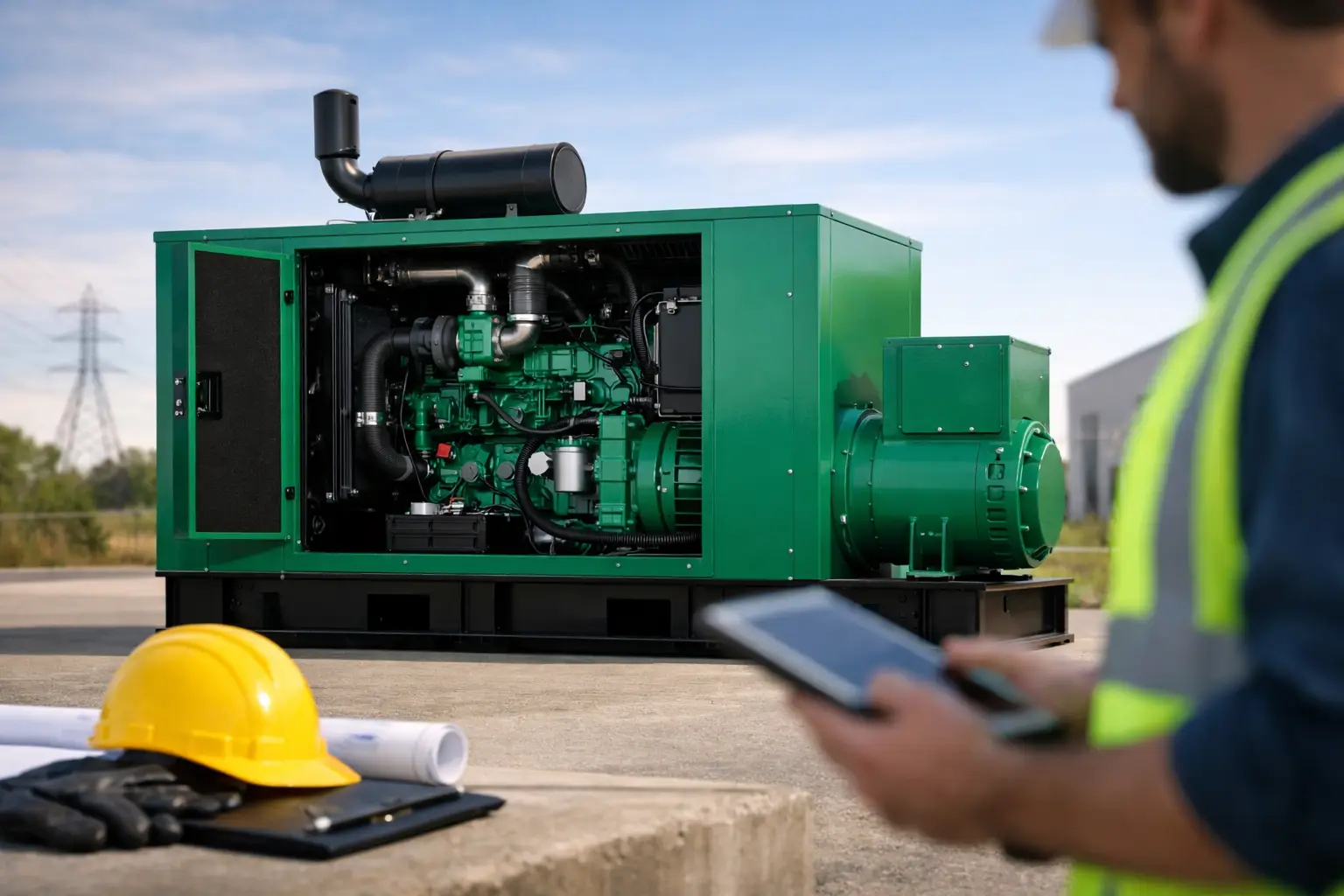
A 110 kVA diesel generator is commonly available as either an open set or a silent generator in a weatherproof canopy. The right format depends on where the set will operate and how it will be installed.
An open generator is often suitable for plant rooms or controlled internal environments where acoustic attenuation is handled by the building design. It can offer easier service access in the right setting, but it places more responsibility on the installation design for ventilation, noise control and safety.
A silent generator is generally the more practical option for outdoor positioning, mixed-use estates and locations with tighter noise expectations. For many buyers, the enclosure is not just about neighbour consideration. It also provides weather protection, site practicality and a cleaner packaged installation.
The trade-off is straightforward. Open sets can make sense in engineered indoor applications. Silent sets tend to offer broader deployment flexibility.
Engine brand, alternator quality and controls
At 110 kVA, the market includes both high-quality industrial packages and lower-cost units that may look comparable on paper. Serious buyers should not treat them as equivalent.
Engine pedigree matters because it affects service support, parts availability, emissions compliance where relevant and long-term reliability. For mission-critical backup, recognised engine platforms remain the safer commercial decision. The same applies to alternator quality. Stable output, insulation class, voltage regulation and fault tolerance all matter once the generator is supporting valuable processes or sensitive equipment.
Control systems also deserve scrutiny. A modern controller should provide clear operating data, alarms, protections and straightforward integration with automatic transfer switching. If remote monitoring is important, that should be addressed at the specification stage, not added as an afterthought.
Installation factors that shape the final decision
A generator at this size is not purchased in isolation. The site arrangement often determines whether the selected set will be easy to deploy and maintain.
Access and delivery
Check transport route, lifting requirements and final positioning before ordering. A generator that suits the electrical load but cannot be placed without costly enabling works is not the right fit.
Fuel system design
Base tank capacity, external bulk storage and refuelling strategy should reflect actual runtime expectations. For standby applications with long resilience targets, fuel planning is as important as generator output.
Ventilation and exhaust
Whether the set is open or enclosed, airflow and exhaust routing need proper design. Heat rejection, emissions management and safe dispersion cannot be left to chance.
Maintenance access
Service clearances are routinely overlooked during procurement. Filters, belts, battery access and control panel visibility all affect long-term operability.
Running costs and whole-life value
Purchase price is only one part of the decision. A 110 kVA diesel generator may serve for years as insurance against operational loss, so whole-life value is the more useful measure.
Fuel consumption should be reviewed at realistic load points rather than idealised figures. Maintenance intervals, consumable costs, service accessibility and likely spare parts support all influence the true operating cost. If uptime carries high financial or safety consequences, a stronger specification is usually cheaper over time than a lower-cost set that introduces reliability risk.
This is also why stock availability matters. Fast delivery has commercial value when a project is live, a replacement is urgent or a resilience gap has already been identified. For many UK buyers, dealing with a supplier that holds recognised generator sizes in stock reduces programme risk as much as it reduces lead time.
When 110 kVA is the right choice
A 110 kVA diesel generator is often the right answer when the site needs credible three-phase backup power without moving into a significantly larger footprint, heavier fuel demand or higher capital cost than necessary. It works well for buyers who have a defined operational load, understand their duty profile and need a proven industrial package rather than a generic commodity unit.
It may be less suitable where loads are highly motor-driven, future expansion is imminent, or the application involves long-duration prime running at demanding utilisation levels. In those cases, stepping up in rating or revisiting the wider power design is usually the more defensible choice.
For specification-led buyers, the practical route is clear. Start with the load, confirm standby or prime requirement, choose the right enclosure format, and assess the engine, alternator and controls as a complete package. If the set will support a mission-critical application, treat service access, fuel strategy and installation design as part of the same purchasing decision.
Global Generators supplies this part of the market for customers who need dependable equipment, clear specification and fast availability rather than guesswork. The right generator is not simply the one that matches a headline number. It is the one that keeps the site running when failure is not acceptable.