A power cut at a warehouse, hospital plant room or data-driven production site is rarely just an inconvenience. It can stop output, compromise safety systems, damage stock, interrupt communications and create immediate financial exposure. That is why backup power systems are specified around risk, load profile and recovery time - not just headline price.
For most commercial and industrial buyers, the real question is not whether backup power is needed. It is what level of resilience the site actually requires, how quickly the load must be restored and which generator configuration will support dependable operation when the grid does not.
What backup power systems need to do
A backup power system has one job: maintain continuity when utility power becomes unstable or fails entirely. In practice, that can mean anything from supporting emergency lighting and fire systems to carrying a full building load, a manufacturing line or a telecoms installation.
The specification depends on what must stay live. Some sites only need selective standby coverage for essential circuits. Others need whole-site support because any interruption creates operational or contractual risk. That distinction matters, because a system sized for life safety support is not the same as one intended to maintain process loads, refrigeration, pumps or critical IT infrastructure.
Speed of transfer matters as well. If the site can tolerate a short interruption, a conventional standby generator paired with an automatic transfer arrangement may be suitable. If there is no tolerance for even a brief break in supply, the backup strategy may need to include battery support or UPS equipment upstream of the generator. The generator then becomes part of a wider continuity design rather than the only answer.
Standby or prime power?
One of the most common specification errors is treating standby and prime power ratings as interchangeable. They are not. Standby-rated generators are intended for emergency use during utility failure. Prime-rated generators are designed for variable load over extended periods where mains power is unavailable or unreliable.
For a buyer, the operational question is simple. Is the generator there for occasional outage protection, or will it carry regular daily demand? A construction site, remote utility installation or temporary works package may need prime power. A factory connected to a reliable grid supply but exposed to high outage costs will usually need standby power.
This affects both equipment choice and long-term running costs. A generator selected too close to its duty limit may perform adequately in a brochure scenario but prove less suitable under real operating conditions. Where outages are frequent, fuel storage, service intervals and engine loading all need closer attention.
Sizing backup power systems properly
Generator sizing is where technical clarity prevents expensive mistakes. Too small, and the set may struggle with motor starting, voltage dip or load acceptance. Too large, and the equipment may run lightly loaded for long periods, which is inefficient and can create engine issues on diesel sets.
The starting point is always the actual site load, not a rough estimate. That means understanding running load, starting load, peak demand, load sequencing and any sensitive equipment that cannot tolerate unstable voltage or frequency. HVAC plant, compressors, pumps, conveyors and lifts can all alter the sizing requirement significantly because their start-up behaviour is often far more demanding than their steady-state consumption.
Future expansion should be considered, but carefully. There is a difference between sensible capacity headroom and over-specification. If a site expects additional plant within a defined timeframe, that should be part of the sizing exercise. If expansion is only a possibility, modular planning or parallel sets may be more commercially sensible than buying too much generator from day one.
Backup power systems and generator configuration
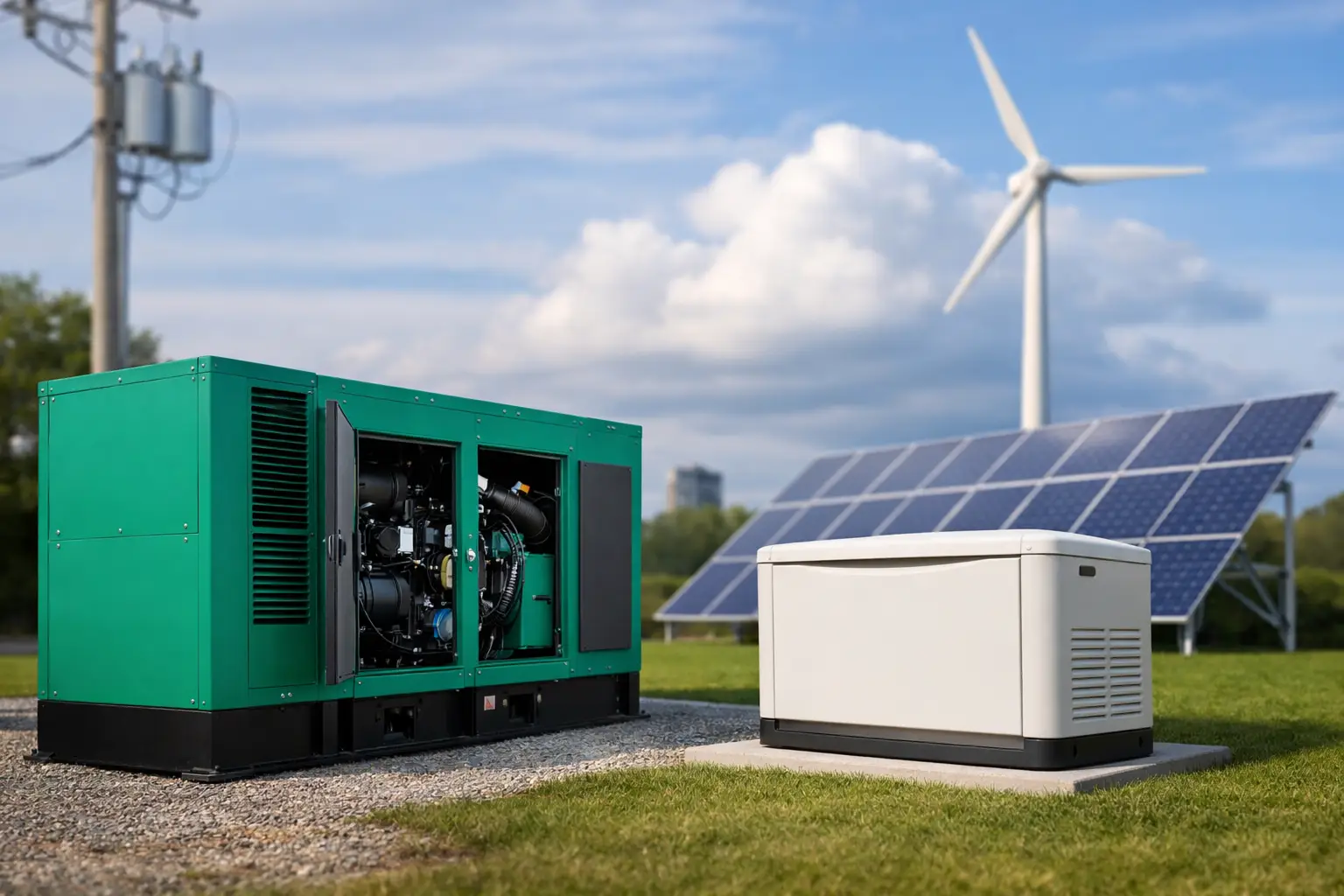
The right generator format depends on environment, installation method and duty. Open sets are often suitable where the generator is installed within a dedicated acoustic or weatherproof plant arrangement. They can offer practical access for service and are often chosen for enclosed plant rooms or engineered compounds.
Silent generators are typically preferred where noise control is a planning issue or where the set operates near occupied buildings, commercial premises or public-facing sites. The enclosure is not simply about comfort. In many applications, acoustic performance is a core procurement requirement.
Single phase and 3 phase specification must also match the site distribution. Most industrial and larger commercial applications require 3 phase power because of the equipment being supported. Smaller commercial premises or certain residential installations may require single phase. A mismatch here creates avoidable complexity at best and an unusable installation at worst.
Engine brand, alternator quality and control systems
Backup power systems are only as dependable as the components at their core. Buyers in critical sectors generally look first at the engine platform, because serviceability, parts support and field-proven performance matter as much as the quoted output.
Well-established diesel engine brands remain the standard choice for many standby and prime power applications because they offer predictable performance, strong torque characteristics and broad support networks. That said, the engine is only part of the package. Alternator quality, controller capability and protection logic have a direct impact on reliability, load handling and fault management.
Control systems should provide clear operating status, alarm visibility and protection functions appropriate to the site. For many buyers, remote monitoring is no longer optional. If a generator protects a critical site, operations teams need to know fuel level, running status, fault conditions and maintenance requirements without waiting for a call from site staff.
Installation factors that affect uptime
A good generator can still underperform if the installation has been treated as an afterthought. Ventilation, exhaust routing, fuel storage, access for service, cable runs and changeover integration all influence real-world reliability. For a complete overview of installation best practices, checkout diesel generator installation guide
Fuel autonomy is a practical example. A standby set may be technically suitable on paper, but if the base tank only covers a short runtime and the site has poor refuelling access during an incident, resilience is weaker than it appears. For longer outage scenarios, fuel planning is part of the power strategy.
Maintenance access is another point often missed during procurement. If service points are difficult to reach, routine maintenance becomes slower and more disruptive. For high-availability sites, that affects both operating cost and uptime planning.
Ambient conditions matter too. Outdoor installations, high dust environments, heat exposure and coastal conditions all place different demands on enclosure choice and protection level. The correct specification depends on where the set will run, not just how much power it produces.
Compliance, testing and operational readiness
Backup power systems should never be viewed as fit-and-forget assets. If they are there for mission-critical use, they need regular inspection, load testing and maintenance discipline. A generator that starts on no-load test cycles but has never been proven under realistic demand is an operational risk.
Testing should reflect the application. Some sites need routine off-load exercise runs. Others need periodic on-load testing to verify transfer operation and load acceptance. The right regime depends on criticality, site policy and the consequence of failure.
Procurement teams should also pay attention to local compliance requirements, emissions considerations, acoustic limits and any site-specific standards. These are not secondary details. They can affect whether the system is approved for use, where it can be installed and how it must be operated.
Buying backup power systems with fewer surprises
Commercially, the lowest purchase price is not always the lowest cost decision. Availability, lead time, technical support and the accuracy of the original specification all shape project outcome. In urgent or high-risk environments, fast access to stock in the correct kVA range can be more valuable than a marginal saving on equipment cost.
A clear procurement process usually starts with five decisions: required duty, kVA range, voltage and phase, enclosure type, and expected runtime. Once those are defined, it becomes much easier to narrow the right equipment and avoid being sold a generic solution that does not fit the site.
This is where an enquiry-led approach has value. Buyers with mixed loads, complex site conditions or phased expansion plans often benefit from discussing the actual operating profile rather than selecting solely from a category page. For businesses such as Global Generators, that conversation is less about selling power generation in the abstract and more about matching stock, specification and delivery speed to the operational requirement in front of the buyer.
The best backup power systems are not necessarily the biggest or the most feature-heavy. They are the ones that start when required, carry the intended load without drama and fit the realities of the site they protect. If you begin with uptime, load behaviour and installation constraints, the right specification usually becomes much clearer.