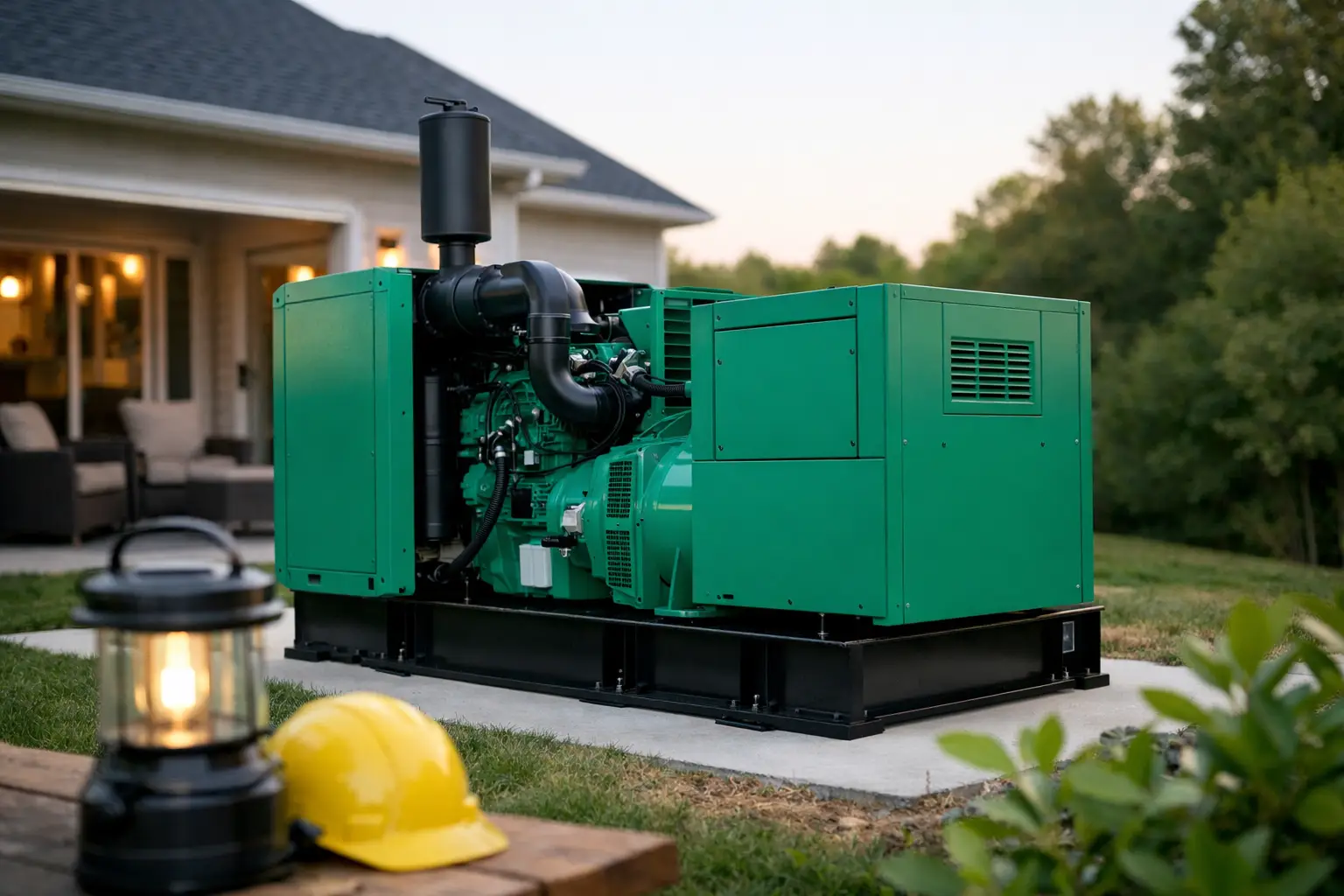
A power cut is inconvenient until it stops heating, alarms, pumps, refrigeration and gate access at the same time. That is usually the point at which a diesel generator for home use moves from a nice-to-have purchase to a practical resilience decision.
For domestic buyers, the challenge is rarely whether backup power is useful. It is deciding what level of backup is actually required, what can be installed safely, and whether diesel is the right fit compared with other fuel types. The right answer depends on load profile, run time expectations, site layout and local operating constraints. A home generator is still a piece of serious power equipment, and it needs to be specified that way.
When a diesel generator for home makes sense
Diesel is not the default answer for every property. For a small house that only needs a few lights, internet equipment and a fridge for occasional outages, a smaller petrol set or battery-backed system may be enough. Where diesel starts to make sense is when the expectation is broader whole-house coverage, longer run times, or support for equipment with high starting demands.
That often includes larger rural properties, homes with private water supply or sewage systems, houses with electric gates and security infrastructure, or domestic sites where a workshop, outbuilding or small business operation also relies on backup power. If the generator may need to run for extended periods, diesel usually offers better fuel efficiency, stronger durability under load, and a more suitable platform for engineered standby systems.
There is also a procurement reality. Buyers who think in terms of uptime usually want a machine designed for dependable service, not a lightweight portable set intended for occasional leisure use. That is where product quality, engine platform, control system and enclosure design matter more than headline price.
Start with the load, not the generator
The most common buying mistake is choosing output by guesswork. A domestic property may appear straightforward, but total running load and starting load are not the same thing. Borehole pumps, air source heat pumps, compressors, refrigeration equipment and larger air conditioning units can all create a startup demand that materially exceeds normal running consumption.
A proper sizing exercise should identify which circuits need backup, whether the objective is whole-home or partial-home supply, and whether loads will start simultaneously or in sequence. If the property has three phase infrastructure, that must be addressed from the outset. A single phase set is suitable for many homes, but some larger residences and mixed-use domestic sites require three phase support.
Undersizing creates nuisance trips, unstable operation and accelerated wear. Oversizing is not ideal either. A generator running too lightly loaded for long periods can suffer from poor combustion performance and reduced efficiency. The best specification is usually close to actual demand with a sensible allowance for motor starting and future expansion.
Standby duty is different from prime power
Most domestic installations are standby applications. The generator remains off-grid until mains supply fails, then starts to restore essential or full-property power through an automatic transfer arrangement. In that case, the standby rating is the figure that matters most.
Prime power is a different operating category. It is relevant where the generator is expected to act as the main supply for sustained periods, perhaps during construction, refurbishment or where grid availability is unreliable. For domestic buyers, this distinction matters because not all generator ratings mean the same thing in real use. The machine should be selected against the intended duty, not just the largest number on the data sheet.
Silent or open generator for domestic sites
For almost all residential installations, a silent canopy is the practical choice. Noise control is not a minor detail in a home environment. Even where the property is detached and has reasonable outdoor space, acoustic performance affects day-to-day usability, neighbour relations and planning considerations.
An open generator can be suitable inside a properly designed plant room, but that is a more specialised arrangement. Ventilation, exhaust routing, access for maintenance and fire safety all need to be managed correctly. Unless the site already has an appropriate technical space, an enclosed silent set is normally the simpler and more realistic route.
The enclosure should not be treated as cosmetic. It contributes to weather protection, security and service access, as well as sound attenuation. For domestic sites, all four matter.
Installation is where good projects stay good
A generator is only as reliable as the installation around it. For home use, this includes the concrete base, cable routing, earthing, exhaust discharge, fuel system, ventilation clearances and the transfer equipment that isolates the property safely from the public supply.
Automatic mains failure capability is often worth serious consideration. If backup power is needed to protect heating systems, cold storage, security or critical domestic infrastructure, a manual changeover may not be enough. Automatic transfer allows the set to start and assume load without someone being on site, though that convenience comes with added equipment cost and commissioning requirements.
Fuel storage also needs practical thought. Diesel gives good run-time potential, but storage volume, bunding requirements and refuelling access should be resolved before purchase. A generator that cannot be refuelled easily during a prolonged outage is less useful than its specification suggests.
For that reason, domestic buyers with larger properties often benefit from taking a commercial approach to what is technically a residential application. Treat the installation as critical infrastructure and fewer problems emerge later.
What to look for in a home backup generator
Specification quality is more important than marketing language. Buyers should focus on the engine platform, alternator quality, controller capability, enclosure standard, fuel tank capacity and support for service parts.
Recognised diesel engine brands matter because reliability is tied to component quality and long-term supportability. Control systems matter because fault indication, protection logic and operating visibility become important the moment a mains failure occurs at an inconvenient hour. Service access matters because routine maintenance should be straightforward, not a complicated dismantling exercise.
You should also look carefully at voltage, phase, frequency, rated output in kVA, acoustic level and physical dimensions. Domestic projects are often constrained by access gates, outbuilding clearances or discrete siting requirements. A generator that fits the electrical brief but not the site envelope is not properly specified.
Cost, noise and emissions - the trade-offs
There is no perfect generator, only a suitable one. Diesel offers strong performance and efficient longer-duration running, but it is heavier, more infrastructure-dependent and typically more expensive than a small portable alternative. It also requires proper maintenance discipline. If a unit sits unused for months, battery condition, fuel quality and periodic testing still need attention.
Noise is manageable but not eliminated, even with a silent enclosure. Buyers should think in terms of acceptable operational impact rather than assuming silent means inaudible. Site position, acoustic orientation and proximity to bedrooms or boundaries all influence the result.
Emissions are another factor. For occasional standby use, diesel remains a practical and widely accepted solution. For frequent operation in more sensitive settings, buyers may weigh diesel against gas or hybrid alternatives. The right decision depends on run hours, site constraints and the consequences of failure.
Buying with future demand in mind
Domestic power needs rarely stay static. EV charging, workshop expansion, electric heating upgrades and additional outbuildings can all shift the demand profile over time. It is sensible to account for known future load, but not to the extent that the generator becomes badly oversized for present operation.
This is where supplier input has real value. A serious enquiry should test not just available stock, but whether the proposed set aligns with actual operating conditions. Buyers who already understand load, phase and installation preferences tend to get to the right shortlist quickly. Buyers who do not should expect questions, because a generator that is sold without application review is often a generator that creates problems later.
For homeowners and project teams looking at higher-quality standby equipment, the same principles used in commercial procurement still apply. Output classification, enclosure type, control functionality, lead time and aftersales support should all be part of the decision. Global Generators works in that specification-led way because backup power is not a category where assumptions are cheap.
Is diesel the right answer for your property?
If the requirement is dependable backup for a larger home, an estate property, a mixed residential and workshop site, or a house with systems that cannot tolerate extended outages, diesel is often the right place to start. If the requirement is light, occasional and highly budget-sensitive, another fuel type may be more proportionate.
The key is to buy against operational need rather than broad product labels. A home generator is not small industrial equipment by accident. It sits at the point where domestic convenience meets infrastructure risk. Get the load assessment, rating, enclosure and installation right, and the generator becomes a dependable asset rather than an expensive compromise.
Before choosing any set, define what must stay on, for how long, and under what conditions. That usually tells you whether you need a simple backup unit or a properly engineered diesel standby system.