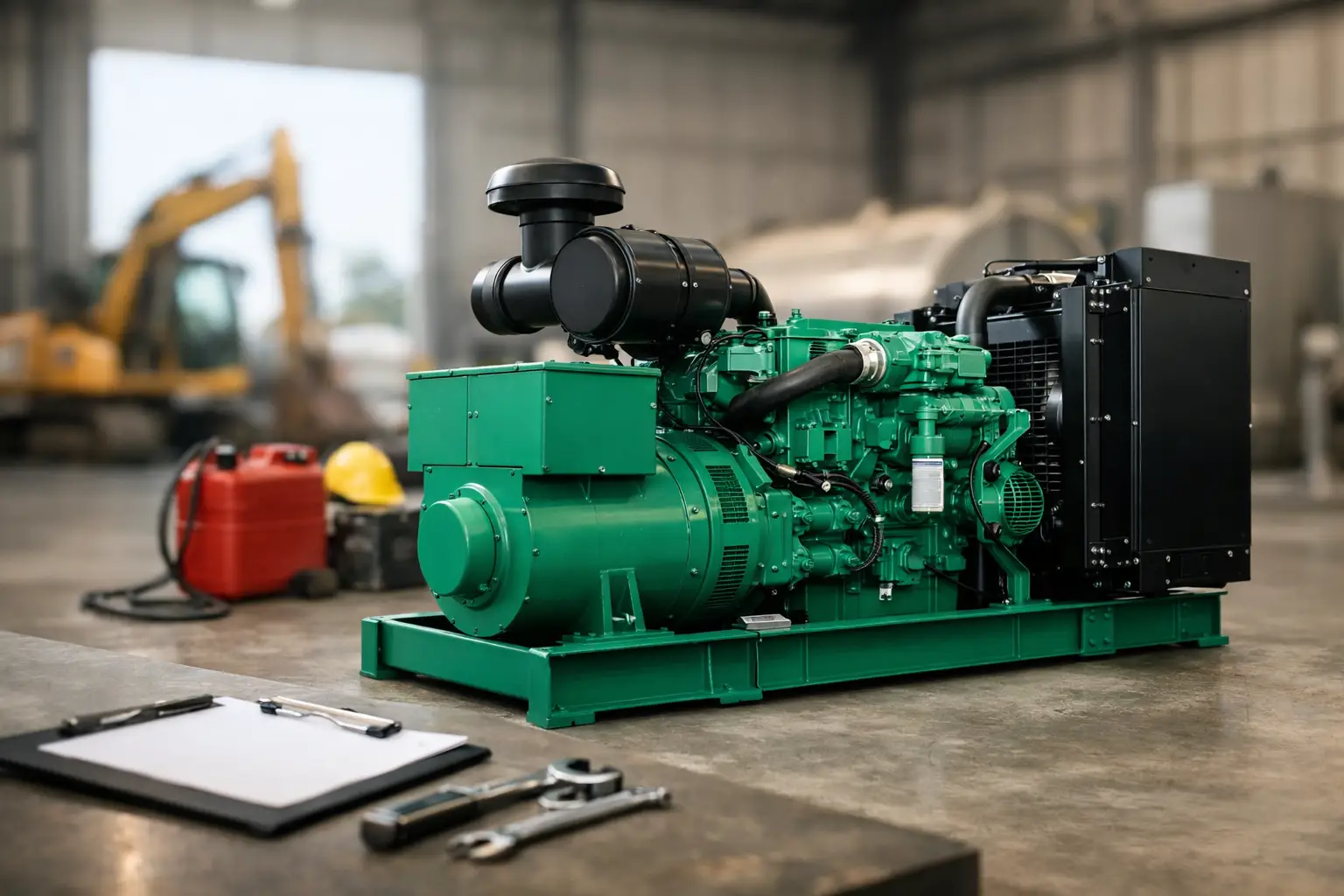
Power loss rarely arrives at a convenient time. On a live construction site, in a distribution hub, at a healthcare facility or across a manufacturing line, a failed supply quickly becomes a cost, a safety issue and an operational problem. That is why specifying the right diesel motor generator matters - not simply as a piece of equipment, but as a core part of site resilience.
For buyers responsible for uptime, the question is not whether diesel generation still has a place. It does. The real question is which set, rating and configuration will hold load reliably under real operating conditions. A poor match leads to underperformance, excessive fuel use, nuisance shutdowns or avoidable wear. A correct match supports continuity, compliance and predictable running costs.
What a diesel motor generator is expected to do
In practical terms, a diesel motor generator converts mechanical engine power into electrical output that can support site loads during mains failure or provide ongoing power where no stable grid exists. For most commercial and industrial buyers, that sounds obvious. What matters more is duty.
A standby set may sit unused for long periods and then need to start immediately when utility power fails. A prime power set, by contrast, may run daily for extended hours, often in remote or temporary applications. The same machine format does not suit both roles in the same way, and the specification should reflect that from the outset.
This is where many procurement decisions either become efficient or expensive. The generator itself is only one part of the answer. Engine quality, alternator performance, fuel autonomy, acoustic treatment, control system capability and the expected load profile all affect suitability.
Standby or prime power?
The first filter should always be operational duty. If the unit is protecting a facility against occasional grid outages, standby rating is usually the right reference point. If the set is expected to support regular site operations, temporary infrastructure or off-grid work, prime rating is the more meaningful figure.
That distinction is not just a label. Standby and prime ratings are based on different operating assumptions. A buyer who chooses only by the highest headline kVA without checking the duty cycle can end up with a set that is technically powerful enough, yet wrong for the way the site actually runs.
For critical facilities, it is also worth considering how the load behaves at start-up. Motor-driven equipment, pumps, compressors and HVAC systems can impose high inrush currents. A generator that appears adequate on paper may struggle if those transient demands are ignored.
Why load profile matters more than headline kVA
Sites rarely draw power in a flat, predictable line. Some loads step up sharply, others cycle on and off, and some are sensitive to voltage or frequency variation. The sizing exercise therefore needs more than a total connected load figure.
A good specification considers starting currents, diversity, future expansion and whether the generator will support the whole site or only selected essential circuits. In many cases, a slightly larger set is justified for stability and headroom. In other cases, oversizing creates its own problems, including inefficient running and light-load operation that is not ideal for diesel engines over time.
Choosing the right diesel motor generator size
Generator sizing should be treated as an engineering decision, not a rough estimate. In broad terms, buyers need to account for total demand, load type, power factor, starting method and expected runtime. If the set is feeding non-linear loads such as certain IT, telecoms or variable-speed equipment, alternator and control compatibility should also be checked.
In straightforward applications, single phase demand may be enough. In most industrial and larger commercial settings, 3 phase output is the standard requirement. Getting this wrong is not a small administrative issue. Voltage and phase mismatch can make a set unusable for the intended plant.
The same applies to fuel storage and autonomy. A facility needing eight hours of backup has a different fuel planning requirement from a remote site expecting prolonged operation. Tank size, refill logistics and access for servicing all need to be considered before the order is placed.
Common sizing mistakes
The most common mistake is buying too small. That tends to show up quickly through unstable performance, overload trips or poor motor starting. The second common mistake is buying too large without understanding the downside. Diesel engines perform best within an appropriate load band, and a heavily oversized set may spend too much time running inefficiently.
A third issue is planning for today's load only. If a site expansion is likely within the equipment life cycle, that should be built into the original selection. Replacing a generator early because the load has outgrown it is rarely cost-effective.
Open or silent generator configuration
The enclosure type should reflect both the operating environment and the site's constraints. Open generators are often selected for plant rooms or protected installations where acoustic treatment is handled by the building or external attenuation measures. They can be practical for service access and are often suitable where noise is not the primary constraint.
Silent generators are better suited to external installation, urban sites, commercial premises and any setting where noise control matters. The enclosure adds protection as well as sound reduction, but buyers should still check exact acoustic performance data rather than relying on the word silent alone. A low-noise requirement on a hospital boundary or a mixed-use development needs measured figures, not assumptions.
There is always a trade-off. Enclosed sets improve acoustic control and weather protection, while open sets may offer easier access in certain engineered spaces. The right choice depends on site layout, planning conditions and maintenance strategy.
Engine brand, build quality and long-term reliability
For serious standby and prime applications, engine pedigree matters. Buyers are not simply purchasing a power output figure. They are purchasing start reliability, parts support, service familiarity and confidence under load. Proven engine platforms remain the safer choice where failure carries operational or financial consequences.
This is one reason many commercial buyers prefer established diesel generator packages built around recognised engine manufacturers. The engine, alternator and control system need to work as a package, supported by clear technical documentation and known performance standards.
A lower upfront price can look attractive, but if it introduces uncertainty around parts, warranty support or long-term serviceability, the total ownership picture changes quickly. For mission-critical use, reliability is not a premium feature. It is the baseline requirement.
Controls, compliance and site integration
Modern generator selection goes beyond the engine block and alternator frame. Control systems now play a major role in start sequence management, alarms, protection logic and site integration. Buyers should consider whether they need automatic mains failure functionality, remote monitoring, synchronisation capability or compatibility with existing site infrastructure.
In more complex installations, integration with transfer switching, building management systems or parallel power arrangements may shape the specification as much as the kVA rating does. That is particularly relevant for healthcare, telecoms, utilities and large commercial facilities where response time and visibility are critical.
Compliance should also be checked early. Noise limits, emissions expectations, installation standards and on-site operating conditions differ by sector and location. A generator that is technically capable still needs to be suitable for the planned environment.
Procurement should be based on application, not catalogue position
A structured range helps buyers move quickly, especially when comparing outputs from smaller commercial sets through to high-capacity industrial machines. But no serious purchase should stop at the catalogue listing. The final decision should always be tied back to application.
That means asking direct questions. Is the set covering life safety systems, production lines or temporary welfare blocks? Does the site need immediate automatic response, or manually controlled backup? Is the installation fixed, mobile, indoor or external? Will it be lightly loaded most of the year, or expected to carry a hard-working daily duty?
The stronger suppliers are the ones that can answer those questions with specification clarity rather than vague reassurance. Stock availability, lead time and delivery capability matter, but so does the discipline of matching the generator to the real operating case. For buyers working to short programmes or critical uptime demands, that combination is what reduces risk.
Global Generators works in that specification-led space, where fast availability only has value if the equipment is correctly matched in the first place.
What good buying decisions look like
A good diesel motor generator purchase is rarely the cheapest unit on a page, and it is not automatically the largest one either. It is the set that fits the duty, starts reliably, carries the required load, suits the site conditions and remains supportable over its service life.
For procurement teams and engineers, the best results usually come from treating generator selection as an operational continuity decision rather than a simple equipment order. When the specification is right, the generator becomes unremarkable in the best possible way - it starts when it should, carries the load it was bought for and lets the rest of the operation continue.