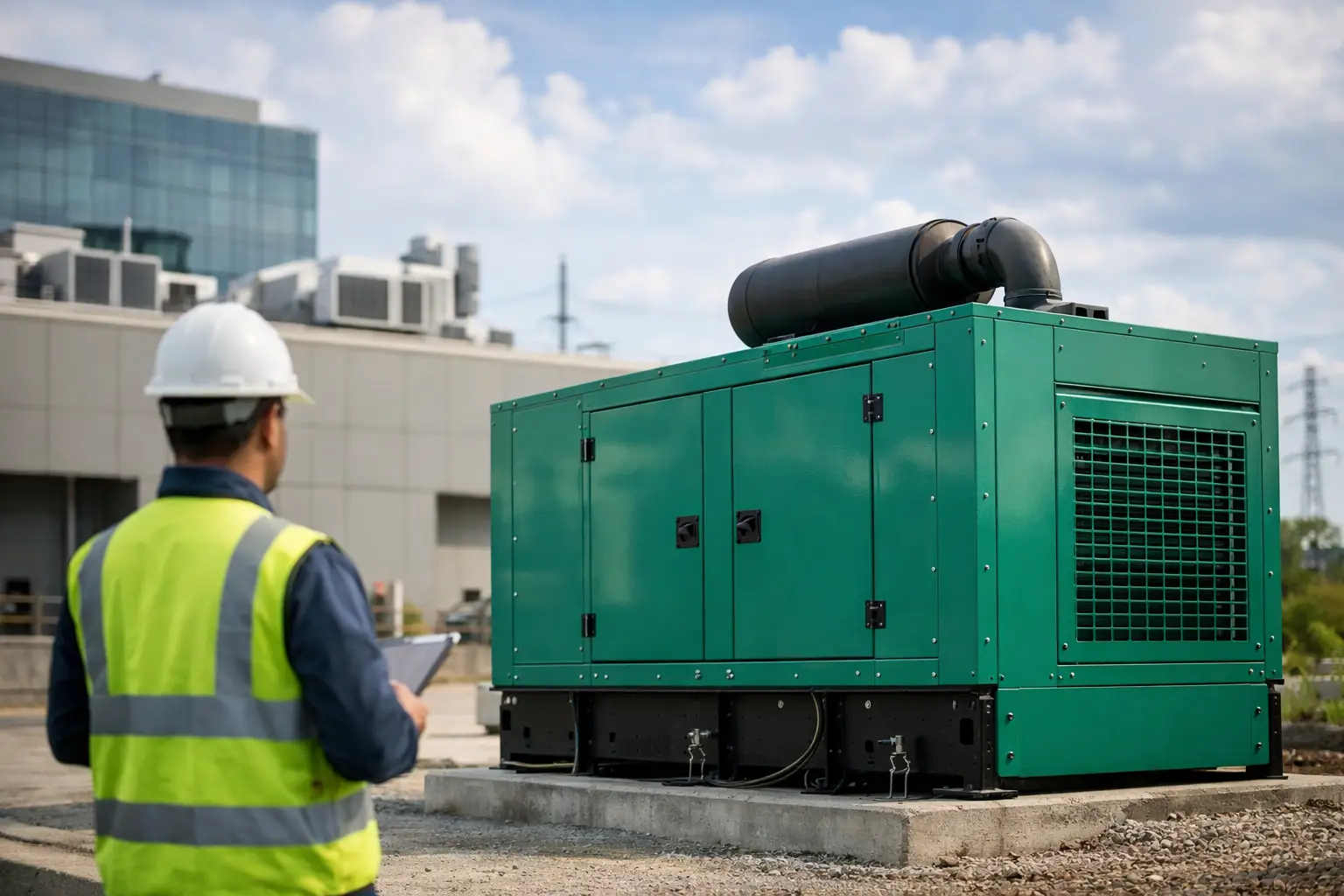
A generator that starts but cannot carry the site load is not backup power. It is an expensive point of failure. Knowing how to choose a backup generator starts with the operational consequence of an outage: which systems must remain live, how long they must run, and whether the set is for occasional standby use or regular prime power duty.
For a warehouse, that may mean emergency lighting, security, loading systems and essential IT. For a healthcare, telecoms or manufacturing site, the critical load may include far more: life-safety systems, process equipment, refrigeration, pumps, controls and communications. The correct specification is determined by that load profile, not by the size of the building or an estimate based on a previous installation.
Start with the load, not the generator size
The first task is to establish the electrical demand the generator must support. Review site load data, distribution drawings and equipment schedules, then separate essential circuits from non-essential demand. A backup generator should be sized for the equipment that genuinely needs continuity, unless the business case requires whole-site resilience.
Record each item’s running power, starting demand and operating voltage. Motors, compressors, pumps, lifts and air-conditioning plant can require a significantly higher current when starting than when running. If several motor loads start together, the alternator and engine may see a short but severe demand that causes voltage and frequency to dip. This can trip sensitive equipment or prevent the generator from accepting the load.
kW and kVA are related but not interchangeable. kW is the real power consumed by equipment. kVA is the apparent power capacity of the generator. The difference is governed by power factor. Many generator ratings are quoted in kVA at a stated power factor, commonly 0.8, so a 100 kVA set may provide 80 kW under that rating condition. Confirm the actual load power factor rather than assuming a standard figure, particularly where variable-speed drives, UPS systems or non-linear electronic loads are present.
A sensible allowance for future expansion is usually necessary, but oversizing should not be treated as risk-free. Diesel generators that spend long periods operating at very low load can suffer from poor combustion, carbon build-up and wet stacking. The target is adequate capacity, starting performance and reserve margin without routinely running the set far below its intended operating range.
Decide whether you need standby or prime power
Duty rating is one of the most important choices in a generator procurement. Standby power is intended for use during utility failure. The set normally sits ready to start automatically and operates for limited emergency periods, subject to the manufacturer’s rating conditions.
Prime power is for locations where the generator is the regular or principal source of electricity. This applies to remote construction projects, temporary facilities, utility-constrained sites and operations with extended daily running hours. A prime-rated generator is designed for variable load operation over longer periods, but the permitted average load and annual running profile still need checking against the manufacturer’s data.
Do not specify a standby-rated set for a site that expects it to run every day. Equally, buying prime power capability for infrequent emergency operation may add cost without improving the outcome. State the expected running hours, annual operating pattern, load variation and any planned load-sharing requirement at enquiry stage.
Select the right electrical configuration
Most industrial and commercial installations require a three-phase generator, commonly at 400/230 V and 50 Hz in the UK. Three-phase sets support higher loads and are suited to plant, motors, distribution boards and commercial services. Single-phase generators are appropriate for smaller, simpler loads, but may not suit a site with three-phase equipment.
Voltage, frequency, earthing arrangement and connection method must all match the existing installation. Consider whether the generator will supply a fixed changeover panel, a manual connection point or a temporary distribution system. For fixed standby applications, an automatic transfer switch is generally required so the set starts after a mains failure, transfers the essential load and returns the site to mains supply when it is stable.
The control system should match the operational risk. A basic controller may be sufficient for a simple installation. Critical sites may require remote monitoring, alarm notifications, fuel monitoring, scheduled exercise functions, mains paralleling, generator paralleling or integration with a building management system. These are not cosmetic extras. They affect response time, fault visibility and the ability to manage an outage without sending an engineer to site.
Consider sensitive and non-linear loads
Modern sites increasingly rely on UPS systems, data equipment, LED drivers, variable-speed drives and rectifiers. These loads can introduce harmonics and may behave differently during generator operation than under a stable grid supply. UPS input characteristics, battery charging demand and bypass arrangements need particular attention.
A specialist assessment may identify a need for alternator oversizing, harmonic mitigation, staged loading or a revised starting sequence. The lowest purchase price can become costly if the generator repeatedly trips when the UPS recharges or a large motor starts.
Choose the fuel and runtime arrangement
Diesel remains the standard choice for dependable industrial backup power because it offers strong load acceptance, established service support and practical on-site fuel storage. The question is not simply whether diesel is suitable, but how much fuel autonomy the site requires.
Calculate runtime using the expected load rather than the generator’s full-load fuel consumption alone. A set operating at 50 per cent load will consume less fuel than at 100 per cent, but real-world demand can rise during an outage as equipment restarts or operational priorities change. Include a realistic reserve, refuelling access during adverse weather and the supplier’s ability to deliver fuel when regional infrastructure is under pressure.
The base tank may be adequate for a short utility interruption. Sites with longer resilience requirements may need an external bulk tank, day tank arrangement or fuel transfer system. Fuel quality management matters as much as tank size. Diesel stored for long periods can be affected by water contamination and microbial growth, so planned inspection, filtration and fuel polishing may be appropriate for critical installations.
Match the enclosure to the installation environment
Generator format affects noise, weather protection, maintenance access and installation cost. An open generator is normally suited to a purpose-built plant room or protected containerised installation. It can be economical and straightforward to service, but the room must provide correct ventilation, cooling-air flow, exhaust routing, fire protection and access for replacement of major components.
A silent, weatherproof canopy is generally the practical choice for external installations. It reduces noise and protects the set from the elements, but it does not remove the need to assess acoustic limits at the site boundary. Planning conditions, neighbouring premises and night-time operation can require additional attenuation, acoustic louvres, critical-grade silencers or a bespoke enclosure.
Space around the generator matters. Engineers need access to filters, batteries, control panels, radiators and lifting points. The installation also needs a safe route for delivery, offload and future removal. Check ground bearing capacity, crane or forklift access, exhaust clearances, flood risk and the impact of prevailing wind on ventilation.
Build reliability into the specification
The engine, alternator, controller and transfer equipment should be selected as a system. Proven engine brands, clear rating data and readily available service parts reduce uncertainty over the generator’s working life. For larger or higher-risk applications, ask about the alternator class, controller capability, circuit protection, battery charger, coolant heater, emergency stop arrangement and load-bank connection provision.
A generator cannot protect a site if it is never tested. Specify a maintenance plan that includes regular start tests, on-load exercise, inspection of batteries and coolant, fuel checks and periodic transfer testing. An unloaded monthly run proves that the engine starts. It does not prove the set can carry the required load, that the automatic transfer system operates correctly or that cooling performance remains satisfactory under sustained duty.
For mission-critical facilities, consider N+1 resilience, where one additional generator is available beyond the calculated requirement, or load sharing between multiple sets. This adds capital and control complexity, but it can prevent a single generator fault or planned maintenance activity from becoming a site-wide outage.
How to choose a backup generator with confidence
The strongest procurement process begins with documented loads and ends with an installation and test plan. Provide prospective suppliers with the essential load schedule, starting characteristics, existing voltage arrangement, required runtime, operating environment, acoustic constraints and intended duty rating. This enables the proposed kVA, enclosure, fuel system and controls to be assessed against the real application.
Avoid approving a generator solely on headline kVA or initial price. Review the stated standby and prime ratings, expected load percentage, engine and alternator specification, delivery scope, commissioning requirements and service access. If the site has unusual loads or no reliable load data, arrange a site survey or power-quality assessment before finalising the order.
Global Generators can support this process with generator options across key power ranges, including silent and open diesel sets for standby and prime power applications. A clear enquiry with the site details above leads to a faster, more accurate specification and avoids costly changes after delivery.
Power resilience is decided long before the first outage. Specify the generator around the load your operation cannot afford to lose, then test the complete system as rigorously as you expect it to perform.