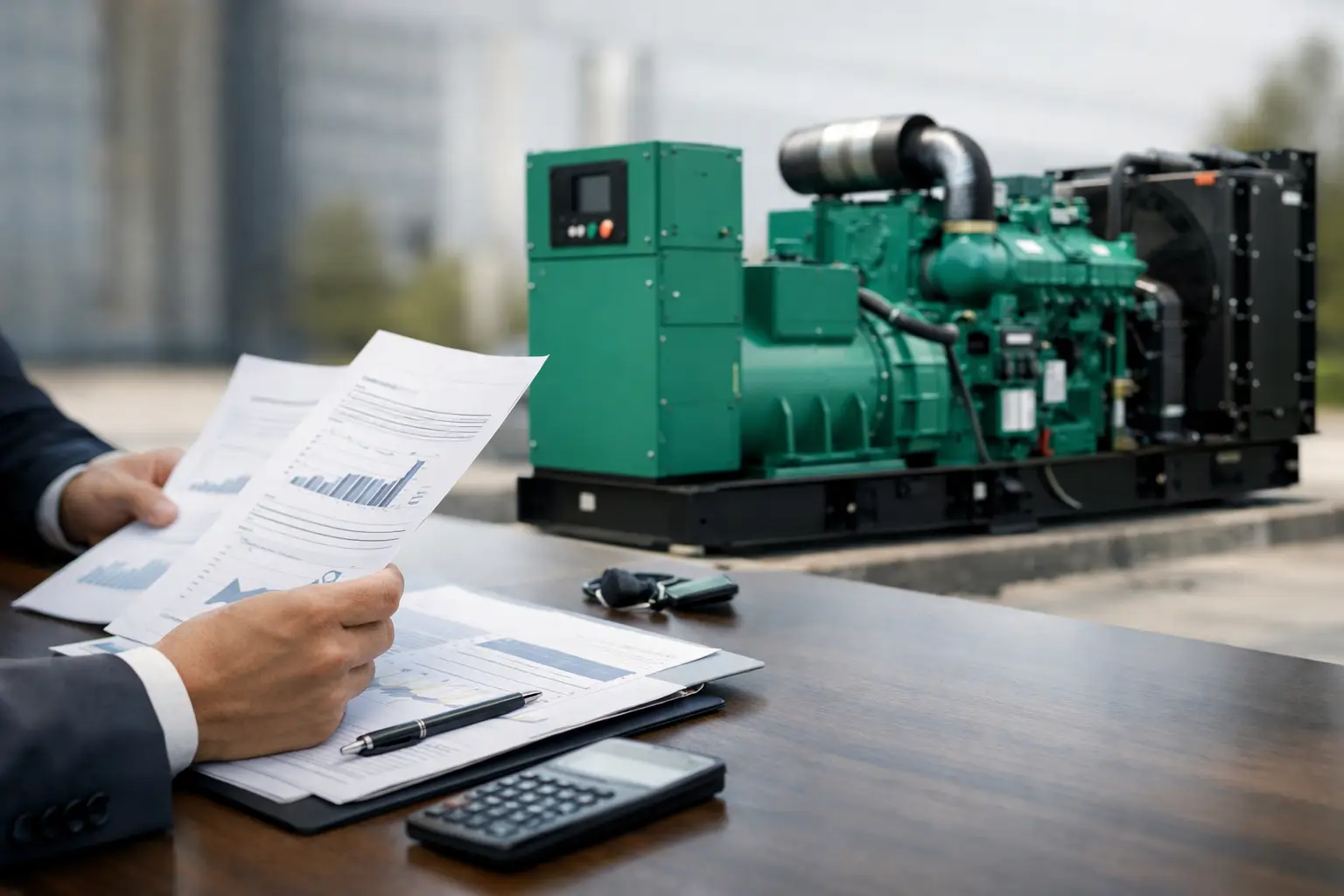
A low headline price on a generator quote often becomes expensive once installation constraints, duty rating, transport, controls, and aftersales support are brought back into the picture. If you need to know how to compare generator quotes properly, the starting point is simple: make sure every supplier is pricing the same job, to the same operating requirement, with the same level of detail.
For commercial and industrial buyers, quote comparison is not just a procurement exercise. It is a risk decision. A generator that is incorrectly sized, supplied without the right alternator specification, or priced without realistic lead times can create operational exposure long after the purchase order is raised. That is why the best comparison process is technical first and commercial second.
How to compare generator quotes without missing key differences
The first question is whether each quotation is based on the same application. A standby set for emergency backup is not priced the same way as a prime power generator expected to carry regular or continuous load. If one supplier has quoted standby duty and another has quoted prime duty, the numbers are not directly comparable even if the kVA figure looks similar.
You also need to check whether the rating shown is standby kVA, prime kVA, or both. Some buyers compare the top-line kVA number too quickly and assume like-for-like value. In practice, the duty classification matters just as much as the capacity. A 200 kVA standby set and a 200 kVA prime-rated set are built around different operating expectations, and the price difference reflects that.
Fuel type and phase should also be aligned before you compare costs. Most industrial applications will be looking at diesel, but even then you need to confirm whether the quote is for single phase or 3 phase output, and whether the voltage and frequency match the site requirement. A cheaper quote is not useful if it requires redesign work later.
Start with the specification, not the price
A reliable quote comparison begins with a written specification sheet from your side. That does not need to be overly complicated, but it should set out the core requirements clearly. Include required kVA, standby or prime duty, voltage, phase, frequency, site conditions, preferred engine brand, enclosure type, tank requirements, and any compliance or acoustic targets.
Without that baseline, suppliers will fill in the gaps differently. One may price an open set, another a silent canopy. One may include a larger base fuel tank, another may not. One may assume a standard control panel, while another includes remote monitoring capability. All of those decisions affect price, and all of them can distort a comparison if they are not standardised at the outset.
This is where procurement teams often lose time. They receive three or four quotes that look broadly similar, but each one solves a slightly different problem. The result is a false comparison. A better process is to evaluate technical compliance first, then compare commercial value among the quotes that actually meet the requirement.
What should be included in every generator quote
A serious supplier should provide enough detail for you to understand exactly what is being offered. At minimum, the quotation should identify the generator rating, engine and alternator make, enclosure format, control panel type, voltage, frequency, fuel tank arrangement, dimensions, and weight.
It should also make clear what is included and what is excluded. Transport, offloading, commissioning, synchronisation equipment, automatic transfer switching, cabling, exhaust systems, and attenuation are all areas where scope can vary. If those items are not defined, the cheapest quote can quickly become the most expensive once project extras are added.
Lead time matters as well. A quote for a unit available from stock is materially different from a quote based on a future production slot. If your requirement is linked to a live project, shutdown window, or resilience upgrade with a fixed date, availability should be weighted alongside price.
Warranty terms need the same attention. Check the duration, what components are covered, whether labour is included, and whether any servicing conditions apply. A warranty that appears generous on paper may be less useful if response support is unclear or geographically limited.
How to assess kVA, load profile, and real site demand
One of the most common mistakes in generator procurement is comparing prices on nominal size alone. The right way to assess value is to look at how the quoted generator matches the actual load profile.
Start with your running load, then consider motor starting, load step acceptance, power factor, future expansion, and any non-linear loads. A site with variable motor loads or sensitive equipment may require a different alternator or control setup than a site with a straightforward resistive load. Two 500 kVA quotations can look identical in headline terms but perform differently once the load is applied.
Ambient conditions also influence the specification. If the generator will operate in high temperatures, at altitude, or in a restricted plant space, derating and cooling considerations become relevant. A supplier that has accounted for those conditions may not be the cheapest, but the quote may be more accurate and more dependable.
This is also where engine brand and build quality enter the discussion. Proven engine platforms, clear technical data, and established serviceability usually command stronger pricing than unproven alternatives. For critical applications, that premium is often justified. The cost of one failure event can outweigh the purchase saving very quickly.
Compare enclosure, noise, and installation assumptions
A quote for a silent generator should not be compared directly against a quote for an open set unless you are deliberately evaluating two different installation strategies. Acoustic performance has a cost. So do weather protection, integrated attenuation, and secure steel enclosures.
Check the quoted sound level and how it has been measured. Noise figures can be presented at different distances and under different test conditions. If one supplier quotes 7 metres and another quotes 1 metre, the numbers will not tell you much until they are normalised.
Installation assumptions are equally important. One supplier may be pricing a base-mounted unit for straightforward positioning, while another assumes additional accessories for site integration. If space is tight, lifting access is limited, or the plant area requires specialist ducting and exhaust routing, those factors need to be addressed before comparing totals.
Look closely at controls, compliance, and accessories
Control systems are often under-checked during quote review. For some sites, a standard controller is enough. For others, you may need AMF functionality, remote monitoring, building management integration, load shedding, or synchronisation capability. If one quote includes a more advanced control package, that difference needs to be recognised rather than treated as a pricing anomaly.
Compliance should be explicit. Depending on the application, that may include CE marking, emissions alignment, electrical standards, or project-specific documentation. If your site has consultant oversight or formal approval stages, documentation quality matters. A cheaper quote that creates delays at technical approval stage is not really cheaper.
Accessories should also be tested against operational need rather than accepted or rejected on price alone. Battery chargers, jacket water heaters, larger bunded tanks, fuel polishing provision, automatic transfer panels, and remote alarm outputs all affect the final figure. Some are optional. Some are essential. The point is to know which is which before you decide.
Supplier strength matters as much as unit cost
When you compare generator quotes, you are also comparing suppliers. Stock position, responsiveness, technical understanding, and aftersales capability all affect project outcome. For a mission-critical purchase, the supplier’s ability to answer technical questions clearly and confirm what is actually available carries real value.
This is especially relevant where lead time is tight or the application is complex. A supplier with strong stock coverage at key kVA bands can remove procurement risk in a way that is not obvious from the quote total alone. Global Generators, for example, focuses heavily on dependable stock availability and specification clarity because those two factors often decide whether a project stays on programme.
Commercial terms should be reviewed with the same discipline. Check payment terms, validity period, incoterms if relevant, export scope, and any assumptions around unloading or site attendance. A quote can be technically compliant and still create problems if the commercial detail is vague.
A practical way to score generator quotations
A useful approach is to score each quote across four areas: technical compliance, availability, total delivered cost, and supplier confidence. That keeps the process grounded. It also stops the decision from being driven by headline price alone.
Technical compliance should carry the greatest weighting for critical applications. If the generator does not match the duty, load profile, or site constraints, the rest of the quote is secondary. Availability comes next where programme matters. Delivered cost should include all known extras, not just the equipment price. Supplier confidence is harder to quantify, but it often becomes decisive when you need fast answers and dependable execution.
The best quote is rarely the cheapest on the page. It is the one that meets the requirement fully, arrives when needed, and reduces the risk of future operational issues.
Before asking for revised prices, tighten the specification and ask every supplier to requote on exactly the same basis. That single step usually tells you more than another round of negotiation ever will.