Quick answer
On the evening of 30 July 2026, Kenya suffered its first nationwide blackout of the year, plunging Nairobi, Mombasa, Eldoret, Nakuru, and several other cities into darkness for more than five hours. Kenya Power blamed a grid "technical disturbance" without naming a specific fault, while a separate statement pointed to a "sudden energy demand" triggering a cascade of generation trips — two explanations that don't fully agree with each other. More than six weeks later, no official cause has been confirmed. It's the latest in a pattern of unexplained Kenyan grid failures stretching back to 2023, and Kenya's own published figures show the national grid was running on a razor-thin reserve margin of roughly 2.3% at the start of the year — leaving almost no buffer when something does go wrong.
What Kenya Power Actually Said — And Why It Doesn't Quite Add Up
Kenya Power's public statement described the network as being in "stable condition" and attributed the outage to a "sudden energy demand" that triggered a cascade of generation trips across the system. Separately, Energy Cabinet Secretary Davis Chirchir characterised the failure as a grid "technical disturbance."
Neither explanation names a specific fault, plant, or line — and the two accounts sit somewhat awkwardly together. A "technical disturbance" implies an equipment or infrastructure failure; a "sudden demand spike" implies the system was simply overwhelmed by consumption. No independent post-incident report has been announced, and Kenya Power has not indicated whether one is coming.
This Isn't the First Time
Kenya's grid has a documented history of nationwide failures whose causes were never conclusively established. In August 2023, the country experienced its longest blackout on record — nearly 24 hours — with Kenya Power blaming a fault at a major wind facility, and the wind farm's operators blaming the grid right back. The cause was never resolved either way.
A further nationwide outage in December 2023 disabled Jomo Kenyatta International Airport, where two terminals lost power for several hours — not just because the grid failed, but because the airport's own backup generators reportedly failed to activate immediately when they were needed. That detail is worth sitting with: even critical national infrastructure with backup power in place can be caught out if that backup capacity isn't properly tested and maintained.
Kenya's own sector data illustrates the broader trend: outages per customer rose from 29.29 in the 2020/21 financial year to 47.54 in 2023/24 — a near-70% increase in reported customer-facing interruptions over three years.
The Number That Explains the Fragility: 2.3%
Behind the specific triggers, Kenya's grid has a structural vulnerability that makes any single fault more likely to cascade into a nationwide event. By the end of January 2026, the country's published system peak stood at 2,439.06 MW against firm, operationally available capacity of 2,495 MW — a reserve margin of roughly 2.3%.
That's an extraordinarily thin buffer. A well-managed grid typically aims to hold reserve margins well into double digits precisely so that a single large generating unit or transmission line going offline doesn't cascade into a wider failure. At 2.3%, Kenya's grid has almost no cushion — a single unplanned trip during evening peak demand can be enough to destabilise the entire network, which is broadly consistent with how the July event unfolded.
Rising demand is part of the story here too: electric vehicle charging and a continuing wave of new grid connections are both cited as factors adding pressure to a system with very little spare capacity to absorb it.
Why "Sabotage" Keeps Coming Up in Kenya's Blackout Conversations
It's worth being clear-eyed about this: officials have raised the possibility of sabotage after previous Kenyan blackouts, including the December 2023 JKIA incident, without any confirmed findings following those requests. No sabotage claim has been made regarding the July 2026 event specifically. The recurring speculation says less about any particular incident and more about a broader trust deficit — when explanations are vague, inconsistent, or simply never followed up with a published report, the public naturally starts filling in the gaps with their own theories. That pattern, more than any single blackout, is the more revealing part of Kenya's ongoing power story.
The Backup Power Lesson Kenyan Businesses Shouldn't Skip
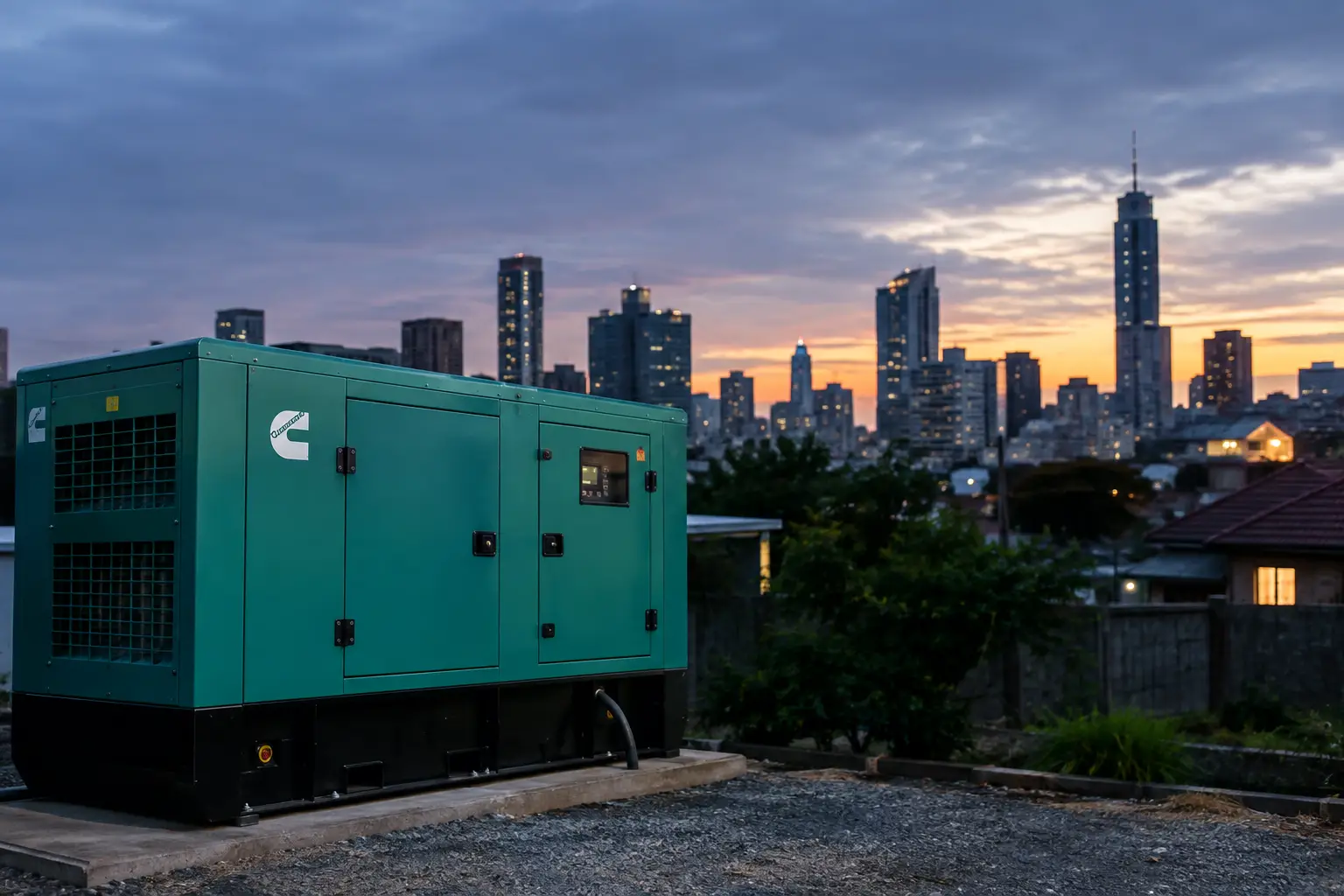
The JKIA incident in particular offers a genuinely important, transferable lesson: having a backup generator on site is not the same as having reliable backup power. A generator that hasn't been properly load-tested, serviced, and integrated with automatic transfer switching can fail at exactly the moment it's needed — which is precisely what appears to have happened at one of East Africa's busiest airports.
For businesses operating in a grid environment with this little reserve margin, a few practical points follow directly from Kenya's own recent history:
Untested backup power is a false sense of security. Regular load-bank testing — actually running the generator under real load, not just a quick start-up check — is the only way to know a system will perform when the grid genuinely fails.
Automatic transfer switching removes the human delay. A nationwide event like July's can happen with essentially no warning; manual generator start-up depends on someone being present and ready to act in the first critical seconds.
Given how thin Kenya's margin currently is, "if" is the wrong framing — "when" is more realistic. A grid operating at a 2.3% reserve margin is not a system where occasional strain is an edge case; it's closer to the expected operating condition. As we explored in The Growing Global Problem of Grid Instability, a thin reserve margin combined with rising demand is one of the clearest early warning signs of a grid heading toward more frequent, not fewer, disruptions.
Correctly sized, well-maintained standby power — not just any generator sitting in a plant room — is what actually protects a business from a repeat of what happened at JKIA.
The Bottom Line
Six weeks after Kenya's grid failed nationwide, the country still doesn't have a clear, confirmed answer for why. That's not a new experience for Kenyan businesses and residents — it's the latest entry in a pattern stretching back to at least 2023, sitting on top of a grid running with almost no spare capacity to begin with. Whatever the eventual explanation for July's event turns out to be, the practical lesson for any business in that grid's territory doesn't change: backup power only protects you if it's been sized, tested, and maintained properly — because the alternative, as JKIA discovered, is finding out it doesn't work at the worst possible moment.