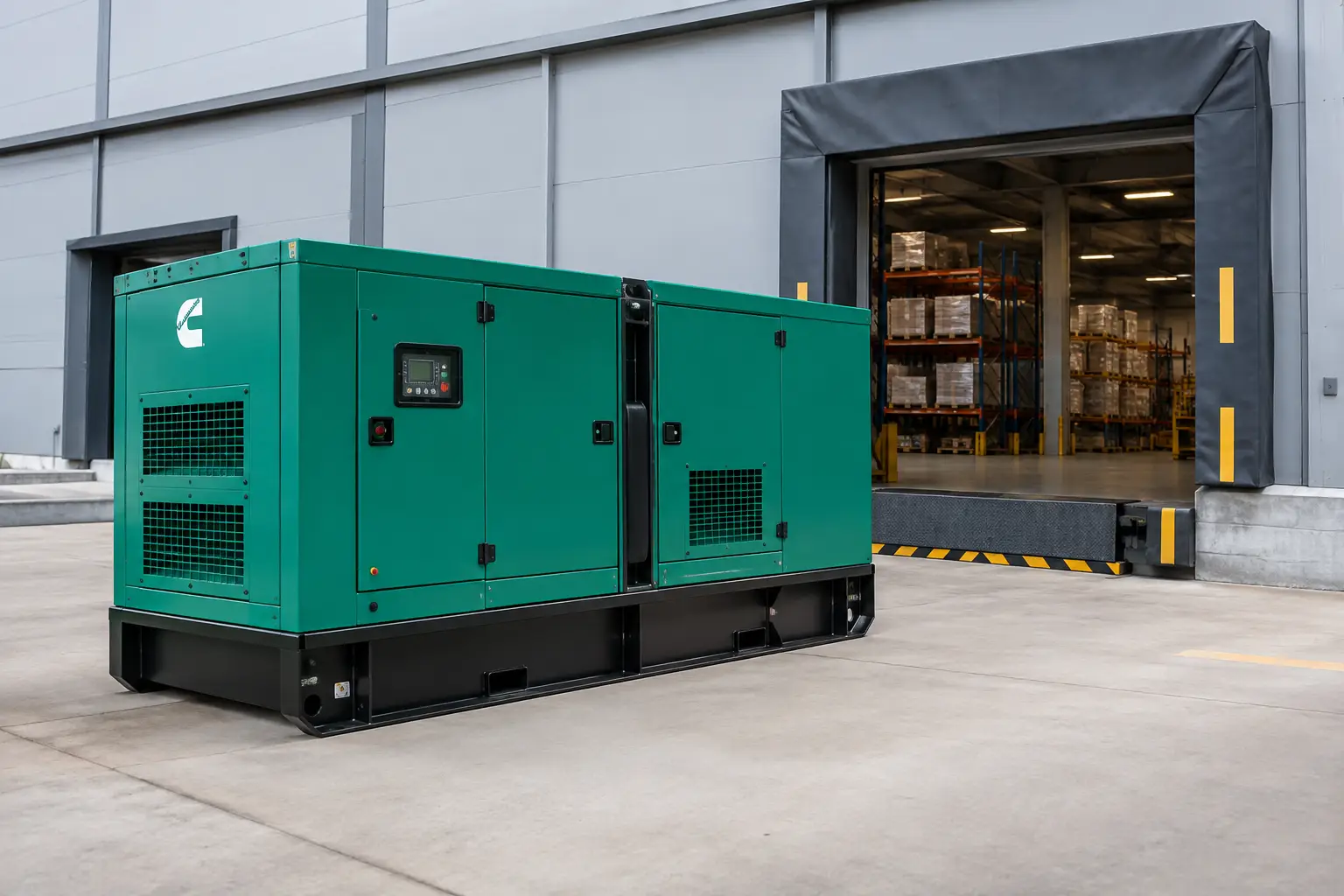
A warehouse power failure does not simply turn off the lights. It can stop conveyor lines, warehouse management systems, dock levellers, security, refrigeration, battery charging and dispatch at the same time. The best backup generators for warehouses are therefore not selected by building size alone. They are specified around the loads that must remain live, the starting characteristics of that equipment and the period the site must operate without mains supply.
For most UK logistics and industrial facilities, a diesel standby generator with automatic mains failure capability is the practical starting point. However, the right kVA rating, enclosure, fuel arrangement and changeover design depend on how the warehouse operates when the grid fails. A generator that is too small can trip or suffer unacceptable voltage dip during motor starts. One that is significantly oversized can add unnecessary capital cost and may spend too much time operating at light load.
What makes the best backup generators for warehouses?
The strongest warehouse backup solution is a complete power system, not just a generator set. The generating set must be correctly sized and rated, but the automatic transfer switch, electrical distribution, fuel storage, controls and maintenance plan are equally relevant to uptime.
A typical warehouse specification will include a three-phase, 400/230V diesel generator, an automatic transfer switch and a sound-attenuated canopy for external installation. Three-phase supply suits the motors, pumps, conveyors, loading equipment and larger HVAC loads commonly found on industrial sites, while retaining 230V supply for selected single-phase circuits.
The generator should start automatically following a mains failure, allow the engine and alternator to stabilise, and transfer the defined essential load without manual intervention. The acceptable interruption period should be set by the operation. A conventional standby system may be suitable for general warehousing, whereas critical IT, controls or life-safety equipment may require uninterruptible power supplies to bridge the transfer period.
Engine and alternator quality matter. Established diesel engine platforms, including Cummins-powered generator sets, are widely specified where dependable performance, parts support and clear power ratings are required. The final selection should always be based on the manufacturer’s data sheet and the actual duty expected at site conditions.
Start with the load study, not the warehouse floor area
Two warehouses with the same footprint can have entirely different standby requirements. A basic storage facility may only need emergency lighting, security, fire-system interfaces, office communications and a small number of loading doors. A high-throughput fulfilment centre may need conveyors, sortation, scanners, servers, refrigeration plant, dock equipment and selected charging infrastructure to remain operational.
Separate loads into three practical groups: life safety and statutory systems, essential operational loads, and non-essential loads that can remain off until mains power returns. This approach often reduces the generator size required and protects the most valuable functions first.
The load assessment must consider more than the running kW figure. Electric motors can draw substantially higher current when starting, particularly where equipment uses direct-on-line starting. Conveyor drives, extraction fans, pumps, compressors and refrigeration compressors can all create a brief but material starting demand. If several items restart together after transfer, the generator may experience a voltage and frequency dip that affects controls or trips protective devices.
Sequenced load restoration is often a better solution than buying excessive capacity. A properly configured control system can reconnect essential circuits in stages, allowing the generator to accept one significant load before the next is introduced. Variable-speed drives and soft starters may reduce starting current, but they can also introduce harmonic effects that need consideration during alternator and control-system selection.
Battery charging deserves specific attention. Forklift and materials-handling fleets can create large, variable loads. In many cases, keeping all chargers active during an outage is neither necessary nor economical. Prioritising a limited charging bank, or delaying charging until mains supply is restored, can materially reduce standby capacity requirements.
Choose the correct standby or prime power rating
Warehouse generators are often purchased for standby duty, meaning they operate when the normal utility supply fails. This is different from prime power, which is intended for variable-load operation over extended periods where utility supply is unavailable or unsuitable.
A standby-rated generator can be the correct and cost-effective choice for a warehouse with a reliable grid connection and occasional outages. A site that experiences frequent or prolonged power interruptions, or is operating through a planned utility constraint, may need a prime-rated set instead. The rating must reflect the intended operating profile, expected annual running hours and load pattern.
Do not treat standby and prime ratings as interchangeable. Their available outputs can differ for the same generator model. Specify the required rating at the start of procurement and verify the stated kVA and kW output, power factor, ambient temperature assumptions and altitude derating where relevant.
A useful commercial question is not only, “What size generator do we need?” but also, “What must the site continue doing after four, 12 or 24 hours without mains power?” That answer determines fuel autonomy, refuelling access and whether a larger tank, external bulk tank or planned fuel delivery arrangement is justified.
Select a warehouse-ready configuration
For external installations near staff areas, offices or neighbouring premises, a silent generator with an acoustic canopy is normally the preferred format. It protects the equipment from weather and reduces operating noise. The enclosure should still allow safe access for service work, daily checks and emergency refuelling.
Open generators can be appropriate within a purpose-designed generator room or protected plant area, but they require the installation to provide suitable ventilation, exhaust routing, acoustic control and fire precautions. A generator room must remove engine heat effectively. Poor ventilation can reduce available output and cause high operating temperatures when the unit is needed most.
The automatic transfer switch should be selected to match the site’s distribution arrangement and fault level. It also needs a clear switching philosophy. Most warehouse standby systems are designed as break-before-make changeover systems that isolate the generator from the grid. Parallel operation, closed-transition transfer or any arrangement capable of exporting power requires additional engineering and agreement with the relevant network operator.
Remote monitoring is valuable where the site is unattended outside operating hours or managed across several locations. At a minimum, facilities teams should be able to receive alarms for failed start, low fuel, low battery voltage, high coolant temperature and transfer-switch position. Monitoring does not replace maintenance, but it shortens the time between a fault developing and corrective action being taken.
Typical warehouse generator capacity ranges
There is no universal warehouse generator size, but the following ranges illustrate how capacity commonly aligns with operational scope:
| Standby capacity | Typical application | | --- | --- | | 13-100 kVA | Security, emergency lighting, IT, gates and limited office or small warehouse essential loads | | 100-300 kVA | Medium warehouse operations, selected dock equipment, conveyors and controlled essential distribution | | 300-800 kVA | High-throughput logistics sites, larger conveyor systems, refrigeration support and wider operational continuity | | 800-3000 kVA | Major distribution centres, large refrigerated facilities and complex industrial sites with substantial motor loads |
These are planning ranges, not final sizing figures. A 250 kVA generator may be adequate for one warehouse and unsuitable for another with similar operational turnover. Motor starting, refrigeration duty, charger loads and the required level of continuity will determine the final specification.
Plan installation, testing and maintenance from day one
A generator that has not been tested under load is not a proven backup arrangement. Routine automatic test runs confirm basic start and control functions, while periodic on-load testing verifies that the engine, alternator, transfer equipment and essential distribution operate as intended. Testing should reflect the real sequence of events, including transfer, load acceptance, alarms and return to mains supply.
Fuel quality and battery condition are frequent causes of standby failure. Diesel held for extended periods can require monitoring and treatment, especially where tanks are large or site turnover is low. Starting batteries, battery chargers, coolant condition, belts, hoses and filters also need planned inspection. Prolonged operation at very low load can be unsuitable for some diesel engines, so the maintenance provider should assess the actual load profile and test regime.
Physical access is another practical consideration. The generator must be reachable for service engineers, fuel deliveries and eventual replacement, without obstructing yard traffic or loading activity. Position exhaust outlets away from air intakes, pedestrian routes and stored goods, and allow sufficient space around the set for cooling airflow and maintenance.
Global Generators supplies diesel generator sets from 13 to 3000 kVA, including silent, open and three-phase configurations for standby and prime power requirements. For a warehouse project, the most useful enquiry information is the essential-load schedule, starting method of major motors, required runtime, installation location and the existing incoming supply details.
Specify the generator around the operation you need to protect, then test it as if the outage has already happened. That is how a standby asset becomes a dependable part of warehouse continuity planning.