A generator that looks correctly sized on a quotation can still be the wrong asset for the site. The purpose of a generator procurement specification guide is to turn operational risk, load demand and installation constraints into a defined equipment requirement. This avoids the common outcome of buying on headline kVA alone, then finding the set cannot start the required load, meet noise limits or provide the required run time.
For facilities managers, contractors and procurement teams, the specification should establish what the generator must do during a power event, how often it will run and what conditions it will operate in. A clear brief also allows suppliers to quote comparable equipment rather than making assumptions that affect price, lead time and performance.
Start with the duty: standby, prime or continuous power
The required duty rating is the first procurement decision because it determines how the generator is selected and operated. Standby power applies where the set supports a site during a mains failure. It is intended for emergency use, usually with variable load and limited annual operating hours. Hospitals, offices, warehouses and many commercial facilities commonly procure standby sets.
Prime power is different. A prime-rated generator is designed to provide the main source of electricity where grid power is unavailable or unreliable. Typical applications include construction compounds, remote process sites, temporary infrastructure and utility works. It can operate for extended periods under varying load, subject to the manufacturer's stated conditions and maintenance programme.
Continuous-duty requirements are more specialised and should be stated explicitly. If the generator will carry a constant base load for long periods, do not assume a standby or prime rating is interchangeable. Ask for the rating basis, permissible annual hours, load profile and ambient conditions to be confirmed in writing.
A specification should state the intended duty, expected operating hours per year and anticipated average load. This protects against an undersized engine, an incorrect alternator rating or a proposal that appears lower cost only because it has been quoted at the wrong duty classification.
Define the load before selecting generator kVA
Generator capacity must be based on the actual site load and the way that load behaves, not simply the rating of the incoming supply. Establish the running load in kW, the apparent load in kVA, power factor and the largest individual load that may start while the generator is carrying normal demand.
Motors, pumps, compressors, lifts and refrigeration plant deserve particular attention. Their starting current can be several times their running current. Direct-on-line starting creates a much greater demand than a soft starter or variable speed drive, although drives can introduce harmonic distortion that also needs assessment. A set that runs the normal load may still suffer an unacceptable voltage or frequency dip when a large motor starts.
Include non-linear loads such as UPS systems, IT equipment, LED lighting and modern building services controls. Their harmonic content can affect alternator sizing and voltage waveform quality. For mission-critical sites, provide the supplier with single-line diagrams, load schedules, motor details and any planned load-shedding sequence.
Do not specify excessive spare capacity without reason. Generators operating at very low load for extended periods can experience inefficient running and, with diesel engines, wet stacking or carbon build-up. Capacity allowance is sensible where expansion is planned, but it should reflect a credible future demand and be reviewed against the lowest expected operating load.
Voltage, frequency and phase requirements
Most industrial and commercial sites in Great Britain require 400/230V, 50Hz, three-phase supply. However, the specification should confirm the required voltage, frequency, number of phases, earthing arrangement and neutral configuration. A single-phase generator may suit smaller loads, while a three-phase set is generally required for plant, distribution boards and larger commercial installations.
If the equipment is being exported, local voltage and frequency standards may differ. Confirm these at the enquiry stage rather than relying on a standard UK configuration. The same applies to switchgear compatibility, cable termination arrangements and any requirement for 415V, 480V or 60Hz operation.
Specify the generator set, not just the engine
A generator is an integrated package. The engine, alternator, control panel, circuit breaker, baseframe, enclosure, fuel system and battery charging arrangement must work together for the stated application.
Engine manufacturer, rated speed and fuel type should be clearly identified. Proven diesel engine platforms, including Cummins-powered generator sets, are widely specified where dependable performance and established parts support matter. However, brand alone is not a complete specification. Confirm the exact engine model, duty rating and site derating conditions.
Alternator performance is equally material. State the required voltage regulation, insulation class, winding pitch where relevant, protection rating and suitability for non-linear loads. For sensitive loads or significant UPS demand, ask the supplier to confirm the alternator and automatic voltage regulator are suitable for the expected harmonic profile.
The control panel should match the level of operational oversight required. A basic automatic mains failure panel may be sufficient for a straightforward standby installation. More complex sites may need remote monitoring, event logging, programmable inputs and outputs, synchronisation, load sharing, or integration with a building management system. Specify required communications protocols rather than assuming every controller will interface with existing site systems.
Generator procurement specification guide for installation conditions
Site conditions can change the selected rating and physical configuration. Record the maximum ambient temperature, altitude, exposure to dust or salt air, ventilation limitations and available footprint. High ambient temperature and altitude reduce engine output, while restricted airflow can cause overheating. A supplier cannot accurately account for these factors if the enquiry only states a kVA requirement.
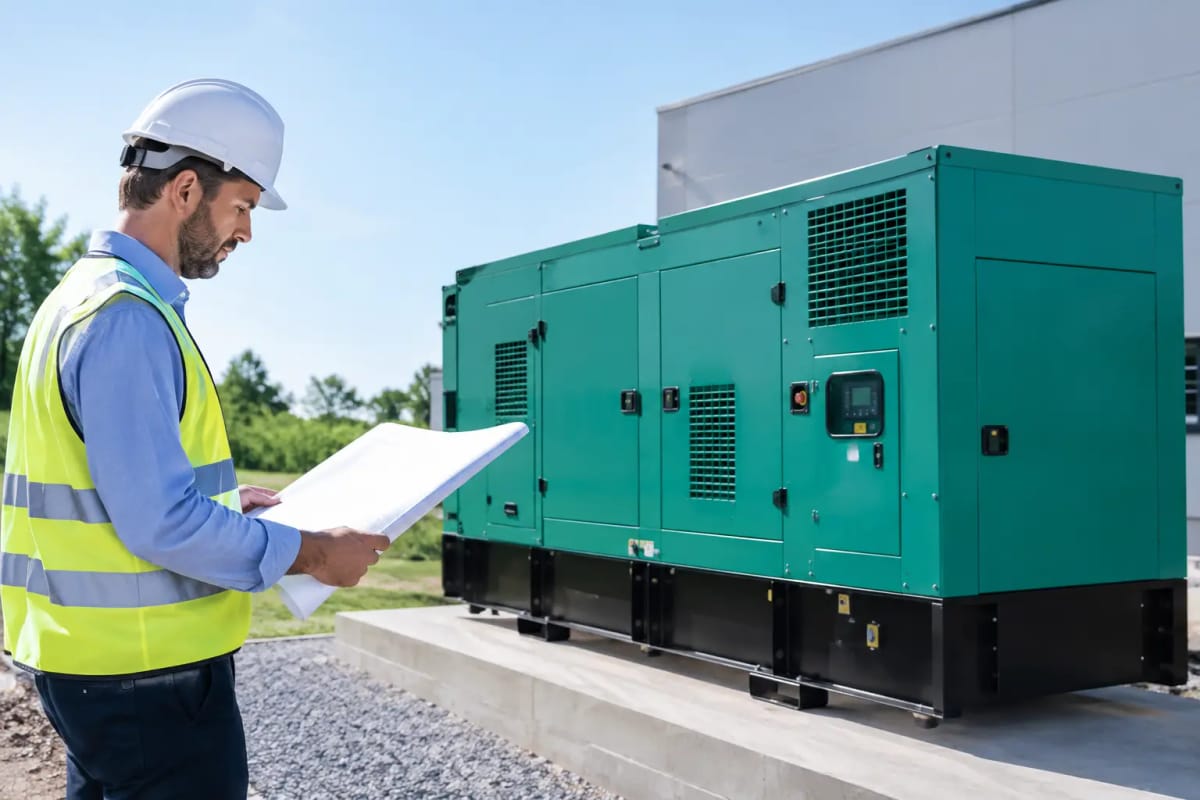
Choose enclosure type according to the operating environment. An open generator is often suitable for a purpose-built plant room with correctly designed ventilation, exhaust routing and acoustic treatment. A silent or weatherproof canopy is normally more appropriate for external installations where noise, weather protection and security are considerations.
Noise requirements should be expressed as a measured sound level at a stated distance, not simply as ‘quiet’. Define whether the limit applies at one metre, seven metres or a site boundary, and whether it must be met under full load. If the set is installed near neighbouring properties, hospital wards or night-time operations, acoustic attenuation may require a higher-specification canopy, silencer or separate enclosure.
Fuel autonomy should be calculated from the required load and expected outage duration. State the minimum run time before refuelling, whether an integrated base tank is acceptable, and whether a bulk tank, day tank or automatic fuel transfer system is required. Consider fuel quality management, leak detection, bunding, fire safety requirements and access for deliveries by tanker or lorry.
Include transfer, protection and resilience arrangements
The generator cannot provide automatic continuity without suitable transfer equipment. Specify whether the site requires an automatic transfer switch, manual changeover, bypass isolation or a more complex synchronised mains parallel system. The transfer arrangement must be coordinated with the generator controls and the site distribution system.
For critical operations, clarify the permitted interruption period. Some loads can tolerate a short loss of supply while the generator starts and transfers. Others require UPS support to bridge that interval. Where resilience requirements are high, a single generator may not be sufficient. Parallel sets, N+1 capacity, sectionalised distribution and dual fuel storage arrangements can reduce single points of failure, but they increase capital cost, controls complexity and testing obligations.
Protection settings also require attention. Short-circuit performance, earth fault protection, breaker rating and discrimination with downstream devices should be reviewed by a competent electrical designer. A generator has different fault characteristics from the grid, and existing protection may not operate as expected when the site is on generator supply.
Make acceptance, support and delivery part of the specification
Procurement should include how the equipment will be inspected, tested, delivered, installed and accepted. Request factory test information, load-test requirements, commissioning scope, documentation, operating manuals and warranty terms. For critical sites, define whether a witnessed load test is required and what load bank duration must be demonstrated.
Also establish practical delivery constraints early: access width, lifting points, crane requirements, plinth design, exhaust route, fuel connections and cable entry. A correctly selected 1,000 kVA set is of little value if it cannot be positioned in the allocated compound or connected without redesign.
Global Generators can support an enquiry with available power ranges, enclosure options and the technical information needed to compare standby and prime power proposals. Providing a detailed specification at the outset helps identify the most suitable set quickly, particularly where fast UK delivery or export arrangements are required.
The strongest procurement brief is not the longest one. It is the one that states the duty, verified load, starting demands, installation conditions and resilience target clearly enough for every bidder to price the same operational requirement. That is where dependable power provision starts.