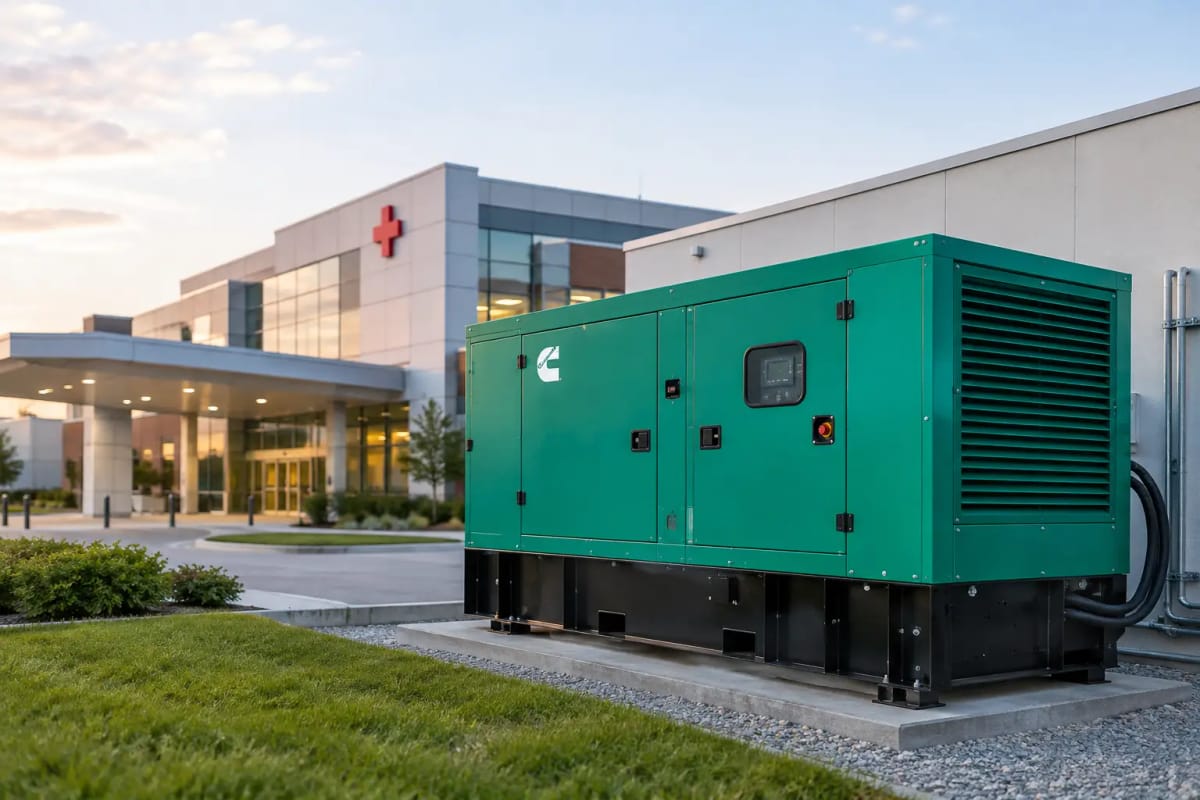
A hospital can lose utility power in seconds, but its critical services cannot pause while a generator starts. Theatre ventilation, critical care systems, emergency lighting, medical gas controls, fire systems, communications, security and essential clinical equipment may all depend on a defined emergency power strategy. Hospital generator resilience is therefore not simply a matter of installing a diesel genset with sufficient kVA on paper. It is the ability of the entire standby power system to start, accept priority loads, operate for the required period and remain available after a real outage.
For estates teams, project engineers and procurement leads, the risk is clear. An underspecified generator can start successfully yet still fail the site when high inrush loads connect, transfer equipment does not operate correctly, fuel is unavailable or maintenance has been deferred. The specification must address the generator set, its controls, distribution, fuel installation and operating regime as one system.
What Hospital Generator Resilience Must Deliver
Resilience begins by defining which electrical loads are genuinely essential and how quickly each must be restored. Not every hospital load belongs on generator supply. Clinical risk assessments, local emergency planning and the site electrical design should establish the priority of life-safety systems, critical clinical loads and operational services. This prevents a standby plant from being consumed by non-essential demand during a utility failure.
The required restoration time also matters. Some systems require no-break continuity and must be supported by uninterruptible power supplies while the generator starts and stabilises. A diesel generator is highly effective for sustained standby operation, but it is not a substitute for a UPS where even a short interruption is unacceptable. The two systems need to be co-ordinated, including the effect of UPS battery recharge once mains supply has failed.
A resilient arrangement also needs a clear response to a single fault. On a smaller facility, one correctly specified standby generator may be proportionate if operational risk, repair response and load profile support that decision. Acute sites and larger hospital campuses will often require greater redundancy, whether through multiple generator sets, sectionalised distribution, alternative supply paths or a combination of these measures. The appropriate design depends on the clinical function of the site, not a generic rule of thumb.
Correct Generator Sizing Is More Than the kVA Total
Adding the nameplate ratings of connected equipment is not a reliable sizing method. A hospital load can include motors, pumps, lifts, compressors, air-handling plant, imaging support systems and UPS equipment, all of which behave differently when supply is restored. Starting current, harmonic content, load sequence and power factor can determine whether a set performs properly when it matters.
The generator must be assessed against both the running load and the largest credible step load. A set may carry the final connected kW demand but experience unacceptable frequency or voltage dip when a major motor starts. That can disrupt sensitive loads, trigger protective devices or cause control systems to drop out. Sequenced load restoration, soft starters, variable-speed drives and properly configured controls can reduce that impact, but each measure needs to be accounted for during design and testing.
Standby and prime ratings must not be treated as interchangeable. Hospital emergency generators are commonly selected for standby duty, but the anticipated outage duration, testing programme and any requirement to support planned works can affect the duty profile. Where a unit may run for extended periods or carry regular operational load, the prime rating and manufacturer operating limits require careful consideration.
Specification should state the required voltage, frequency, phase arrangement, ambient conditions, altitude where relevant, enclosure type, fuel configuration and allowable performance criteria. Three-phase diesel generators are normally required for major hospital infrastructure, while individual single-phase requirements may form part of local resilience planning. The key is to size the complete system for the actual load it will carry.
Allow for Growth and Change Control
Hospitals change continually. A new imaging suite, additional ward equipment, revised ventilation plant or extension can materially alter emergency demand. Reasonable future capacity is valuable, but excessive oversizing is not automatically safer. Diesel generators that operate at very low load for prolonged periods can suffer from poor combustion conditions and wet stacking.
The better approach is to forecast likely development, maintain an accurate critical-load schedule and review generator capacity whenever major electrical works are planned. For larger sites, modular generator capacity can provide a more controllable route to expansion and redundancy than one oversized set.
Transfer Equipment and Distribution Are Critical Assets
The generator itself is only one part of the power path. Automatic transfer switches, automatic mains failure panels, synchronising controls, circuit breakers, interlocks and distribution boards determine whether emergency power reaches the intended services. A high-quality generator cannot compensate for poorly designed or poorly maintained switching equipment.
Transfer schemes should be designed around load priority and fault containment. Critical clinical circuits may need a different restoration sequence from general essential services. Sectionalised arrangements can prevent a fault on one section from removing all emergency supply, while synchronised multiple-set systems can improve capacity management and maintenance flexibility. These arrangements add complexity, however, and require controls that are fully understood by the site team.
Protection settings need particular attention. Generator fault current is generally lower than utility fault current, which can affect the operation of protective devices. Selectivity studies must reflect generator operating conditions so that a downstream fault clears locally rather than unnecessarily tripping the generator incomer or a wider section of the essential supply.
Fuel Autonomy Must Be Planned, Not Assumed
Fuel is frequently the weak point in an otherwise capable installation. Day tanks, bulk storage, transfer pumps, fuel polishing, leak detection, tank bunding and remote level monitoring all influence whether a generator can operate through an extended disruption. The required autonomy should be based on the site's risk assessment, expected resupply options and the consequences of access restrictions during a local emergency.
Stored diesel also degrades over time. Water ingress, microbial contamination and sediment can block filters or damage fuel-system components precisely when the set is called upon. A documented fuel-quality regime, routine sampling and appropriate fuel treatment are practical resilience measures. Fuel transfer systems should be included in operational testing, rather than assuming the engine can draw reliably from long-term storage.
Resupply arrangements need to be realistic. Consider vehicle access, safe delivery procedures, supplier response, fuel connection points and the possibility that regional disruption will affect multiple sites simultaneously. A nominally large tank provides limited assurance if the installation has not been designed to use and replenish that fuel safely.
Testing Proves the Design Under Real Conditions
Routine no-load starting checks are useful, but they do not prove hospital generator resilience. The generator may start and show healthy parameters while transfer equipment, fuel systems or load acceptance problems remain hidden. A planned test regime should progressively verify the full emergency power path.
This normally includes routine exercising, automatic start and transfer tests, loaded tests, checks of alarms and remote monitoring, and periodic validation of longer-duration operation. Tests should reflect credible operating conditions, including priority load restoration and significant step loads where it is safe to do so. Any abnormal result should lead to investigation and corrective action, not simply a recorded pass or fail.
Load-bank testing has a valuable role where site loads are unsuitable or insufficient for generator exercise. It can confirm engine performance and help avoid light-load running, but it does not replace an on-load test of real switchgear and distribution. Both methods have a place in a mature maintenance programme.
Maintenance records should cover battery condition, coolant, lubricants, belts, hoses, filters, heater operation, control-panel events, breaker condition and fuel status. Starting batteries deserve close attention because battery failure remains a straightforward way for a healthy engine to become unavailable. Remote monitoring can give estates teams early warning of low fuel, charger faults, alarms and failed exercises, but it should support competent inspection rather than replace it.
Procurement Decisions That Protect Availability
For new installations or replacement projects, procurement should assess the supplier's capacity to provide a correctly matched set, not only the initial purchase price. Engine provenance, alternator specification, control capability, acoustic enclosure requirements, physical footprint, access for service and availability of parts all affect long-term uptime. A silent generator may be essential where plant is close to wards, residential areas or planning-sensitive boundaries, while an open set can suit protected internal plantrooms with suitable ventilation and fire strategy.
Fast availability matters when an existing generator has failed or a project programme is under pressure, but it should not bypass site surveys, load data review and integration planning. A Cummins-powered diesel generator in the appropriate standby rating can provide dependable emergency capacity, provided it is matched to the hospital's electrical and operational requirements.
Global Generators supports this specification-led approach with generator sets across key power ranges and configurations for urgent UK delivery and wider export requirements.
The most useful question for any hospital is not whether its generator starts. It is whether the site has evidence that essential services will remain supplied, protected and manageable for as long as the utility failure lasts. That evidence comes from disciplined design, realistic testing and a maintenance regime that treats standby generation as critical clinical infrastructure.