Quick Answer
Under the government's new Smart Secure Electricity Systems (SSES) scheme, licensed suppliers will soon be able to remotely reduce power to heat pumps, EV chargers, and home batteries at peak times - in exchange for a discounted tariff. It's opt-in and won't switch devices off completely, but it signals a grid that manages demand more tightly. The only way to keep full control of your home's power supply regardless of grid decisions is a backup source that sits outside the scheme entirely, such as a correctly sized standby generator with an automatic transfer switch.
The way Britain manages electricity at home is about to change. Under new government plans, licensed energy suppliers will soon be able to remotely adjust how much power certain home devices - heat pumps, EV chargers, and home battery systems - draw from the grid during periods of peak demand.
For many households, this will happen quietly and by agreement, in exchange for cheaper tariffs. But it raises a fair question for any homeowner who values reliability: if control of your power supply is shifting further into the hands of your energy supplier and the National Grid, how do you keep some of that control for yourself?
Here's what's actually changing, why it's happening, and the practical options homeowners have to stay in charge of their own power.
What Is Grid Load Control?
Grid load control is the ability of an energy supplier or grid operator to remotely turn down - not off, but reduce - the electricity draw of specific connected devices in your home. It's being introduced through a government and regulator programme called the Smart Secure Electricity Systems (SSES), run jointly by the Department for Energy Security and Net Zero (DESNZ) and Ofgem.
The scheme targets what are known as Energy Smart Appliances (ESAs) - devices with the biggest impact on electricity demand:
- Heat pumps (including hot water heat pumps and electric hot water cylinders)
- EV smart charge points (excluding public and rapid chargers)
- Domestic battery energy storage systems
Under the plans, a supplier such as a major energy provider would be able to instruct these devices to draw less power for a limited period - typically during a cold winter evening when national demand peaks. The mechanism is officially termed "load control”, and it requires organisations carrying it out to hold a specific licence, expected to come into force by the end of 2026, with full licensing requirements following in 2027.
Crucially, participation is expected to be opt-in. Households that agree to have their devices load-controlled would be offered discounted tariffs in return - similar in principle to existing off-peak or smart tariff schemes, but with the supplier having direct, remote influence over the device rather than just the price signal.
Why the Government Is Doing This
The core justification is grid stability. Britain's electricity system is under growing pressure for a few converging reasons:
- Electrification of heating and transport. As more homes switch from gas boilers to heat pumps and from petrol cars to EVs, a much larger share of national energy demand is shifting onto the electricity grid - and that demand spikes hardest on cold winter evenings, exactly when heating needs are highest.
- A more weather-dependent generation mix. As renewable sources make up a larger share of supply, the grid has less of the steady, on-demand output that traditional gas and coal power stations used to provide, making it more sensitive to sudden surges in demand.
- Rising installation numbers. There are now more than 223,000 heat pumps installed in UK buildings, with a government target of 450,000 new installations per year by 2030. Every heat pump installed since last year has been required to be internet-connectable, laying the technical groundwork for schemes like this.
Regulators frame load control as a tool to reduce blackout risk by smoothing out demand peaks rather than building expensive extra generating capacity that would sit idle most of the year. It's a genuinely contested policy - some industry and political voices have welcomed it as a sensible, low-cost way to balance the grid, while others have raised concerns about handing suppliers remote control over home heating, even on an opt-in basis. Both perspectives are worth understanding as the consultation process continues through 2026.
What This Means for Homeowners
A few practical points are worth separating from the headlines:
It's opt-in, at least for now. The current proposals are built around households actively agreeing to participate in exchange for a discounted tariff. Nobody is expected to have their heating remotely adjusted without having signed up to a scheme that allows it.
It doesn't remove the underlying blackout risk. Whether or not you opt into a load control scheme, the reasons the grid is under strain - rising electrified demand and a more variable supply mix - don't go away. Load control is a tool to manage that strain across the whole system; it isn't a guarantee that your household won't experience a power cut, especially during a severe cold snap when demand is at its highest everywhere at once.
It's a sign of where the grid is heading. Even homeowners who never opt into a load control tariff are, by extension, more exposed to a national electricity system that is increasingly optimised around managing scarcity at peak times rather than simply having abundant spare capacity. That's a structural shift worth planning around, not just a one-off policy announcement.
How to Keep Control of Your Own Power
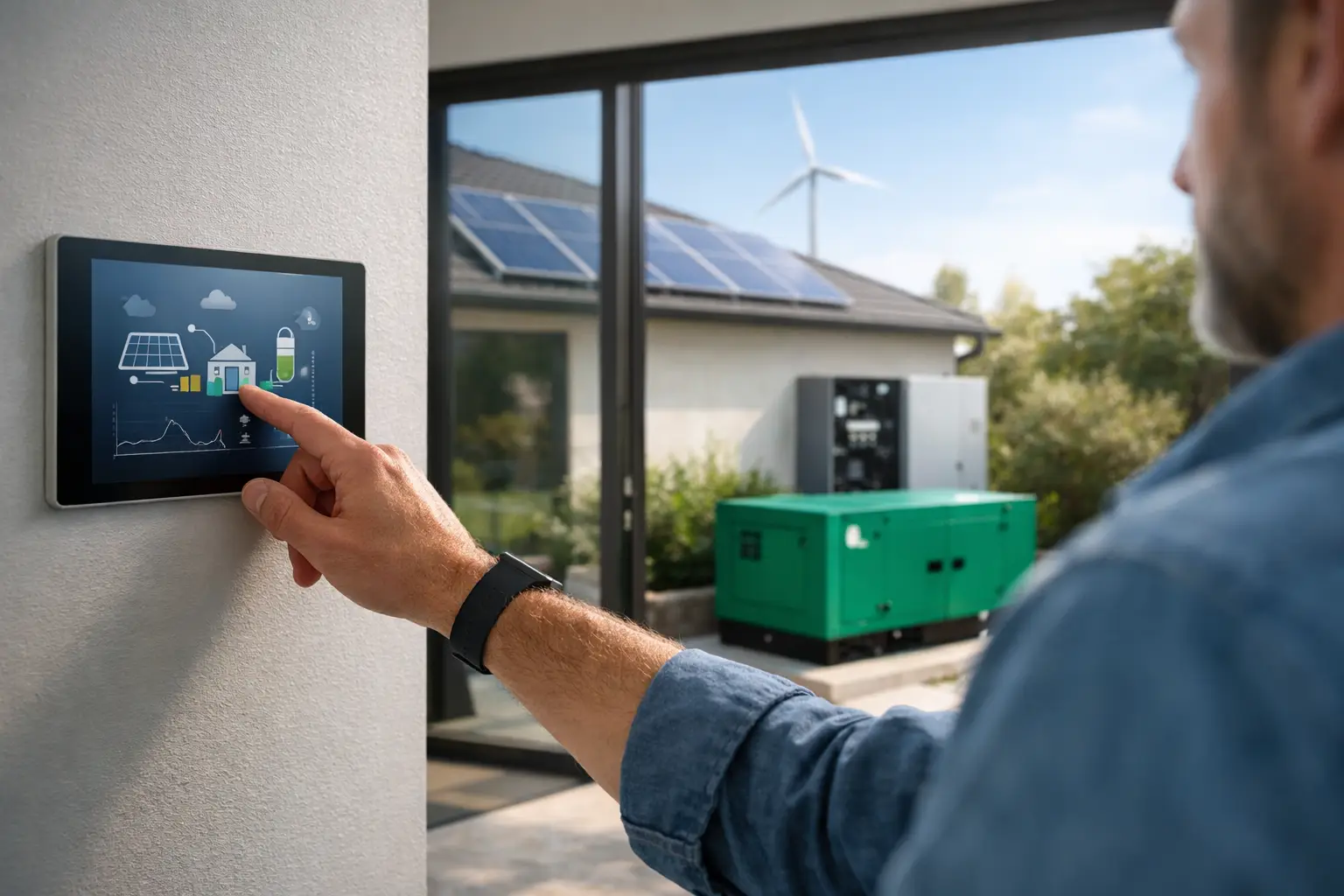
If the direction of travel is a grid that manages demand more actively - and, at times, more tightly - the most direct way for a household to stay in control is to reduce dependence on that grid altogether during the moments that matter most. A backup generator is the most established way to do this. Unlike a battery storage system, which is itself part of the smart appliance ecosystem targeted by these regulations, a generator sits entirely outside the grid and outside any load control scheme. When it's running, your home's power supply is decided by you, not by a remote signal.
For homeowners considering this route, a few things matter:
- Sizing matters more than power alone. A generator needs to be sized to your home's actual peak load, including the surge demand of anything with a motor - a heat pump included. Undersizing is one of the most common mistakes homeowners make, and it leads to nuisance tripping exactly when you need reliable power most.
- An automatic transfer switch (ATS) makes it seamless. Rather than manually starting a generator during an outage, an ATS detects a grid failure and switches your home's supply across automatically, restoring power within seconds.
- Standby vs continuous use. Most residential backup generators are specified for standby duty - designed to run intermittently during outages rather than as a primary power source. This keeps running costs and maintenance requirements sensible for occasional use.
- Fuel and noise considerations. For homes, a silent (acoustically enclosed) diesel generator is usually the right balance of reliability, running cost, and neighbourly consideration compared with an open-frame unit.
- Larger homes and estates benefit most from a properly specified diesel generator. Where a whole-house or estate-scale backup is needed - particularly for larger properties already running heat pumps and other high-demand electrical systems - a correctly sized diesel generator set gives a level of resilience that a home battery alone cannot match during an extended outage.
Getting the Sizing Right
Before buying, it's worth calculating your home's actual power draw rather than guessing. Add up the running load of essential circuits - heating system controls and pumps, lighting, refrigeration, and any medical or security equipment - then account for the startup surge of your largest motor-driven appliance, which can be several times its running wattage for a second or two. A generator sized on running load alone will often fail at the exact moment demand peaks.
This is where working with a supplier who can properly specify - not just sell - a generator makes the difference between a system that works reliably for years and one that disappoints the first time it's actually needed.
The Bottom Line
Grid load control isn't inherently a bad thing - for many households, an opt-in scheme with a discount tariff will be a sensible trade-off. But it's part of a broader shift toward a grid that manages scarcity more actively, and it's a reasonable moment for any homeowner who values reliability to ask how much of their power supply they want left in someone else's hands.
A correctly specified backup generator doesn't replace the grid, and it isn't meant to run your home indefinitely. What it does is give you a genuine fallback - power that switches on when you need it, controlled by you, regardless of what's happening on the national network. As Britain's electricity system continues to change over the next few years, that kind of independence is likely to matter more, not less.