Quick answer
On 26 August 2026, President Trump signed Executive Order 14420, declaring a national emergency over foreign-produced equipment used in America's bulk-power system — the large-scale transmission and generation infrastructure that keeps the national grid running. The order cites risks of cyber exploitation, remote-access backdoors, sabotage, and supply disruption, and gives the Department of Energy authority to block or restrict certain foreign-made transformers, inverters, circuit breakers, and associated software. It does not apply to distribution networks, equipment below 69kV, or behind-the-meter backup generators — so most standby power buyers aren't directly regulated by it. What it does signal, clearly, is that equipment provenance and supply-chain transparency are becoming a bigger factor in how power infrastructure gets bought and specified, across the whole industry.
What the Executive Order Actually Does
On 26 August 2026, President Trump signed Executive Order 14420, "Declaring a National Emergency to Secure the United States Bulk-Power System." It invokes two significant pieces of legal authority — the International Emergency Economic Powers Act (IEEPA) and the National Emergencies Act — to declare that foreign-produced bulk-power system equipment poses an "unusual and extraordinary threat" to the United States.
In practical terms, the order authorises the Secretary of Energy to prohibit, condition, or unwind transactions involving foreign-produced equipment where two things are both true: the equipment has a connection to a "Covered Foreign Entity," and it presents an "undue or unacceptable national security risk." The Department of Energy's own summary confirms the Secretary can also impose mitigation measures — including isolation, monitoring, or outright removal — on foreign equipment that's already installed, not just future purchases.
What Equipment Is Actually Covered
The order casts a fairly wide net over the physical hardware of the bulk-power system: transformers, inverters, circuit breakers, and other electrical equipment, along with the associated software, firmware, and digital capabilities that control them. Critically, it explicitly excludes facilities used for local distribution of electric energy and transmission equipment below 69kV — meaning this is squarely targeted at large-scale grid infrastructure, not local or commercial-scale electrical systems.
The order applies to transactions "initiated" after 26 August 2026. Equipment already installed before that date faces a separate, and according to legal analysts, still-unclear compliance picture — DOE has authority to act on it, but hasn't yet specified exactly how or when.
Who It's Actually Aimed At
The order applies to equipment tied to suppliers or service providers connected to any of 24 named countries. According to legal and industry analysis of the order, aside from China, most of the other listed countries aren't typical suppliers to the US power industry in the first place — a detail that makes the order's real-world target fairly clear, even though it's written in general terms rather than naming any single country as the focus.
This Isn't the First Time — And That History Matters
This order didn't appear from nowhere. President Trump signed a broadly similar order during his first term — Executive Order 13920 — in 2020. President Biden paused it shortly after taking office and formally rescinded it in 2021. The 2026 order doesn't just revive that earlier approach; according to legal analysis from firms tracking the order, it restores and expands the scope of potentially restricted transactions and covered equipment compared to the original 2020 version.
That back-and-forth is worth knowing if you're trying to gauge how durable this policy is likely to be. Grid equipment security policy in the US has now flipped at least twice with changes in administration, which is a genuine consideration for any business making long-term procurement decisions based on the current rules.
The Timeline: What Happens Next
The order itself sets the emergency declaration and the legal framework, but the operational detail — who exactly counts as a "Covered Foreign Entity," which specific equipment gets restricted, and how existing installations will be handled — is left to follow-on rulemaking. DOE is required to publish implementing rules or regulations within 120 days of the order, putting the deadline at around 24 December 2026.
Until those rules are published, the practical scope of the order remains somewhat theoretical for most companies — the order draws the boundary, but the regulations will determine who actually has to act, how quickly, and at what cost.
Why Now? The AI and Data Centre Connection
The order is explicit about part of its reasoning: rising electricity demand from artificial intelligence infrastructure, data centres, and advanced manufacturing is cited as a factor that raises the stakes of any successful attack on grid equipment. A vulnerability that might once have caused a contained, manageable disruption now sits inside a grid under far more strain and carrying far higher economic consequences if it fails — which is the same demand-growth story we've covered elsewhere in the context of PJM's repeated 2026 grid emergencies. It's a useful reminder that America's grid security concerns and America's grid capacity concerns are, increasingly, two sides of the same underlying pressure.
The order also isn't an isolated action. The White House's own fact sheet notes it follows a July 2026 executive order on defense supply chains and an August 2026 proclamation addressing drone imports — part of a broader pattern of supply-chain security actions across critical sectors during 2026.
Does This Affect Backup Generators?
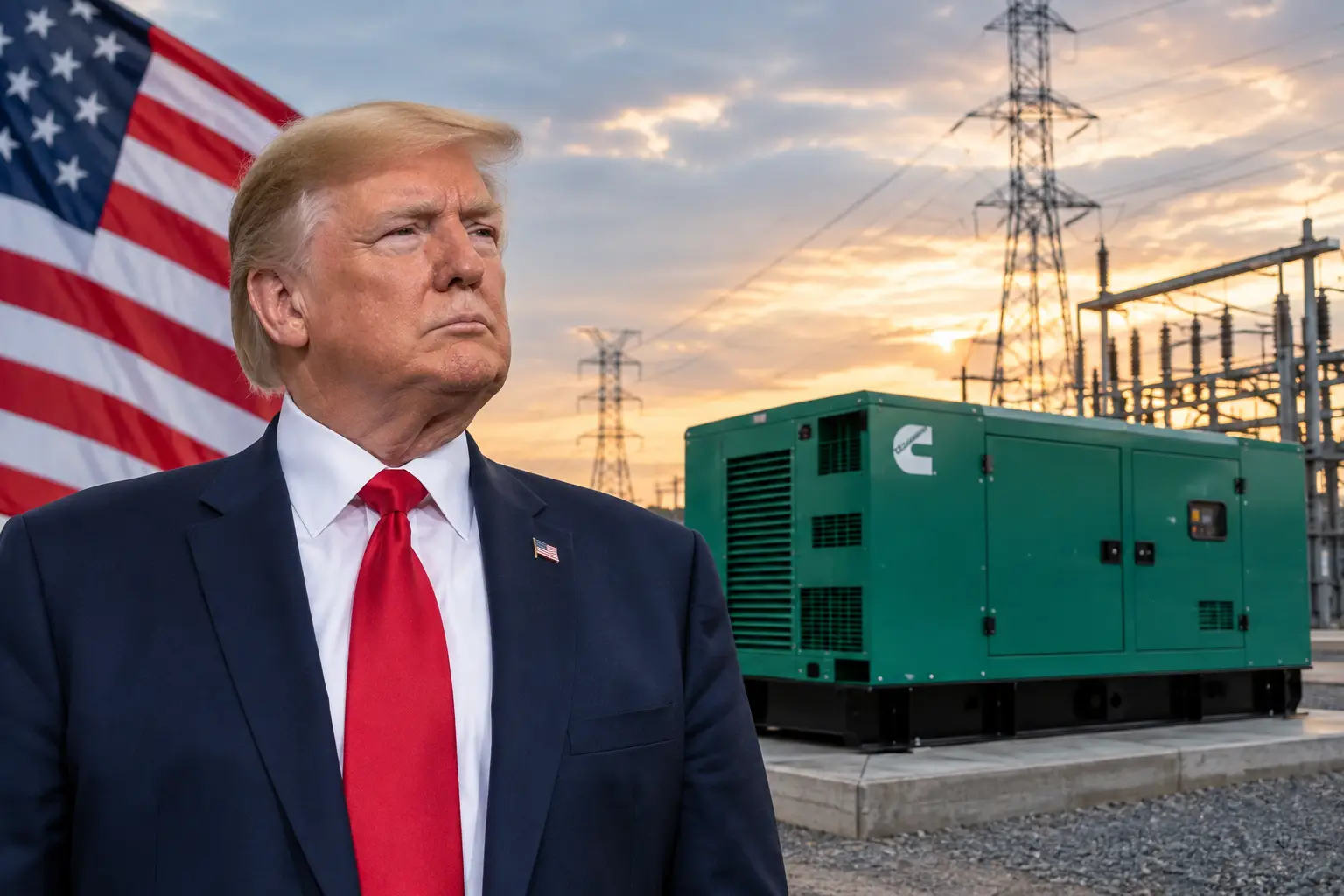
This is the question most relevant to anyone actually buying power equipment, and the honest answer is: not directly, for most buyers. The order is scoped to bulk-power system infrastructure — large-scale transmission (69kV and above) and major generation assets — not behind-the-meter backup generation sitting at a hospital, data centre, or commercial site. A standby diesel generator protecting an individual business isn't the kind of equipment this order is targeting.
That said, it's worth understanding the direction this signals, even for equipment outside its direct scope. Increased federal scrutiny of grid equipment provenance tends to raise awareness across the entire power equipment supply chain, not just the specific category covered by a given order. Buyers of any kind of power infrastructure — utility-scale or behind-the-meter — are likely to face more questions about where their equipment actually comes from over the next few years, whether or not a specific regulation requires it.
What This Means for Power Equipment Buyers More Broadly
Equipment provenance is becoming a genuine due-diligence question, not just a compliance afterthought. Even where a purchase isn't legally covered by an order like this one, knowing exactly who manufactured the engine, the alternator, and the control system in a generator — and being able to demonstrate that clearly — is increasingly a marker of a trustworthy supplier relationship.
Buying from established, traceable manufacturers matters more than ever. Cummins, for instance, designs, builds, and services its own engines, alternators, and control systems in-house, with a clear, well-documented manufacturing footprint — a meaningfully different proposition from equipment assembled from components of uncertain or undisclosed origin.
This is a good moment to ask your current supplier where your equipment actually comes from, particularly for any large-scale or critical infrastructure project, even if a diesel genset itself sits well outside the scope of this particular executive order.
The Bottom Line
Executive Order 14420 is a significant, if narrowly scoped, policy shift — it puts real federal authority behind restricting foreign-made equipment in America's bulk-power system, and it revives and expands an approach that was reversed once already under a different administration. For most buyers of backup and standby power equipment, it isn't a direct regulatory concern. But it's a clear signal of where scrutiny on power equipment supply chains is heading, and a good prompt to make sure you actually know — and can verify — where the equipment protecting your own operations comes from.