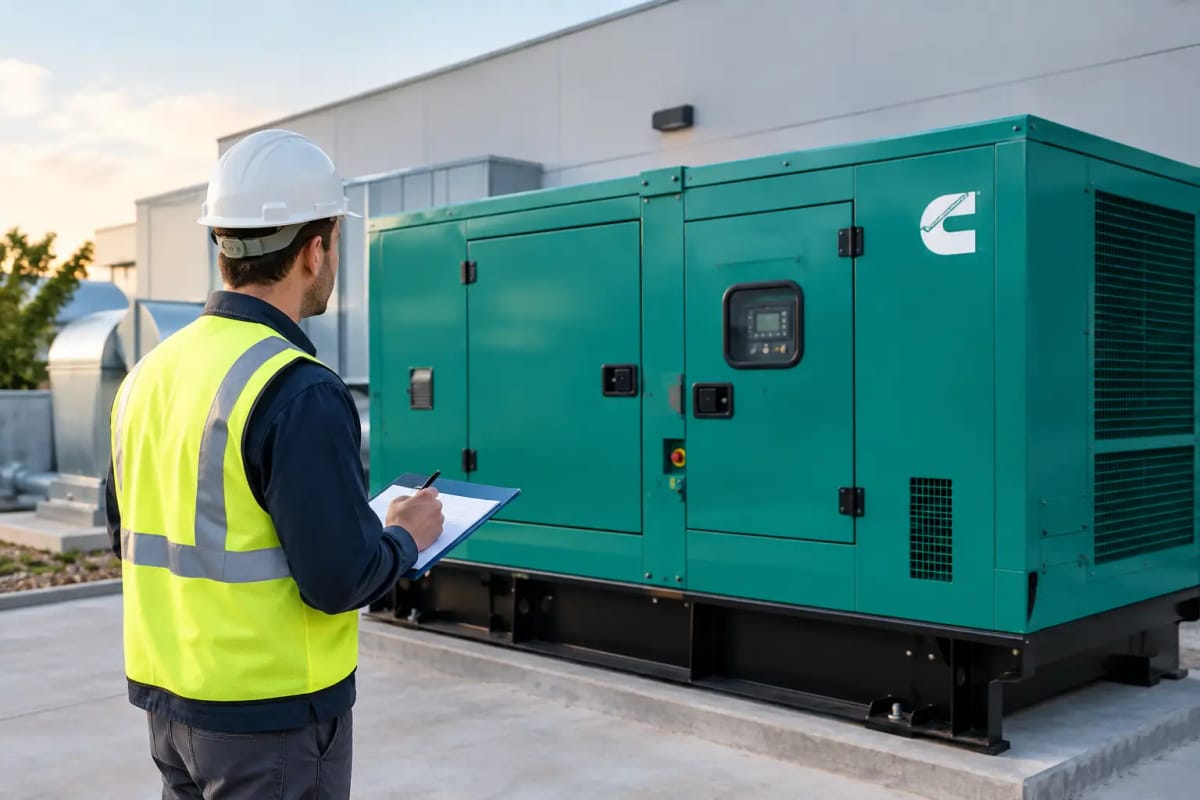
A generator that starts but cannot carry the required site load is not a backup solution. It is an operational liability. Generator procurement mistakes are rarely caused by choosing the wrong paint finish or missing a minor accessory. They usually begin with an incomplete load assessment, an unclear duty requirement, or a specification that has not accounted for how the set will be installed and maintained.
For facilities managers, project engineers and procurement teams, the consequence can be severe: production stops, critical systems are exposed, hire costs rise and a replacement programme begins before the original asset has delivered value. A sound procurement process should establish the electrical demand, operating profile, site conditions and compliance requirements before comparing generator prices.
Generator procurement mistakes that affect availability
1. Sizing from an estimate rather than a load study
The most common error is selecting a generator from a broad estimate of connected equipment. Connected load is not the same as running load, and running load is not always the same as the demand at start-up. Motors, pumps, compressors, lifts and refrigeration equipment can create substantial transient loads. If several items start together, voltage and frequency may dip far enough to trip controls or prevent machinery from starting.
A proper assessment should identify normal demand, maximum coincident demand, power factor, motor starting method and expected future expansion. It should also consider non-linear loads such as UPS systems, variable speed drives and modern IT equipment, which can affect alternator sizing and waveform performance.
Oversizing is not automatically the safer option. A lightly loaded diesel generator can suffer from poor fuel efficiency, wet stacking and avoidable maintenance exposure. The correct capacity is the one that can accept the required load profile with suitable margin, while operating in a healthy working range. The answer may be a single set, a larger set with load-bank provision, or a synchronised arrangement where resilience and variable demand justify it.
2. Confusing standby power with prime power
Standby and prime ratings serve different operating duties. Treating them as interchangeable can lead to an unsuitable purchase, warranty disputes and shortened equipment life.
A standby-rated generator is intended for emergency use during utility failure. Its annual operating hours and load profile are restricted by the manufacturer’s rating conditions. A prime-rated generator is designed for variable load operation over extended periods, making it appropriate for applications such as construction compounds, remote operations and locations with an unreliable grid supply.
Procurement documents should state the expected annual running hours, anticipated load variation and whether the set will support a temporary, continuous or emergency duty. If a site expects regular outages lasting days, a standby-only decision requires close scrutiny. The initial price difference can look attractive, but it is insignificant beside the cost of an unplanned failure or an engine operating beyond its intended duty.
3. Specifying kVA without checking the electrical system
kVA is a necessary starting point, not a complete specification. Buyers must also confirm voltage, frequency, phase arrangement, power factor and the earthing arrangement required on site. A 400/230V three-phase generator may suit a commercial facility, while a single-phase set may be more appropriate for a smaller installation. Neither is simply a substitute for the other.
The relationship between kVA and kW matters as well. Generator ratings are commonly expressed at a stated power factor, often 0.8. A site with a materially different power factor, significant harmonic distortion or sensitive electronic loads may need additional engineering review. This is particularly relevant when supporting data rooms, healthcare equipment, telecoms infrastructure or automated manufacturing lines.
The generator must also work with the transfer arrangement. Automatic transfer switches, changeover panels, protection settings and distribution boards need to be rated and configured for the duty. A generator can be correctly sized in isolation yet still fail to provide an effective system if the switching equipment cannot manage the available fault level, load sequence or neutral arrangement.
4. Treating enclosure choice as a cosmetic decision
Silent and open generator sets are built for different installation environments. An open set can be practical inside a suitably designed plant room, where ventilation, acoustic treatment, fuel safety and exhaust routing are controlled. It is not a low-cost alternative for an exposed external location.
A silent, weatherproof enclosure provides protection and reduces noise, but buyers should check the stated sound level, measured distance and operating condition. Acoustic requirements vary considerably between a remote industrial yard, a city-centre commercial site and a hospital boundary. A set that is acceptable at seven metres may not meet a local planning condition at the nearest receptor.
Physical access matters just as much. Confirm delivery route, lifting points, crane requirements, plinth dimensions, door clearance for service access and the space needed to remove filters, batteries or radiators. If the generator will arrive by lorry but cannot be safely positioned, the project loses time before commissioning has even started.
5. Underestimating fuel, cooling and exhaust requirements
A generator package does not end at the engine and alternator. Fuel autonomy, cooling airflow and exhaust design determine whether it can run for the period the site requires.
A base fuel tank may support only a limited number of hours at the expected load. Sites with prolonged outage risk should calculate consumption at realistic duty, not only at a favourable low-load figure. They should then determine whether an integral tank, external bulk tank, day tank or refuelling contract is required. Fuel quality management is equally relevant. Diesel stored for long periods needs monitoring, water control and, where necessary, treatment to avoid blocked filters and unreliable starts.
Plant rooms require a defined path for combustion air, radiator discharge air and hot-air extraction. Recirculating hot air can cause derating and high-temperature shutdowns. Exhaust runs must be correctly sized, supported and insulated where necessary, with back pressure kept within engine limits. These are engineering requirements, not installation details to resolve after delivery.
6. Buying on headline price instead of whole-life readiness
A low purchase price can conceal missing equipment or future cost. Compare quotations on the complete delivered requirement: generator rating, engine and alternator specification, enclosure, control panel, fuel tank, battery system, circuit breaker, delivery, installation interface, commissioning and warranty terms.
Availability also has commercial value. A lower-priced set with a long lead time may be the wrong choice when a site has a fixed handover date or an ageing generator approaching end of life. Global Generators supports this decision with stocked generator sets across key power sizes, helping buyers balance specification, price and delivery urgency.
Engine brand, parts availability and service access should be considered early. Proven industrial engines such as Cummins-powered units can offer a strong basis for critical applications, but the selected model must still be suitable for the duty, location and fuel strategy. Procurement should not assume that a recognised badge compensates for an incomplete specification.
7. Leaving testing and maintenance out of the project scope
The worst time to discover a generator issue is during a real mains failure. Yet many projects focus entirely on delivery and installation, with no agreed acceptance test, load test schedule or maintenance responsibility.
Commissioning should verify automatic start, transfer operation, alarms, shutdowns, battery charging, output voltage and frequency under load. Where practical, a load-bank test confirms that the set can perform beyond an idle or lightly loaded demonstration. For critical sites, testing should include the actual load sequence and essential systems that the generator is expected to support.
Maintenance planning must cover routine inspections, fluid and filter changes, battery condition, fuel checks and periodic exercising. The right interval depends on operating duty, environmental conditions and manufacturer guidance. A generator that is rarely used still requires attention. Standby equipment ages while it waits.
Build the specification before requesting prices
A clear enquiry produces a more accurate quotation and reduces late-stage changes. At minimum, state the required standby or prime rating, voltage and phase, expected load profile, site location, enclosure or plant-room arrangement, fuel runtime target, transfer requirements and delivery deadline. Include drawings or photographs where access, ventilation or exhaust routing could affect the solution.
If any of these points are uncertain, resolve them before placing the order rather than selecting the cheapest nominal kVA. The best generator procurement decision is one that gives the site a tested, serviceable source of power when the mains supply is no longer available.