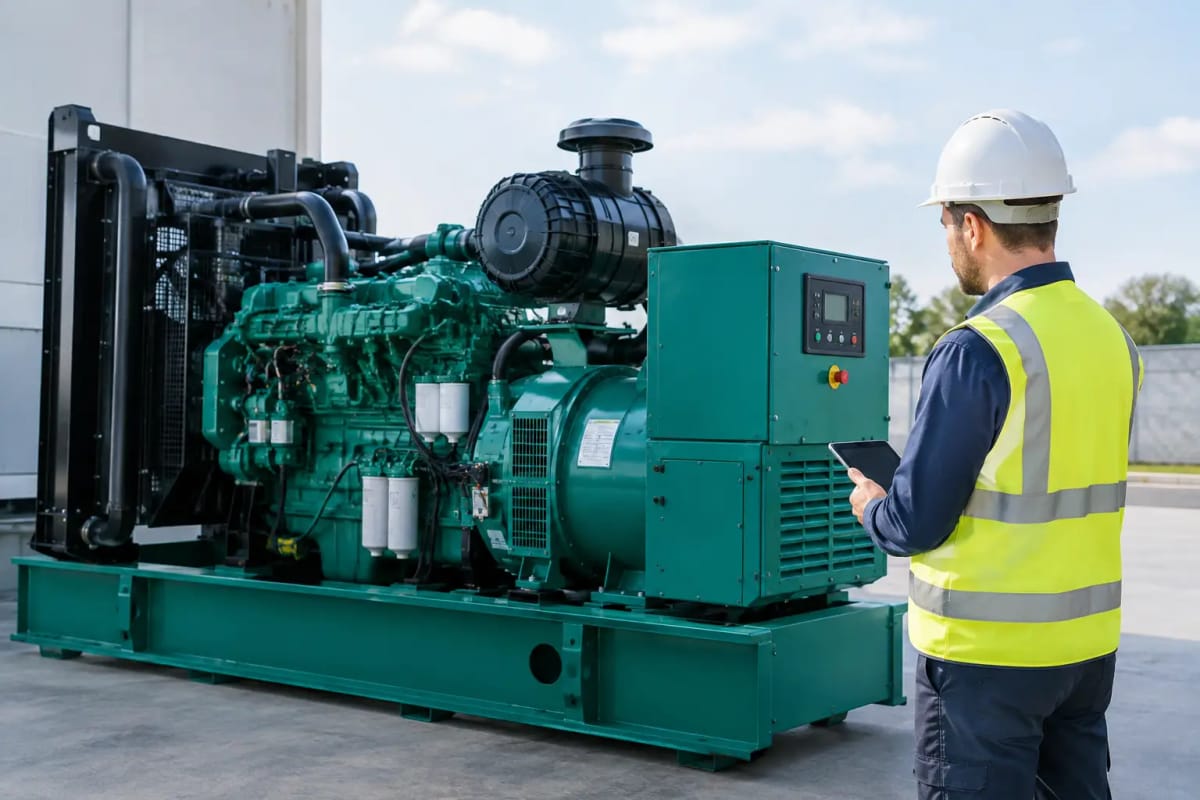
A generator that appears healthy at no load can behave very differently when plant starts, transfer equipment operates or a large motor comes online. If you are asking, why does generator voltage fluctuate, the answer is usually found in the relationship between engine speed, alternator excitation, load behaviour and the condition of the electrical connections. In a critical-power application, the size, duration and cause of the variation all matter.
Small, brief voltage movement following a load change can be normal. Sustained hunting, repeated dips, phase-to-phase imbalance or voltage outside the equipment tolerance is not. It can cause contactors to drop out, drives to trip, motors to overheat and sensitive controls to malfunction. The fault should be assessed against the generator set rating, the connected load profile and the required voltage regulation standard.
Why Does Generator Voltage Fluctuate Under Load?
Alternator output voltage is controlled by rotational speed and magnetic excitation. The diesel engine provides the speed through its governor, while the automatic voltage regulator (AVR) adjusts current to the alternator field to maintain the selected terminal voltage. A disturbance in either control system, or a load demand beyond what the set can respond to, produces voltage movement.
A well-specified industrial generator is designed to recover after a defined load step. However, a large step load creates an immediate demand for electrical power and reactive power. Before the engine and AVR have corrected, voltage may dip. Starting a direct-on-line motor is a common example: its inrush current can be several times its normal running current. Pumps, compressors, cranes, refrigeration plant and heavily loaded conveyors can all create significant transient voltage drop.
The practical question is whether the set recovers quickly and remains within the tolerance of the connected equipment. If voltage falls sharply every time a known load starts, the generator may be undersized for the starting method, or the load sequence may need controlling. If it fluctuates with no meaningful change in demand, investigation should focus on the governor, AVR, sensing circuit and alternator condition.
Load size, power factor and load steps
Generator capacity is not simply a question of total kVA connected to the site. The nature of the load is equally important. A generator operating near its standby or prime power limit has less reserve to manage sudden demand. Low power factor loads require more current for a given kW demand and can make voltage regulation more demanding.
Non-linear loads also deserve attention. Variable speed drives, rectifiers, UPS systems and switch-mode power supplies can introduce harmonics. These may distort the voltage waveform and create heating in alternator windings, even where a basic meter indicates an acceptable average voltage. The alternator, AVR and generator rating should be selected for the expected harmonic content rather than only the headline kVA figure.
Where several large loads are installed, staged starting often offers a better outcome than buying capacity solely to absorb a simultaneous start. Soft starters and variable speed drives can reduce starting current, although their harmonic effects must be considered. The right solution depends on the duty, the process risk and the quality requirements of the downstream equipment.
Engine Speed and Governor Problems
On a conventional 50 Hz generator, engine speed must be maintained at the correct governing speed to support frequency and voltage stability. If engine speed rises and falls, frequency will move with it, and voltage control may become unstable or appear inconsistent.
Governor hunting is a familiar cause. The engine repeatedly over-corrects and under-corrects its fuel delivery as load changes, causing cyclical speed variation. This can result from poor governor adjustment, an incorrectly configured electronic controller, a damaged speed sensor, fuel restriction or air entering the fuel system. Mechanical wear in the throttle or actuator linkage can cause similar symptoms.
Fuel quality and fuel supply should not be overlooked. Restricted filters, contaminated fuel, blocked tank breathers and inadequate fuel lines can prevent the engine from responding cleanly to a load increase. On a standby set that runs only during tests, such problems may remain hidden until a real outage puts the machine under sustained demand.
Frequency should be checked alongside voltage during diagnosis. If both values rise and fall together, the engine and governor side of the set is the likely starting point. If frequency remains steady but voltage moves, attention should move towards excitation, sensing and the alternator.
AVR and Excitation Faults
The AVR continuously compares measured generator voltage with its set point and changes excitation to correct any error. A faulty, poorly adjusted or incorrectly wired AVR can cause output voltage to hunt, drift or overshoot.
Incorrect stability settings are particularly relevant after commissioning work, control-panel alterations or AVR replacement. Excessive AVR gain can make the regulator react too aggressively, creating repeated oscillation. Too little response can allow the voltage to sag for too long when loads are applied. Adjustment should be completed by a competent engineer using the manufacturer’s procedure, not by trial and error on a live critical installation.
Other excitation-side faults include worn brushes and slip rings on applicable alternators, failed rotating rectifiers, loose field wiring and degraded capacitors on smaller brushless arrangements. Heat, moisture, vibration and contamination all affect terminals and electronic components over time. A visual inspection may identify corrosion or loose connections, but proper testing is needed before a component is condemned.
The AVR voltage sensing leads require the same attention. A loose neutral, high-resistance terminal or damaged sensing wire can make the regulator respond to an inaccurate reading. The AVR then makes the wrong correction even though the alternator itself may be mechanically sound.
Residual magnetism and alternator condition
A generator that has been idle for a long period may have insufficient residual magnetism to build voltage correctly. Loss of residual magnetism is more commonly associated with low or absent voltage than normal operation followed by fluctuation, but it remains relevant where output is erratic after storage or maintenance.
Winding insulation deterioration, moisture ingress and localised overheating can also affect alternator performance. Insulation resistance testing, winding resistance comparison and a controlled load-bank test provide much more useful evidence than relying on open-circuit voltage alone. These checks should form part of a planned maintenance regime for sets protecting critical operations.
Connections, Distribution and Three-Phase Imbalance
Not every voltage problem originates inside the generator. Loose cable terminations, damaged changeover equipment, undersized conductors and poor neutral connections can create voltage drop between the set and the load. A connection that heats under current can produce intermittent behaviour that only becomes apparent at higher demand.
On three-phase generators, phase loading must be reviewed individually. A significant imbalance can lead to unstable phase voltages, excess neutral current and reduced alternator performance. It is possible for total site kVA to look reasonable while one phase is overloaded. Single-phase loads added progressively over time are often responsible in commercial premises and temporary installations.
Measure line-to-line and line-to-neutral voltage at the generator terminals and again at the distribution board while the issue is present. Compare phase currents, frequency, kW, kVA and power factor. This establishes whether the fluctuation is being generated at source or introduced downstream. It also avoids replacing an AVR when the actual problem is a failing breaker, cable joint or transfer switch contact.
A Practical Fault-Finding Sequence
Start by confirming the symptom with a calibrated power analyser or suitable true-RMS instrumentation. Record voltage on all phases, frequency, current, kW, kVA, power factor and waveform quality where possible. Record conditions at no load, normal load and during the specific event that causes concern.
Next, compare the observed demand with the generator’s standby or prime rating. Check the largest motor starts, load sequencing, power factor and any recent additions such as drives, UPS equipment or temporary plant. Review whether the set is intended for standby duty, continuous prime duty or a variable-load application, as the permitted operating profile differs.
If frequency is unstable, investigate engine speed control and fuel supply. If frequency is stable but voltage fluctuates, inspect AVR settings, sensing circuits, excitation components and alternator connections. If readings at the generator are stable but downstream readings are not, inspect the distribution path, neutral integrity and transfer equipment.
Do not use a generator’s control-panel display as the only diagnostic source. It is useful for identifying a trend, but a load-bank test and independent measurement under realistic conditions give a clearer basis for corrective work.
Preventing Repeat Voltage Problems
The most effective prevention begins before procurement. Specify the generator around real starting currents, load steps, duty cycle, site voltage, frequency, phase arrangement and the sensitivity of the connected equipment. A set selected only on running kW can be inadequate when the process includes large motors or non-linear loads.
Routine exercise under load is equally valuable. Monthly no-load running confirms that the engine starts, but it does not prove the generator can regulate voltage when the site needs it most. Periodic loaded testing exposes fuel, governor, AVR and connection faults before an outage turns them into operational downtime.
For facilities with no tolerance for interruption, document baseline readings after commissioning and trend them through planned maintenance. Global Generators can support specification discussions where load characteristics, enclosure requirements, standby or prime ratings and available capacity need to be matched before a set is selected.
Voltage fluctuation is rarely a fault to ignore or a problem to solve by adjusting one control blindly. Establish what the generator is doing, what the load is demanding and where the voltage changes first. That evidence leads to a repair or specification decision that protects uptime rather than merely masking the symptom.