Blog Summary
On the evening of 23 June 2026, during a heatwave and England's World Cup match against Ghana, Britain's electricity grid frequency dropped to its lowest level of the year. The National Energy System Operator (Neso) had to call French grid operators for emergency help, and interconnectors sent nearly 2GW back into Britain within minutes, restoring stability. No blackout occurred, but independent analysts say there was no spare capacity left in reserve - meaning a single further failure that evening could have triggered widespread outages. The event is a reminder that grid margins are thinner than most people assume, even in a developed economy, and that backup power planning isn't just a concern for countries with unreliable grids.
No blackout happened. But how close it came, and why, is worth understanding - whether you run a business, manage a data centre, or simply want to know how resilient the grid you depend on actually is.
What Happened on the Evening of 23 June
The day started as a fairly ordinary summer heatwave. Solar generation was strong, meeting close to half of the country's electricity demand by early afternoon. But several warning signs were building beneath the surface.
Around a fifth of Britain's normal generating capacity was offline that day — some of it planned maintenance, some of it unplanned outages, several linked to the heat itself reducing the efficiency of gas-fired power stations. One of the interconnector cables linking Britain to France also went offline earlier in the day, reducing the amount of emergency power available if things went wrong later on.
As the sun began to set, solar output collapsed from its lunchtime peak, wind generation came in lower than forecast, and evening demand climbed as households across the country settled in to watch the match. By early evening, Neso - the body responsible for balancing Britain's electricity supply and demand — was already buying emergency power at more than three times the normal market price.
Grid frequency, which must stay close to 50Hz to avoid automatic safety shutdowns, began drifting outside its normal operating range shortly before 7pm. Neso temporarily halted electricity exports to the Netherlands to free up supply, which briefly restored stability — but by around 8pm, with battery reserves running low and almost no spare gas capacity left in the south of the country, frequency dropped to its lowest point of the year so far.
That's when Neso's control room made the call to RTE, the French grid operator. Within minutes, French interconnectors reversed direction and began sending power back into Britain, and the grid's frequency recovered for the rest of the evening.
How Close Was It, Really?
Independent energy analysts who reviewed the data afterwards were blunt about the margin involved. One described the situation as leaving "no reserve left," warning that losing a single major generator at the wrong moment could have turned a near-miss into a genuine blackout.
The following evening offered a sobering footnote: one of the same interconnectors that had come to Britain's rescue on 23 June suffered its own outage during peak demand on 24 June. Had that happened a day earlier, the outcome that night could have looked very different.
Why This Happened - and Why It's Not a One-Off Explanation
A few structural factors, rather than one single cause, combined to create the squeeze: 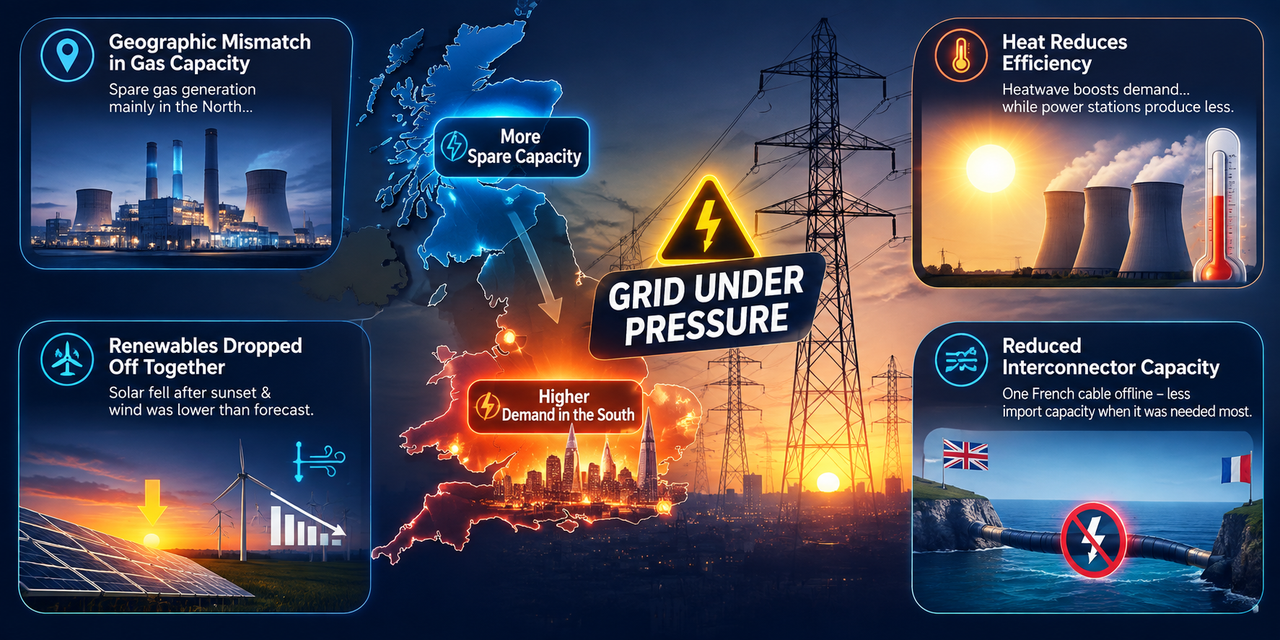
Geographic mismatch in gas capacity. Much of Britain's spare gas-fired generation sits in the north, while demand pressure that evening was concentrated in the south. Because Britain prices electricity nationally rather than by region, price signals didn't reflect the local scarcity — so nothing automatically redirected power to where it was needed most.
Heat reduces efficiency, not just demand. It's intuitive that a heatwave increases demand from air conditioning and fans. Less obvious is that heat also reduces the output of gas-fired and other thermal power stations at the same time, shrinking supply just as demand rises.
Renewables dropped off together. Solar output fell sharply after sunset, as it does every day, but wind also underperformed forecasts that same evening — removing two sources of generation at once during the critical hours.
Reduced interconnector capacity. With one French cable already offline earlier in the day, Britain had less spare import capacity in reserve exactly when it needed it most.
Beyond the Numbers: A Question of Trust
The story has a second layer beyond the technical near-miss. Neso is currently facing whistleblower allegations, under independent investigation, that management sought to downplay how serious the instability was that evening. Neso has stated the system worked as intended throughout. Whichever account proves accurate, the episode has prompted energy analysts and former officials to call for changes — including more gas capacity in southern England, a strategic reserve of backup generation, and pricing reform that reflects regional scarcity rather than a single national price.
A government spokesperson maintained confidence in the UK's security of supply arrangements, stating there was no concern about meeting demand during the heatwave.
What This Means If You're Not a Grid Engineer
It's tempting to file this away as an interesting story about infrastructure most of us never think about. But there's a practical takeaway for any business or household that depends on continuous power: grid resilience has a real, measurable margin - and that margin was thinner on 23 June 2026 than most people would assume for a developed economy's electricity network.
This wasn't a countrywide equipment failure or a slow-burning crisis. It was a single evening where several ordinary, individually unremarkable events — some planned maintenance, a hot day, lower-than-forecast wind, a cable outage — lined up close enough together to bring the system to its limit. That's a useful reminder that backup power planning isn't only relevant to businesses in regions with chronically unreliable grids. It's relevant anywhere a genuinely rare, low-probability combination of events could still happen — because on 23 June 2026, it very nearly did.
Practical Takeaways for Backup Power Planning
Don't assume "developed grid" means "no risk." Businesses with critical operations — data centres, healthcare, cold storage, manufacturing with continuous processes — should treat near-misses like this as a prompt to review, not dismiss, their exposure to a genuine outage.
Summer risk is real, not just a winter concern. Traditional backup power planning tends to focus on winter cold snaps. This event shows summer heatwaves carry their own distinct risk profile, driven by falling equipment efficiency and rising demand at the same time.
Review your margin, not just your average. Just as the grid ran with almost no spare capacity that evening, many backup power setups are sized for typical scenarios rather than worst-case ones. A proper capacity review accounts for peak demand plus a safety margin, not the average day.
A generator and automatic transfer switch remove your exposure to grid-level near-misses entirely. Businesses with continuous power requirements don't need to rely on the national grid holding together during rare high-stress evenings if they have standby generation that switches in automatically the moment supply becomes unstable.
The Bottom Line
Britain avoided a blackout on 23 June 2026, but only just, and largely thanks to a phone call and a favour from a neighbouring grid operator. The structural issues behind that evening — geographic mismatches in generation, thin summer margins, and growing reliance on imported power at peak moments — haven't gone away. For any organisation where a power interruption carries real cost, this is exactly the kind of event worth treating as a planning prompt rather than a one-off news story.