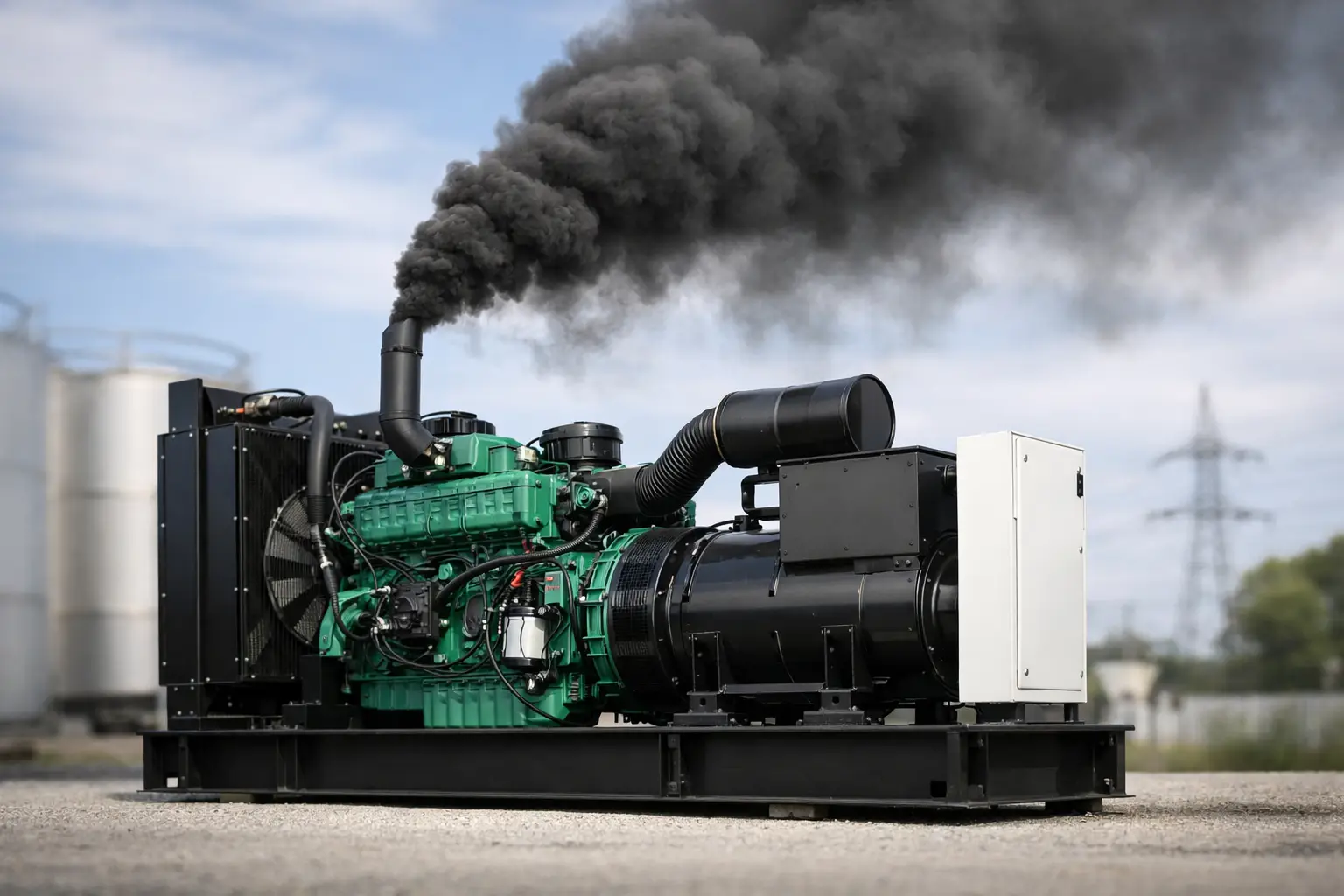
Black smoke from a diesel generator is not a normal operating characteristic to ignore. A brief dark plume when a large motor starts may be acceptable, particularly on a heavily loaded set, but sustained black exhaust smoke indicates incomplete combustion. Fuel is entering the cylinders without sufficient clean air, correct injection control or available engine capacity to burn it efficiently.
For facilities managers and engineers, the priority is not simply clearing the exhaust. Black smoke can signal lost fuel efficiency, carbon build-up, elevated exhaust temperatures and a developing reliability issue. On standby equipment, it can also expose a fault that will only become critical when the mains supply fails and the generator is expected to accept its full site load.
What causes generator black smoke?
In diesel generators, black smoke is principally soot - carbon particles produced when the air-to-fuel balance becomes too rich. The engine may be receiving excessive fuel, insufficient combustion air, or a load demand that exceeds what the engine can support at its governed speed.
The underlying cause depends on the generator's engine condition, duty cycle, maintenance history and operating load. A compact standby set running a short weekly exercise has different risk factors from a prime-power generator supplying a quarry, factory or temporary construction installation. However, the diagnostic principle remains the same: establish whether the fault originates in air supply, fuel delivery, combustion timing or load application before replacing parts.
Restricted combustion air and turbocharger faults
A blocked air filter is one of the most common and simplest causes of black smoke. As restriction increases, the engine control or mechanical fuel system may continue delivering fuel for the required speed and load, while the cylinders receive less oxygen. The result is incomplete combustion and visible soot.
Inspect the air filter element, intake ducting and restriction indicator where fitted. A filter can appear serviceable yet still be restricted by fine dust, moisture or oil contamination. On generators operating in construction, agricultural, recycling or quarry environments, intake contamination can develop quickly even where routine servicing is in place.
Turbocharged engines require further checks. A damaged compressor wheel, split boost hose, loose clamp, leaking charge-air cooler or worn turbocharger can reduce boost pressure and cause black smoke under load. The generator may start and run cleanly at low load, then smoke heavily once demand rises because the turbocharger is no longer supplying the air volume required for full combustion.
Do not assume a turbocharger fault from smoke alone. Confirm intake restriction, examine pipework for oil traces and leaks, and compare measured boost pressure against the engine manufacturer's expected values. Continuing to run with an air-side fault can increase exhaust gas temperatures and accelerate damage to pistons, valves and the turbocharger itself.
Excess fuel delivery and injector problems
If air supply is confirmed, investigate the fuel system. Worn, sticking or poorly atomising injectors can deliver fuel in an incorrect spray pattern. Instead of a fine, evenly distributed mist, larger droplets enter the combustion chamber and do not burn completely. This can produce black smoke, rough running, higher fuel consumption and uneven exhaust temperatures between cylinders.
Injection pumps, electronic fuel controls and common-rail components can also over-fuel an engine. A faulty control sensor, calibration error or governor issue may command more fuel than the available air can burn. On electronically controlled engines, diagnostic fault codes and live data are valuable, but they should support rather than replace physical checks of the intake, fuel quality and load profile.
Poor-quality fuel does not always cause black smoke directly, but contaminated fuel can affect injector operation and combustion quality. Water, sediment, microbial contamination and degraded stored diesel can lead to wider fuel-system problems. Fuel filters should be drained and replaced at the correct interval, and bulk storage should be managed as part of the site resilience plan, not only after a generator fault develops.
Overloading and incorrect generator sizing
Black smoke that appears only when the generator is heavily loaded often points to an application issue rather than a component failure. The engine can briefly produce extra torque when a load is applied, but if the connected load remains beyond its practical capacity, it will over-fuel in an effort to maintain rated speed. Smoke, falling frequency, reduced voltage stability and high coolant temperature may follow.
This is particularly relevant where large motors, compressors, pumps, cranes or refrigeration plant start across the line. Their starting current can be several times their running current. A generator that appears correctly rated for the steady-state kW demand may still be too small to handle the starting profile, especially if multiple loads start together.
The distinction between standby and prime power matters here. A standby-rated generator is intended for limited-duration emergency operation and has a different operating allowance from a prime-rated set supplying variable load for extended periods. Specifying a set solely by headline kVA, without examining load steps, power factor, harmonics, motor starting method and expected running hours, creates avoidable risk.
If black smoke began after new equipment was added to site, review the load before adjusting the engine. A load study may show that the issue is an oversized motor start, poor load sequencing, a failed soft starter or a generator operating outside its intended duty. Increasing fuel delivery to mask poor load acceptance is not a corrective action.
Injection timing, engine condition and exhaust restriction
Incorrect injection timing can cause black smoke because fuel is introduced at the wrong point in the combustion cycle. On mechanical engines, timing may be affected by pump wear, installation errors or service work. On modern electronically controlled engines, crankshaft, camshaft and temperature sensor faults can influence injection events.
Low compression is another consideration on older or high-hour engines. Worn piston rings, damaged valves or cylinder-head faults reduce the heat and pressure needed to ignite and burn diesel efficiently. Smoke may be accompanied by difficult starting, excessive crankcase pressure, loss of power or abnormal oil consumption. This requires a competent engine assessment rather than a routine filter change.
Exhaust restrictions are less common but should not be overlooked. A blocked silencer, collapsed internal baffle or contaminated after-treatment component can prevent exhaust gases leaving the engine efficiently. Back pressure affects scavenging and turbocharger performance, which can contribute to smoke and temperature rise. Any exhaust modification should be assessed against the generator manufacturer's back-pressure limits.
A practical diagnostic sequence
Start by recording when the smoke occurs. Is it limited to cold starting, a sudden load step, operation above a certain kW level, or present continuously? Note generator load percentage, frequency, coolant temperature, ambient conditions and whether the set is operating in automatic or manual mode. This information makes diagnosis materially faster.
Next, check the air filter, intake path, boost hoses and turbocharger condition. Inspect fuel filters and water separators, verify fuel quality where storage is suspect, and confirm that the generator is not carrying more load than its rating and application permit. If the basic checks do not identify the issue, move to controlled testing of injector performance, boost pressure, exhaust temperature and engine fault data.
A load-bank test is often the most useful controlled assessment for critical standby systems. It allows engineers to apply known load steps while monitoring smoke, voltage, frequency, coolant temperature and engine response. Unlike an unloaded exercise run, it shows whether the generator can accept and sustain realistic demand without over-fuelling or instability.
Why running lightly loaded can complicate the picture
Generators that regularly run at very low load can develop carbon deposits in the exhaust system and, on some engines, suffer from wet stacking. This condition is more commonly associated with unburnt fuel and oil residues than dense black smoke, but it can contribute to poor combustion and misleading exhaust symptoms over time.
The remedy is not to run every generator at maximum output. Sustained high load can be equally inappropriate if it exceeds the specified duty. Instead, the set should be correctly sized and exercised under a meaningful load in accordance with the manufacturer's requirements. For prime-power applications, load variation should be considered at the design stage rather than treated as a maintenance issue later.
When black smoke requires immediate action
Take the generator out of service for investigation if black smoke is continuous, becomes rapidly worse, is accompanied by loss of power, high exhaust temperature, overheating, abnormal noise or unstable frequency. These signs can indicate a fault capable of causing expensive engine damage or a failure during an emergency run.
A short, light puff during a fast load acceptance event may be within normal operating behaviour for some diesel engines. It should still be compared with previous test results. Changes in smoke behaviour are often an early warning that filters, injectors, turbocharger performance or site load conditions are moving in the wrong direction.
For mission-critical sites, treat black smoke as operational data rather than an inconvenience. A generator should be matched to its actual duty, tested under realistic conditions and maintained around measured condition as well as service intervals. When a replacement or additional capacity is required, Global Generators can help assess the required kVA rating, standby or prime duty, enclosure format and load profile so the installed set supports dependable uptime rather than merely starting on command.