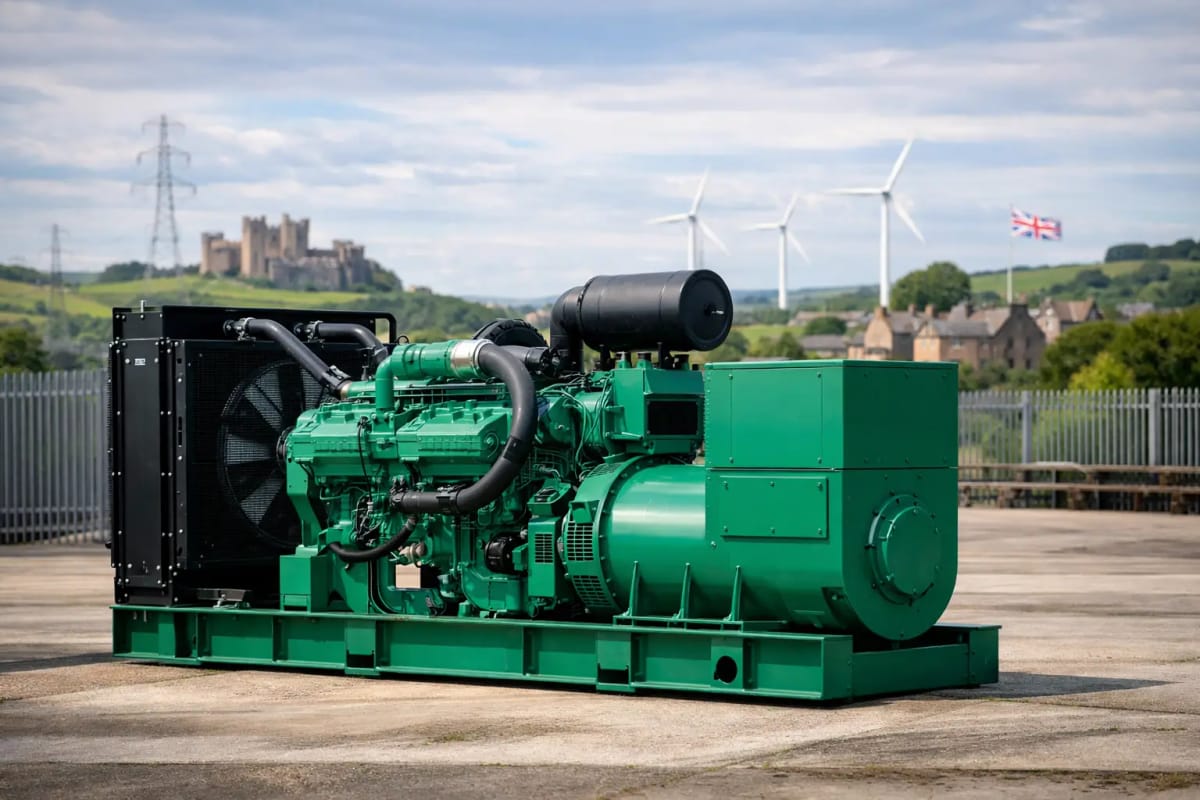
A generator is only as useful as its performance when the mains supply fails, the load transfers and the site has no margin for delay. This Cummins CPG generators review considers the factors that matter to UK commercial and industrial buyers: engine quality, rating integrity, control capability, enclosure choice, maintainability and suitability for standby or prime power duty.
Cummins CPG, now widely associated with Cummins Power Generation equipment, is a recognised name in the industrial power sector. Its generator sets are specified across healthcare, manufacturing, data-led operations, construction, logistics, utilities and commercial property. That reputation is earned through a broad product platform rather than one standard machine. A 30 kVA standby set serving a small commercial premises has different requirements from a 1,500 kVA installation supporting a production site or critical infrastructure.
The right assessment therefore starts with the duty, load profile and installation conditions, not simply the badge on the canopy.
Cummins CPG generators review: where they perform well
Cummins-powered generator sets are valued for their established engine platform, wide power coverage and practical supportability. Across the range, buyers can specify equipment from smaller commercial capacities through to multi-megawatt industrial installations. This matters where a business needs consistent engineering principles across several sites, but not necessarily identical generator sizes.
For standby applications, the principal benefit is confidence under infrequent but high-consequence use. A properly specified set should start automatically, accept the required load and run for the duration supported by its fuel system. Cummins CPG sets are commonly paired with automatic transfer arrangements and generator controllers capable of monitoring mains failure, battery condition, engine alarms and operational status.
For prime power applications, the emphasis changes. The generator may be expected to work for long hours, often with variable loading and challenging ambient conditions. Cummins engines have a strong presence in these environments, particularly where planned maintenance, correct fuel management and realistic loading are part of the operating regime. A prime-rated set should never be selected by treating its standby kVA figure as continuously available capacity.
Build specification is another strength. Depending on size and application, buyers can choose open sets for protected plant rooms, weatherproof acoustic enclosures for external installations, containerised packages and bespoke fuel or control arrangements. This allows the generator to be matched to the site rather than forcing the site to accommodate a fixed format.
Rating discipline matters more than headline kVA
The most common procurement error is selecting a generator solely by its highest advertised kVA. Cummins CPG equipment is available with standby and prime ratings, and the distinction has a direct effect on operational life, permitted running hours and load capability.
Standby power is intended for emergency operation during utility failure. Prime power is intended for variable-load operation where the generator is the primary source or will operate for extended periods. The available rating, permissible average load and overload provisions vary by model and governing standard. These details should be confirmed against the manufacturer data for the exact set, not assumed from a similar unit.
Load composition also matters. Motors, pumps, compressors, lifts, UPS systems and nonlinear electronic loads can produce high starting currents or harmonics. A generator that appears adequate for the running load may experience unacceptable voltage or frequency dip when a large motor starts. In these cases, alternator sizing, transient response, load sequencing and control settings become as important as the engine rating.
A competent specification should establish the expected running load, largest step load, starting method, power factor, anticipated future demand and required autonomy. For three-phase systems, phase balance must also be assessed. Oversizing without purpose is not always the answer, as long-term operation at very light load can create its own diesel engine issues.
Controls, monitoring and site integration
A generator set is part of a power system, not an isolated asset. Cummins CPG control platforms are generally designed to support automatic operation and clear fault visibility, with capability varying by set and controller specification. For a straightforward standby installation, this may mean automatic start on mains failure, engine protection and local indication. For a larger facility, the requirement may extend to remote monitoring, synchronisation, load sharing, closed-transition transfer or integration with building management systems.
The practical question is whether the controls suit the operating plan. A warehouse with a single essential-load board may need a dependable AMF arrangement and routine test provision. A hospital, industrial plant or data-sensitive facility may require multiple sets, selective load shedding and carefully managed transfer arrangements. The generator controller cannot compensate for an incomplete electrical design.
Remote monitoring is particularly worthwhile for unmanned sites and distributed estates. It can provide early warning of low fuel, battery charger failure, coolant temperature issues or unsuccessful exercise runs. However, monitoring does not remove the need for physical inspections. Fuel condition, leaks, belts, hoses, battery terminals and enclosure integrity still need planned attention.
Enclosure, fuel and environmental considerations
Cummins CPG generators are available in formats suited to both indoor and outdoor deployment. The choice between an open set and a silent generator should be based on the installation environment, not just initial purchase cost. Open sets can be appropriate in ventilated plant rooms where acoustic treatment and exhaust routing are addressed within the building design. They are usually easier to access, but the room must provide adequate cooling-air flow and safe maintenance clearance.
An acoustic canopy is normally the more practical route for external sites. It offers weather protection, reduced noise and a secure enclosure, but it does not remove the need to consider exhaust direction, intake and discharge air paths, foundation design and local planning constraints. Noise performance should be assessed at the stated distance and operating condition. A quoted dBA figure without context is not enough for a noise-sensitive boundary.
Fuel storage deserves equal attention. Base tanks provide compact on-set autonomy, while bulk tanks are often required for longer outages or remote sites. The correct arrangement depends on consumption at the actual load, not a nominal full-load figure alone. Fuel polishing, bunding, transfer pumps, low-level alarms and regular turnover can be necessary where diesel is stored for long periods.
Serviceability and lifecycle cost
A recognised engine brand helps, but uptime depends on the full maintenance strategy. Cummins CPG generator sets benefit from widely understood diesel-engine service requirements and an established parts ecosystem. That said, service access varies by enclosure layout, installed location and ancillary equipment. Before purchase, check access to filters, fluids, batteries, radiator areas and control components, as well as clearance for major service work.
Lifecycle cost should include routine servicing, consumables, fuel testing, load-bank testing, battery replacement, cooling-system maintenance and any site-specific compliance work. The cheapest package can become the most expensive if it lacks the fuel capacity, monitoring, acoustic performance or access provisions needed after installation.
There are trade-offs. A larger set may provide useful growth capacity and better transient performance, but it costs more, occupies more space and may run lightly loaded during normal tests. A compact canopy may simplify delivery, while a containerised system can offer stronger environmental protection and integration options at larger ratings. The correct answer depends on the load, location, operating hours and consequences of failure.
Who should consider a Cummins CPG set?
Cummins CPG equipment is a credible option for buyers seeking diesel generation from a proven industrial platform. It is particularly suitable where specification certainty, power range and dependable supportability carry more weight than buying on headline price alone. Applications include single-set standby systems, prime power for worksites, rental-style duties, commercial premises and larger synchronised installations.
The set should be procured with a clear brief: required standby or prime rating, voltage and frequency, single-phase or three-phase output, enclosure type, fuel autonomy, control philosophy, delivery constraints and maintenance expectations. This is where an enquiry-led supplier can add value by checking the practical details before equipment arrives on site. Global Generators can assist buyers in matching available Cummins-powered stock to the required power duty and delivery timetable.
For any critical installation, request the exact technical schedule, confirm the rating basis and review the site design before placing the order. The best generator is not simply the one with the largest kVA figure. It is the set that starts, carries the real load and remains serviceable when the site needs it most.