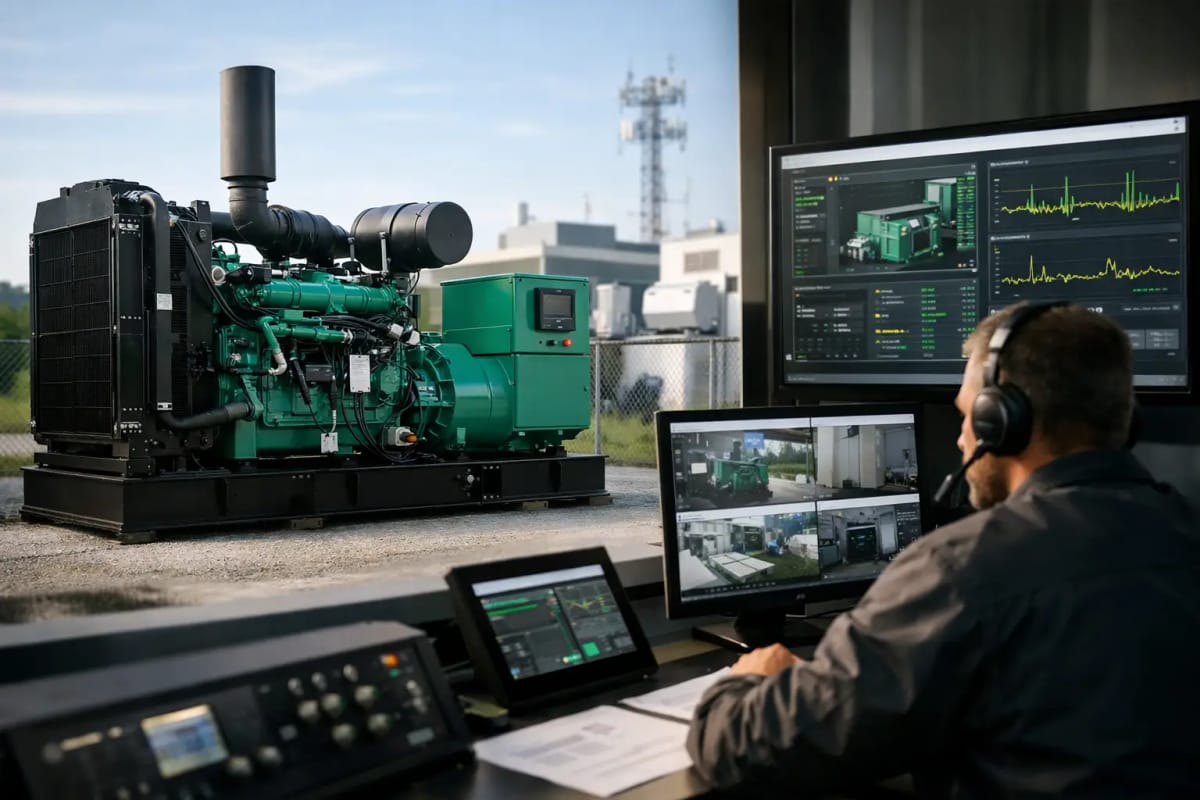
A generator that starts during a weekly test but fails under site load is not a dependable backup asset. For facilities teams managing healthcare, manufacturing, logistics, telecoms or commercial infrastructure, a generator monitoring review should establish whether the control system provides actionable evidence of readiness, not simply a green status light on a dashboard.
Remote monitoring can reduce response times, support planned maintenance and give operations teams better visibility across multiple sites. It does not, however, compensate for incorrect generator sizing, poor installation, contaminated fuel or an inadequate maintenance regime. The most effective monitoring specification is one that is matched to the generator set, the site’s operating risk and the people expected to respond when an alarm is raised.
What generator monitoring must show
At its most useful, a monitoring system answers a small number of operational questions quickly. Is mains power present? Is the generator in automatic mode and available to start? Has it started, accepted load and remained within defined operating limits? Is there a fault that requires immediate attendance, or a maintenance issue that can be planned?
This requires more than engine running hours and battery voltage. A suitable system should capture generator state, mains condition, transfer switch position, engine performance and critical alarm conditions. For prime power applications, it should also provide meaningful records of load, fuel use, service intervals and operating trends.
The level of detail depends on the consequence of failure. A small standby set protecting a retail unit does not require the same reporting depth as a multi-set installation supporting a data room, hospital service or water treatment process. The principle remains the same: monitoring must allow the duty holder to identify loss of resilience before an outage exposes it.
Generator monitoring review: key assessment areas
A proper review begins at the controller. Modern generator controllers can report a wide range of data, but the available information is only valuable if it is correctly configured, communicated and understood. Buyers should examine the monitoring offer as part of the full power system, including the generator, automatic transfer switch, fuel arrangement and site communications.
Alarm quality matters more than alarm quantity
An alarm list can be extensive while still failing to support a useful response. Critical alarms should be prioritised and routed to the appropriate contact. Typical high-priority events include failed start, low oil pressure, high coolant temperature, overspeed, emergency stop activation, low fuel level, charger failure, low battery voltage and generator breaker trip.
The response pathway should be just as clear. A failed weekly exercise may require investigation before the next planned test. A generator that has failed to start after a mains failure requires an immediate escalation process, access arrangements and a defined engineering response. If the same recipient receives every minor warning and every shutdown event, alarm fatigue soon becomes a real risk.
Review whether alarms include a time stamp, current status and acknowledgement trail. For managed estates, the ability to distinguish a live alarm from a historic or cleared event prevents wasted call-outs and allows teams to focus on unresolved faults.
Communications must suit the site
Ethernet, Wi-Fi, mobile data and hardwired building networks all have a place, but their suitability differs by application. A generator in a secure industrial compound may have a reliable wired connection. A temporary construction installation or remote utility asset may depend on a mobile router. Where communications are essential to operational oversight, the connection itself needs consideration as a potential point of failure.
Ask what happens when the site network or router loses power, whether the monitoring equipment has independent backup, and how it reports loss of communication. Mobile connectivity can provide valuable separation from the customer network, but it introduces ongoing SIM costs and relies on signal quality at the installation location.
Cybersecurity also requires practical attention. Remote access should use controlled user permissions, strong authentication and a support process that does not leave default credentials in place. Monitoring should improve control of the asset, not create an unmanaged route into a critical site network.
Integration should serve operations
For a single generator, a dedicated monitoring portal may be sufficient. For larger estates, information often needs to reach an existing building management system, supervisory control platform or central facilities desk. Integration can provide a consolidated view of power status, but it should not strip away the detail needed for engineering diagnosis.
Confirm which data points can be exported, how frequently they update and whether alarm priorities transfer correctly between systems. A simplified BMS graphic can be useful for operators, while the generator controller portal remains necessary for technicians reviewing fault history, electrical values and engine parameters.
Specify monitoring alongside the generator set
Monitoring is easiest to implement when considered before procurement rather than added after commissioning. The required generator configuration influences what should be monitored. A silent generator installed close to occupied areas may need attention to enclosure temperature and ventilation conditions. An open generator within a plant room may require closer monitoring of room temperature, fire interfaces and exhaust arrangements.
Electrical configuration matters as well. For three phase installations, the system should show phase voltage, current, frequency, kW, kVA and power factor where relevant. This helps identify load imbalance, poor power quality or a site demand that is approaching the generator’s practical operating limit. For standby systems, start performance and transfer confirmation may be more significant than continuous fuel analysis. For prime power sets, fuel consumption, load profile and service-hour reporting become far more valuable.
The distinction between standby and prime rating must remain clear throughout the design. A monitoring platform cannot make a standby-rated generator suitable for prolonged or unrestricted operation. Likewise, a correctly rated prime power generator still requires load management, servicing and fuel planning if it is operating for extended periods.
Global Generators supplies industrial generator sets across a broad kVA range, so monitoring requirements can be considered alongside engine choice, enclosure type, voltage and duty rating rather than treated as a separate afterthought.
Test the monitoring system under realistic conditions
A remote dashboard should not be accepted on the basis that it displays live readings at commissioning. The site should test the full chain: simulated mains failure where permitted, generator start, transfer operation, alarm notification, acknowledgement and restoration to normal supply. Results should be documented with the same discipline as generator test records.
Periodic testing should also verify that contact details remain current and that alarms arrive outside normal working hours. A notification sent to a former contractor or an unattended mailbox is no better than no notification at all.
Load-bank testing remains particularly valuable where a standby generator does not regularly carry sufficient load. Monitoring can show that the engine ran for 20 minutes, but it cannot prove that the set will perform satisfactorily at its required duty unless testing reflects the operational demand. Fuel condition, battery health, cooling performance and switchgear operation should sit within the wider maintenance plan.
The commercial case for remote monitoring
The value of monitoring is usually found in avoided uncertainty rather than labour savings alone. It can reduce unnecessary site visits, support faster fault diagnosis and provide an auditable record of testing and runtime. On multi-site estates, central visibility may allow a small engineering team to prioritise work based on actual asset condition.
There are costs to account for: hardware, commissioning, communications, software subscriptions, integration work and ongoing support. A low-cost device with limited alarm handling may be suitable for a low-risk application. For a mission-critical facility, the lower purchase price can be insignificant if the platform cannot evidence transfer status, provide reliable escalation or retain useful event history.
Procurement teams should assess whole-life value. The right question is not whether monitoring is included, but whether it will shorten the time between a developing fault and a competent response.
Questions to ask before approval
Before selecting a monitoring package, establish the following points with the supplier and commissioning team:
- Which generator, mains and transfer-switch data points will be visible remotely?
- Which alarms are critical, who receives them and how are they escalated?
- What communications method is proposed, and what happens if it fails?
- Can the system integrate with the site BMS or central monitoring platform?
- Who owns the data, manages user access and maintains software or SIM subscriptions?
- How will the complete alarm and transfer sequence be tested and recorded?
A generator monitoring review should end with clear responsibilities, not just a selected platform. When an interruption occurs at 02:00, the decisive factor is whether the right team receives a meaningful alarm, understands the system state and can act before a manageable fault becomes a loss of power.