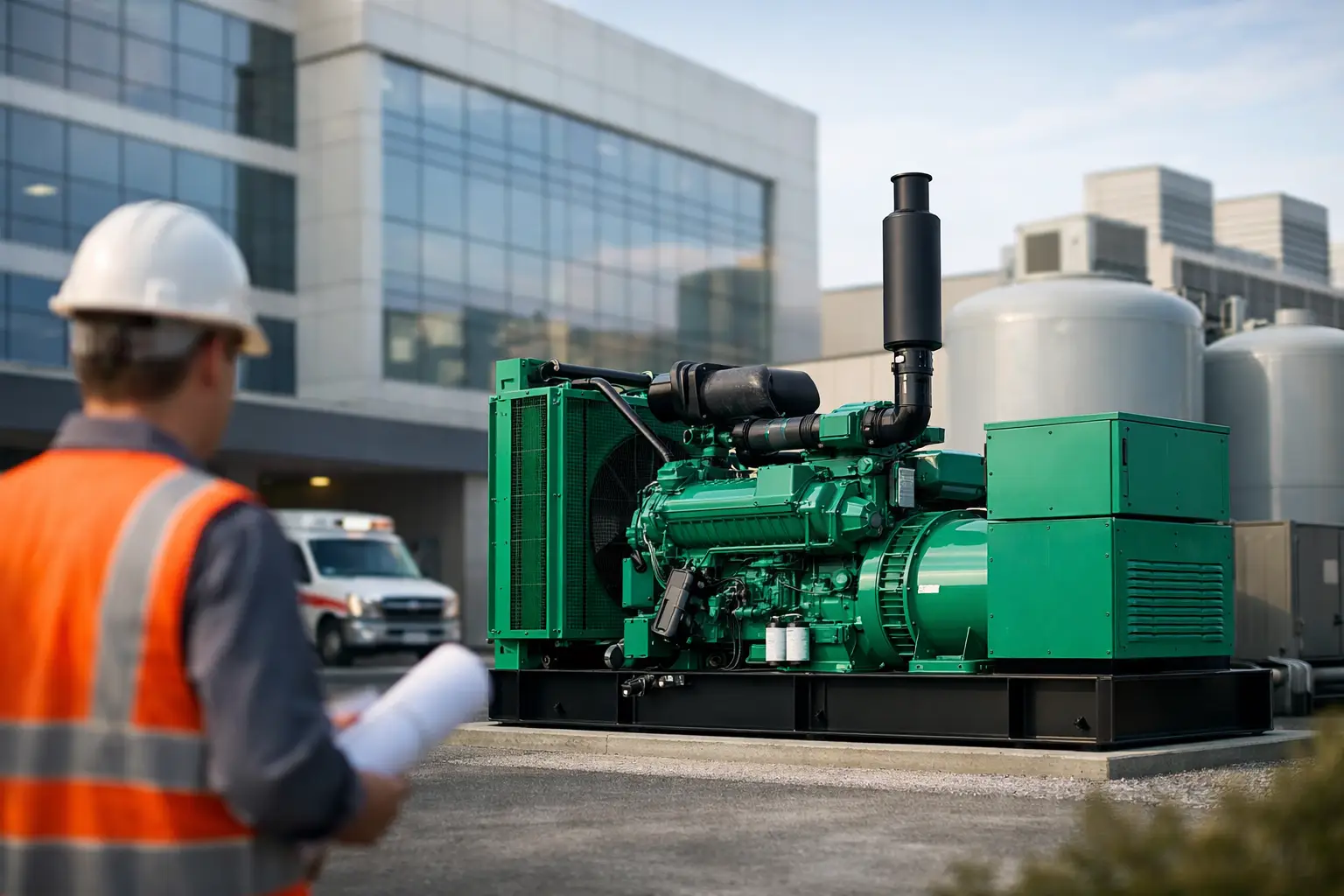
A hospital generator is not a general-purpose backup asset. When the mains supply fails, it must support a controlled transfer of power to life-safety and clinical systems, often while the site is under full operational pressure. The best generators for hospitals are therefore selected around verified load demand, starting reliability, fuel resilience, redundancy and integration with the electrical infrastructure - not simply the highest available kVA rating.
For facilities teams, consultants and procurement leads, the right decision begins with defining what must remain live, how quickly it must be restored and how long the generator must operate without refuelling. A well-specified diesel generator set protects continuity of care. A poorly sized or poorly integrated set can introduce unacceptable risk at the point it is needed most.
Best generators for hospitals: start with the load
Hospital electrical loads are not uniform. Critical care areas, theatres, emergency departments, imaging equipment, fire systems, data rooms, security, communications and selected building services may all have different supply priorities. The generator must be sized against the actual essential load schedule, including both running demand and the starting characteristics of major motors and equipment.
A load study should identify continuous essential loads, intermittent loads, motor starting currents and future expansion requirements. Chillers, lifts, pumps and air handling plant can create significant starting demand. If they are restored simultaneously, the step load imposed on the generator can exceed what a headline kVA rating suggests it can carry.
Generator capacity should be assessed in kVA and kW, with attention to power factor, altitude, ambient temperature and the operating profile. A set that is adequate at a nominal rating may be unsuitable once site conditions and derating are applied. It is also prudent to leave measured headroom for additional clinical equipment, changes to the estate and load growth over the generator’s service life.
For larger acute sites, generator capacity commonly extends into the hundreds or thousands of kVA. Smaller hospitals, community facilities and specialist clinics may require lower outputs, but the selection principles remain the same. The critical question is not the size of the building. It is the electrical consequence of losing each service.
Standby, prime and emergency duty
Most hospital installations use generators for standby duty. The unit remains available to take over when the normal supply fails, then returns to standby after the utility supply is stable. Standby rating is designed for this emergency operating role and should be clearly distinguished from prime power rating.
Prime-rated generators are intended for variable-load operation where they may act as the principal source of power for extended periods. This can be relevant during major utility works, planned resilience projects or temporary hospital facilities, but it should not be assumed that a standby-rated set can be operated indefinitely as a prime power unit.
Duty classification affects engine loading, service intervals and permissible annual running hours. Procurement documents should state the intended operating regime clearly. This avoids selecting equipment that appears suitable on paper but is operating outside its rated application in practice.
Redundancy is often more valuable than oversizing
One large generator is not automatically the most resilient solution. A single set creates a single point of failure, regardless of its output. Where the risk assessment demands high availability, multiple synchronised generator sets may provide a stronger solution than one oversized unit.
An N+1 arrangement provides capacity beyond the expected essential load, allowing one generator to be unavailable for maintenance or fault investigation while the remaining sets support the site. Multiple sets can also improve operational efficiency at lower loads, as generators can be staged to match demand rather than running one large engine lightly loaded for long periods.
The trade-off is greater capital cost and more complex controls, switchgear and maintenance planning. Synchronisation panels, load-sharing controls and protection settings must be engineered as a complete system. For a smaller site with a defined critical load, a single set with a well-managed maintenance strategy may be appropriate. For an acute hospital, resilience objectives often justify a modular approach.
Transfer switching and distribution are part of the solution
The generator set is only one component of emergency power provision. Automatic transfer switches, generator control panels, essential distribution boards, cabling and protection coordination determine whether critical loads receive power correctly after a failure.
The transfer sequence must be designed around clinical priorities. Some systems require no-break power through UPS support until the generator reaches voltage and frequency. Other circuits can tolerate a short interruption. Automatic transfer switching must recognise loss of supply, issue the start signal, confirm generator stability and transfer the designated load in the required sequence.
Selective load shedding can be essential. If the available generator capacity is reserved for critical circuits, non-essential loads should remain disconnected or be shed automatically. This prevents a sudden demand spike from destabilising the set and protects the supply to systems that cannot be lost.
Control arrangements should also permit safe testing without compromising live services. A generator that cannot be tested under meaningful load is not a proven emergency asset. Regular exercise and load-bank testing reveal issues with starting batteries, fuel delivery, cooling, alternator performance and control logic before an actual outage does.
Fuel autonomy and physical installation
Fuel planning must be based on the expected emergency operating period, not the minimum tank size supplied with a generator. Runtime changes substantially with load, so fuel calculations should use realistic load assumptions and include a clear refuelling plan for longer incidents.
Bulk fuel tanks, day tanks, fuel transfer pumps, filtration and monitoring all require careful design. Diesel fuel can degrade during long storage periods, while water contamination and microbial growth can compromise reliability. A fuel quality programme, regular sampling and suitably maintained filtration are operational requirements, not optional extras.
Generator location also matters. A silent enclosed generator can be suitable where the set is positioned near wards, residential boundaries or other noise-sensitive areas. An open generator may suit a protected plant room where acoustic treatment, ventilation and access are addressed within the wider installation design.
Whether enclosed or open, the installation needs adequate ventilation, exhaust routing, heat rejection, fire precautions, drainage, secure access and maintenance clearance. The generator must be accessible for servicing and component replacement. A set squeezed into an unsuitable room can become difficult to maintain and expensive to operate.
Engine, alternator and controls: specify proven components
For hospital duty, recognised industrial engine platforms offer practical advantages: established service support, predictable parts availability and known performance under load. Cummins-powered generator sets, for example, are widely specified across critical applications because they provide a proven base for a broad range of outputs.
However, the engine brand alone does not guarantee a suitable package. Buyers should assess the full configuration: engine rating, alternator performance, controller capability, circuit breaker rating, enclosure, fuel system and compatibility with the proposed switchgear. Three-phase output is standard for most hospital estates, although voltage and frequency must match the site’s electrical design.
The generator controller should provide clear local status indication, alarm history and remote monitoring capability. Facilities teams need visibility of running hours, battery condition, fuel level, active alarms and maintenance requirements. Remote monitoring supports faster response, but it does not remove the need for routine physical inspections and planned maintenance.
Compliance, testing and procurement discipline
Hospital emergency power design should be developed with the relevant healthcare technical guidance, electrical standards, local authority requirements and the site’s own business continuity plan. In UK healthcare settings, this commonly includes consideration of HTM 06-01 alongside applicable electrical and fire-safety requirements. The final specification should be reviewed by competent electrical and healthcare engineering professionals.
Before purchase, require a clear technical submission covering standby and prime ratings, load acceptance, fuel consumption, dimensions, weight, acoustic data, emissions information, alternator details and control functions. Confirm delivery access, lifting arrangements, base design and commissioning responsibilities early. These details are often where programme delays and unplanned costs arise.
Global Generators can support specification-led enquiries across diesel generator outputs from 13 to 3000 kVA, including silent and open configurations for hospital standby and temporary power requirements. The correct set should always be matched to the site’s confirmed load profile and resilience strategy.
The most dependable hospital power plan is built before an outage occurs. Establish the essential load, test the transfer sequence under realistic conditions, maintain the fuel and batteries, and make sure the generator capacity still reflects the hospital you operate now - not the hospital you operated five years ago.