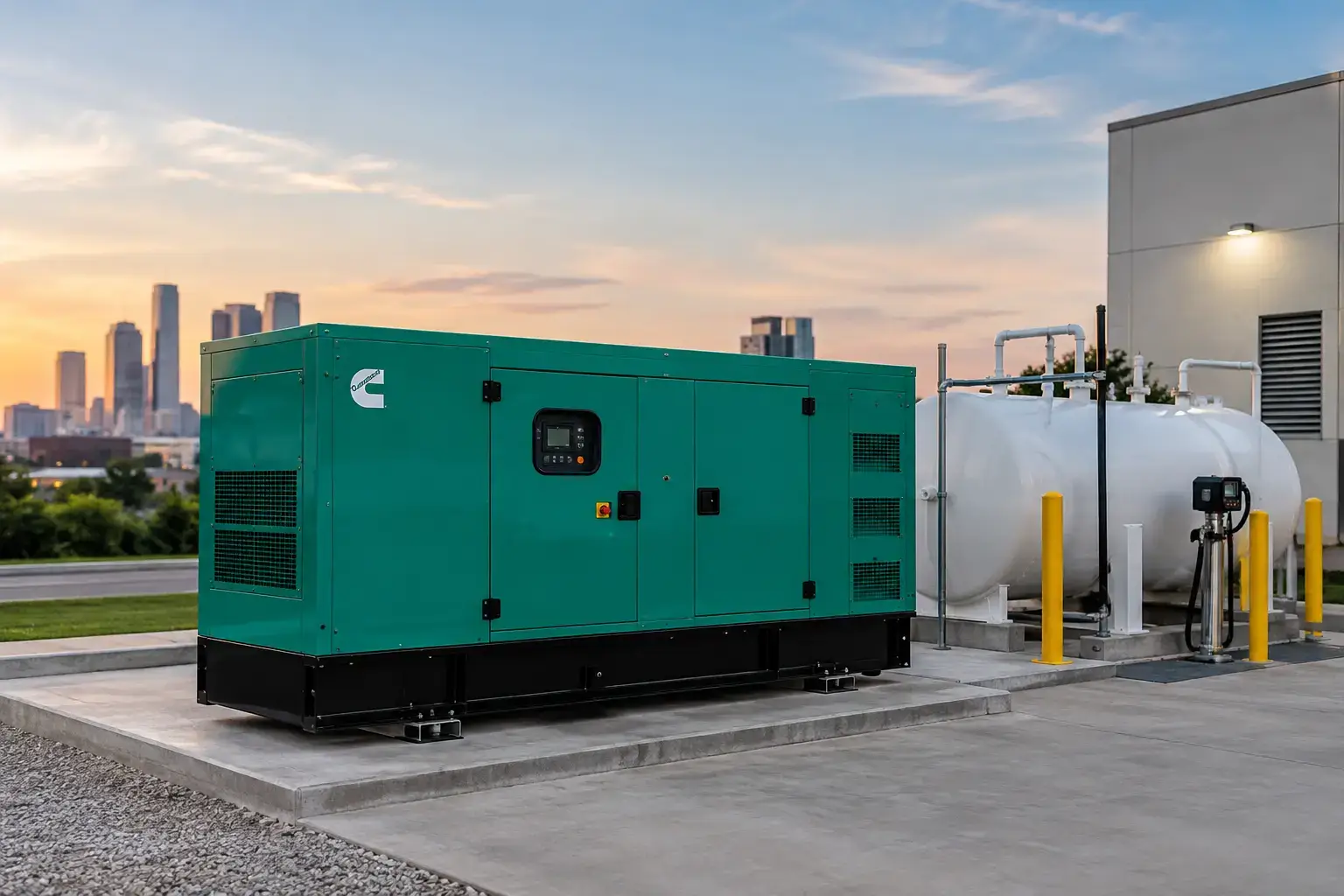
A generator purchase can remain in service for 15 years or more. That makes future generator fuels a live procurement issue, not a distant sustainability discussion. Facilities teams need to protect uptime now while avoiding a power strategy that becomes difficult to operate, fuel or justify over the working life of the asset.
For most critical sites, diesel remains the practical reference point. It is widely available, energy-dense, proven in high-output standby applications and supported by established service capability. The question is not whether diesel disappears overnight. It is how buyers should specify generator sets, fuel systems and operating arrangements so that future changes in fuel availability, emissions requirements and site policy do not compromise resilience.
Why future generator fuels matter to generator buyers
Fuel choice affects more than carbon reporting. It influences generator sizing, tank storage, fuel quality management, runtime, service intervals, emissions controls, refuelling arrangements and whole-life cost. A technically suitable fuel is of little value if it cannot be delivered promptly during an extended grid outage.
This is especially relevant for hospitals, data-intensive facilities, logistics operations, manufacturing plants, utilities and construction projects. These sites cannot base their emergency power provision on optimistic assumptions. They need a tested generator, a verified fuel supply chain and enough on-site capacity to carry the required load for the required duration.
The correct approach is to separate operational certainty from long-term flexibility. A standby generator must start and accept load when needed. Any transition to alternative fuels must preserve that standard.
Diesel remains the baseline for dependable backup power
Modern diesel generator sets continue to provide the strongest all-round solution for many standby and prime power applications. Diesel offers high energy density, making it practical to store substantial runtime within a manageable tank footprint. It also performs well across a broad kVA range, from smaller commercial installations to multi-megawatt industrial power systems.
For critical standby duty, diesel engines are familiar to operators and service engineers. Fuel logistics are established across the UK, including emergency delivery arrangements for sites with appropriate contracts and access. This matters when a local or regional incident disrupts normal operations for more than a few hours.
There are trade-offs. Conventional diesel carries fossil carbon implications, and local emissions requirements can affect planning, operating hours and equipment selection. Fuel stored for long periods also requires active management. Water contamination, microbial growth and degradation can create avoidable starting and performance issues. Routine testing, tank inspection and fuel polishing where required are part of dependable generator ownership.
Diesel is therefore not simply a default. It is a mature, controllable fuel option when supported by correct storage, maintenance and load testing.
HVO: the most practical lower-carbon route for many sites
Hydrotreated vegetable oil, commonly known as HVO, is currently the most realistic alternative fuel for a large number of diesel generator applications. It is a paraffinic renewable fuel produced from waste oils, fats and other approved feedstocks. Subject to engine manufacturer approval and fuel specification, HVO can often be used in suitable diesel engines with little or no equipment modification.
Its main attraction is operational continuity. A site can retain the familiar generator architecture, fuel tank arrangement and refuelling model while reducing lifecycle greenhouse gas emissions compared with fossil diesel. HVO also has favourable storage characteristics in many applications and can produce lower particulate emissions at the point of use.
However, procurement teams should not treat all HVO claims as equivalent. Feedstock origin, certification, delivered price, regional supply availability and compatibility confirmation all need checking. The fuel must meet the appropriate standard, and the generator manufacturer’s position should be confirmed in writing. Warranty conditions, fuel changeover procedures and tank cleaning requirements vary by engine and installation.
For an existing generator fleet, HVO is often worth assessing first because it can improve environmental performance without replacing a proven source of standby power. For new installations, specifying an HVO-approved engine gives the site a clear near-term option while retaining conventional diesel capability where appropriate.
Gas generator sets have a role, but depend on supply resilience
Natural gas and biomethane can be effective fuels for prime power, combined heat and power and sites with a stable gas connection. Gas generator sets can support lower local emissions profiles than traditional diesel equipment and may suit operations with long running hours.
The limitation for standby power is often the dependency on the gas network. A grid failure, major incident or network constraint may affect both electricity and gas supply, depending on the location and event. Gas pressure and supply capacity must be assessed under emergency conditions, not only normal operation. A gas generator should not be assumed to provide independent resilience without a proper site-specific review.
Biomethane can improve the renewable credentials of a gas-based strategy, but contractual supply and traceability matter. The physical fuel supplied to a site may not be distinct from the wider gas network. Buyers should understand whether their requirement is for a certified supply arrangement, a specific emissions outcome or fully independent on-site fuel storage.
For sites requiring absolute independence during outages, diesel or HVO-fuelled standby generation still provides a clearer route to on-site energy security.
Hydrogen is promising, but not yet the standard answer
Hydrogen is frequently presented as a future fuel for power generation. It may become relevant in selected applications, particularly where there is dedicated hydrogen production, storage infrastructure or a defined decarbonisation programme. Fuel cells can provide quiet, low local-emission power, while hydrogen-capable engines are under development for larger duties.
For most industrial standby generator buyers, the immediate constraints are practical. Hydrogen has low volumetric energy density, requiring substantial storage volume or compression. Its handling, safety systems, site layout and refuelling arrangements demand specialist engineering. Supply remains limited and can be expensive, particularly for low-carbon hydrogen.
Hydrogen should therefore be evaluated as part of a wider site energy plan rather than specified as a generic replacement for diesel. It may be appropriate for a controlled demonstration project, a depot with dedicated infrastructure or a location where local emissions restrictions outweigh the cost and complexity. It is less likely to be the most dependable choice for a remote site needing a high-kVA standby set delivered and commissioned quickly.
Battery hybrid systems reduce runtime, not the need for generation
Battery energy storage can materially improve generator operation when matched to the load profile. A hybrid arrangement can absorb short peaks, support low-load periods, reduce unnecessary generator running and provide immediate bridging power before the generator starts. This can lower fuel consumption and reduce engine wear in applications with fluctuating demand.
Batteries do not remove the need to assess long-duration resilience. Their stored energy is finite, and the required battery capacity rises rapidly when supporting large loads over extended outages. For many mission-critical facilities, the generator remains the asset that sustains operations after the battery has covered the first minutes or hours.
The strongest hybrid designs use each technology for its best duty. Battery storage manages response and variable loads; the generator provides sustained power; on-site fuel storage protects runtime. This arrangement can be particularly effective for construction, temporary power, telecoms and industrial sites with irregular demand.
Specifying a generator for fuel flexibility
Fuel flexibility begins with the generator specification, not an assumption made after delivery. Buyers should establish the required standby or prime rating, voltage, frequency, phase, starting method, enclosure type, noise limits and operating environment before considering fuel options.
The fuel system then needs equal attention. Tank capacity should be calculated against actual site load, not generator nameplate rating alone. A lightly loaded generator consumes less fuel than a fully loaded unit, but sustained low-load operation can create its own engine issues. Duty cycle, load profile and expected outage duration should all inform runtime calculations.
For a future-ready installation, the specification should address engine approval for HVO, filtration requirements, tank materials and seals, bunding, fuel monitoring, transfer pumps and emergency refuelling access. Where a site is considering hybrid operation, controls integration and load management must be designed from the outset. Retrofitting these elements later can add cost and introduce avoidable risk.
A silent generator may be essential where planning restrictions or occupied premises demand low noise. An open generator may suit secure plant rooms or industrial compounds where enclosure is not required. Neither format changes the underlying fuel decision, but both affect installation, ventilation, maintenance access and total project cost.
Choose proven uptime before future claims
The direction of travel is clear: generator fuel strategies will become more diverse. Yet the timeline will differ by sector, location, grid capacity, emissions policy and the availability of approved fuel. There is no single future fuel that suits every site.
For many buyers, the sensible position is a proven diesel generator set that is approved for HVO, supported by correctly sized on-site storage and maintained under a disciplined testing regime. Gas, hydrogen and battery systems can be highly effective where the site conditions justify them, but they should be selected against measurable resilience requirements rather than broad claims.
Global Generators can support the specification of dependable diesel and HVO-capable generator solutions across standby and prime power duties. Start with the load, runtime and operating risk, then select the fuel pathway that keeps the site powered when normal supply is not available.