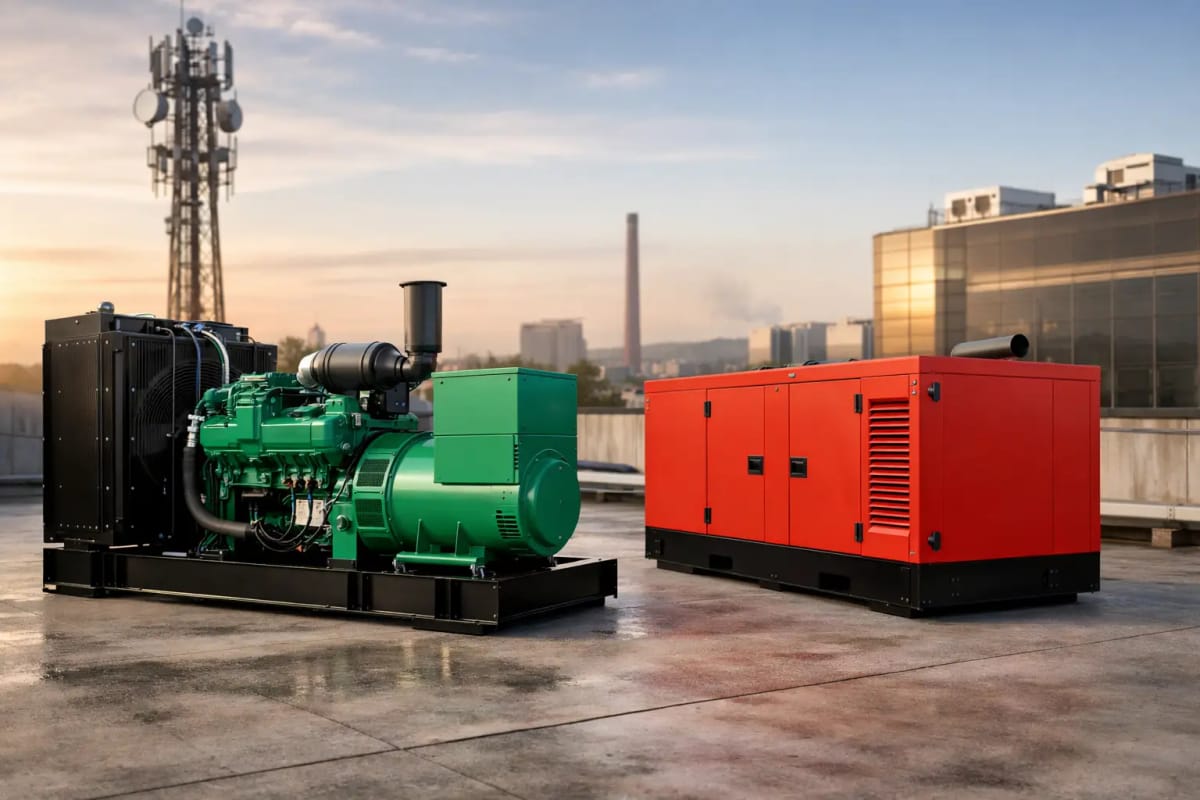
A generator that only has to start during an outage is specified very differently from one expected to carry a site through daily production, remote operations or an extended grid failure. This prime power generator guide sets out what buyers need to assess before committing to a diesel generating set for continuous or long-duration duty. The objective is not simply to purchase enough kVA. It is to secure stable, efficient power under the real operating conditions of the site.
What prime power means in generator specification
Prime power, commonly shown as PRP, is the rating used where a generator is the main source of electrical power or is expected to operate for extended, variable-load periods. It applies to sites without a dependable mains connection, as well as facilities requiring sustained generation while grid works, infrastructure failures or construction programmes continue.
A prime-rated generator is designed to operate for an unlimited number of hours per year at variable load, subject to the manufacturer’s stated operating conditions and maintenance schedule. It is not a licence to run permanently at maximum output. Engine loading, ambient temperature, altitude, fuel quality and servicing intervals still determine whether the set will deliver its expected life.
This differs from a standby rating. Standby power is intended for emergency use during utility failures, generally for limited annual hours. A standby generator may have a higher headline kVA figure than its prime rating, but that does not make it the correct selection for regular site duty. Using a standby set as a continuous power plant can lead to premature wear, warranty issues, higher fuel use and avoidable downtime.
Long-duration operation may also be described as continuous power in certain applications. The distinction between prime and continuous ratings is technical and manufacturer-specific. Continuous duty normally assumes a consistent load profile, while prime duty allows variation. Procurement teams should compare the stated rating basis, not just the largest number on a datasheet.
Prime power generator guide: start with the load profile
Generator sizing begins with a load study. A site’s connected load is rarely its actual running load, and the highest kVA figure on an equipment schedule may not occur at the same time as every other demand. Equally, a generator selected solely against average consumption can fail when large motors, compressors or pumps start.
Record the normal running load, the anticipated peak load, the operating hours and any future expansion. Separate essential and non-essential circuits where possible. This can materially reduce required generator capacity and preserves fuel during extended operation.
Account for starting currents and poor power factor
Motor-driven equipment can draw several times its running current during direct-on-line starting. Refrigeration plant, hoists, pumps, crushers, compressors and workshop machinery require particular attention. Variable speed drives, soft starters and staged starting can reduce peak demand, but they can also introduce harmonic distortion that needs assessment.
Power factor matters because generators are rated in kVA while much site equipment is discussed in kW. At a power factor of 0.8, a 500 kVA generator supports 400 kW under the stated rating conditions. A load at lower power factor requires more kVA for the same kW output. Do not assume a generator has spare capacity because its kW demand appears below the headline kVA rating.
A competent sizing exercise should also consider load steps. If a large block of demand is applied suddenly, voltage and frequency may dip before the engine governor and alternator recover. For sensitive control systems, telecommunications equipment and process plant, acceptable transient performance can be as important as the steady-state kVA rating.
Avoid sustained underloading
Oversizing is not a harmless precaution. A diesel generator operated for prolonged periods at very low load can suffer poor combustion, carbon build-up and wet stacking. It will also consume more fuel than a correctly matched set. The practical target depends on the engine, duty cycle and expected load variation, but a generator should generally spend meaningful operating time within an efficient working range.
Where the site load varies widely, consider staged generation, load management or a smaller duty set alongside a larger unit for peaks. The lowest capital cost is not always the lowest operational cost.
Choose the correct generator configuration
The electrical system determines whether a single-phase or three-phase generator is required. Most commercial and industrial sites require three-phase output, typically 400/230V at 50Hz in the UK. Single-phase sets are appropriate for smaller loads, temporary compounds and limited equipment groups, but they are not a substitute for a balanced three-phase distribution strategy.
Phase balancing should be reviewed even where total capacity appears adequate. Excessive imbalance can affect alternator performance and restrict usable output. A mixed site with lighting, IT loads, pumps and machinery needs its distribution board and cable design considered alongside the generator.
The physical format also affects suitability. An open generator is appropriate for a protected plant room or dedicated acoustic enclosure. A silent, canopy-mounted generator is often better for external installation, occupied premises and locations with planning or environmental noise constraints. The enclosure must still provide adequate airflow, service access and exhaust routing.
For demanding applications, specify the controls and alternator package with the same care as the engine. Automatic mains failure panels, synchronising controls, remote monitoring, battery chargers, jacket-water heaters and appropriately rated circuit breakers can determine whether the set performs when the site needs it. Cummins-powered generator sets are widely specified because the engine platform, service support and proven industrial duty credentials suit critical applications, but final selection must be based on the complete generating package.
Fuel storage and autonomy are operational decisions
A prime-rated generator is only as useful as its available fuel supply. Calculate autonomy from the expected load profile, not the no-load or full-load consumption figure alone. Fuel use rises with demand, while low-load operation brings its own efficiency and engine-health concerns.
Determine how many hours the site must operate before refuelling can be guaranteed. Remote locations, severe weather exposure, restricted delivery access and emergency response requirements may justify an extended base tank or external bulk storage. Tank design must address bunding, fuel transfer, filtration, water contamination and safe access for deliveries.
Diesel stored for long periods also requires management. Water ingress, microbial contamination and degradation can compromise filters, injectors and generator availability. Routine fuel sampling and tank housekeeping are part of the power resilience plan, not optional extras.
Plan installation around heat, air and access
A correctly sized generator can still fail if installation conditions are ignored. The engine requires cool combustion air, the radiator needs sufficient airflow to reject heat, and exhaust gases must be discharged safely away from personnel and building air intakes. Recirculating hot air into the enclosure can rapidly reduce available output and trigger high-temperature shutdowns.
Noise, vibration and emissions require early consideration. Acoustic enclosures, residential silencers, anti-vibration mounts and correctly designed exhaust systems should be selected to suit the site rather than added as an afterthought. Planning conditions and local noise limits may dictate the final arrangement.
Installation should also allow clear service access. Filters, belts, batteries, control panels and coolant points must be reachable without dismantling surrounding works. Position the set so a lorry can deliver fuel and maintenance engineers can safely work around it. For larger sets, lifting routes and foundations must be confirmed before delivery.
Test and maintain for the duty you expect
Prime power operation demands a disciplined maintenance regime based on running hours, not just calendar dates. Oil and filter changes, coolant checks, belt inspections, battery testing and fuel-system inspections should follow the engine manufacturer’s requirements. Operating records should capture hours, load levels, alarms, fuel consumption and any unusual starts or shutdowns.
Load testing is particularly valuable where the generator may spend periods lightly loaded or on standby between prime-duty events. It confirms that the engine, alternator, controls and changeover equipment perform together. A simple unloaded start test proves far less than a controlled test at representative site load.
Remote monitoring can strengthen operational control by reporting run status, alarms, fuel level and electrical performance. It does not replace inspection, but it allows facilities teams to act before a minor fault becomes a loss of power.
When prime power is not the right rating
A prime rating is appropriate where generation is expected to carry real operational load for sustained periods. If the generator exists solely to protect a building during occasional mains failures, standby power may be the more economical and technically correct choice. Conversely, if the load is fixed and genuinely continuous, a continuous-duty rating may need consideration.
The decision should be based on duty cycle, load behaviour, site environment and the consequences of failure. For a construction project, remote utility asset or production facility, the right answer may be a prime-rated set with generous fuel autonomy and planned servicing. For a hospital support system or commercial building, standby resilience and automatic transfer performance may take priority.
Before placing an order, provide the supplier with the load schedule, starting method of major equipment, required voltage, expected operating hours, installation environment and fuel autonomy target. Global Generators can use those details to match the kVA rating, enclosure type and control specification to the actual duty. The most dependable generator is the one specified for the work it will be asked to do, then installed and maintained as a critical site asset.