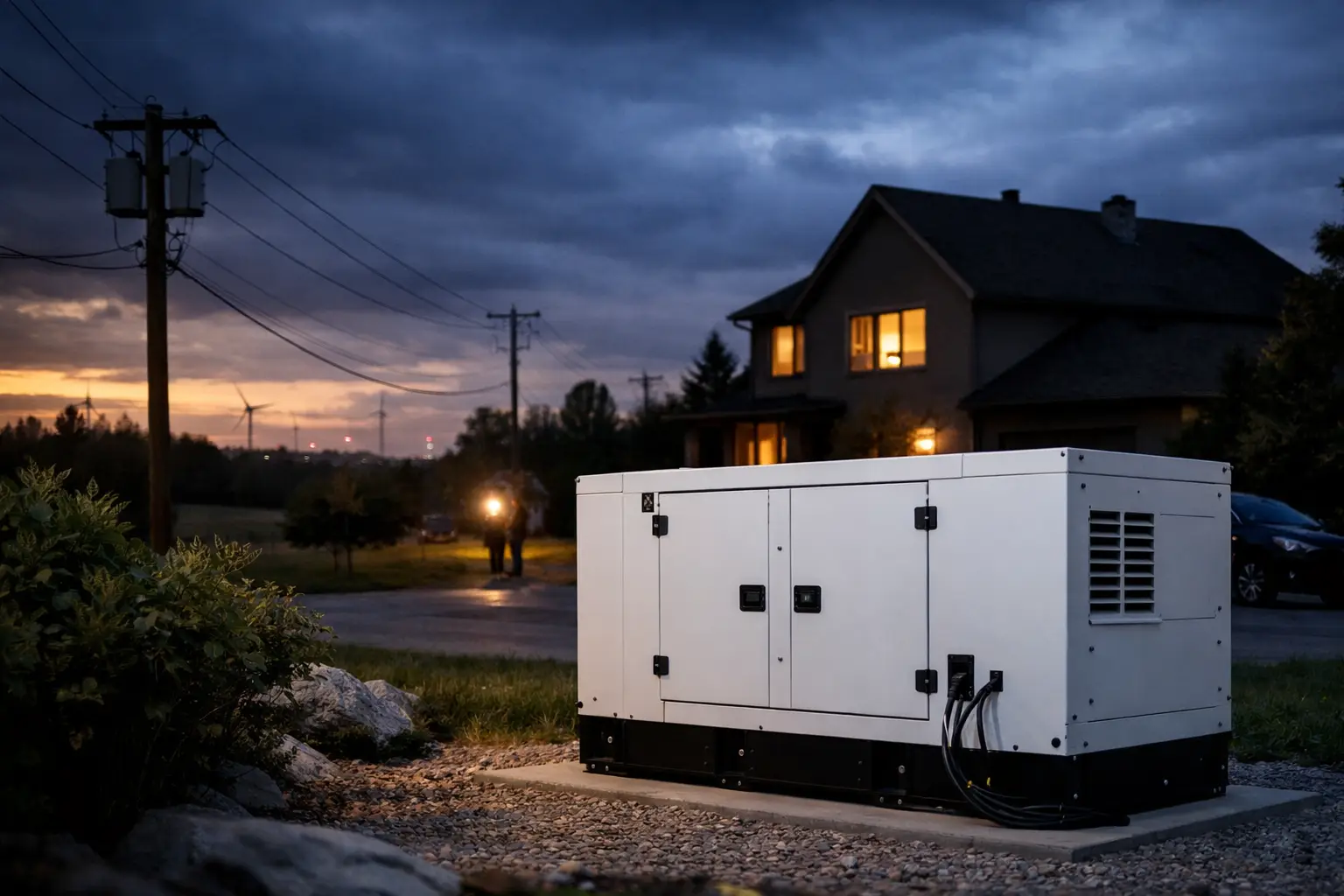
A four-hour supply interruption at a manufacturing plant is not simply four hours of lost output. It can mean scrapped product, failed temperature control, missed despatch windows, unsafe shutdowns and a recovery period that lasts well beyond the outage itself. Rising energy insecurity means backup power has moved from a contingency line on a risk register to an operational requirement for many UK sites.
For facilities managers, project engineers and procurement teams, the question is not whether a generator can start. The question is whether the complete standby power system can assume the required load, sustain it for the required period and return the site to normal operation without creating another point of failure. That requires a specification based on duty, load profile, fuel autonomy, controls and maintainability - not headline kVA alone.
Rising energy insecurity makes backup power a board-level issue
Energy insecurity takes several forms. A site may face a complete network outage, localised faults, planned works, voltage disturbance, capacity constraints or a disruption to its fuel supply. Severe weather, ageing infrastructure and a more electrically dependent operating environment can increase exposure, but the consequences still vary by site.
A warehouse may need power for emergency lighting, security, fire systems, IT and dock operations. A healthcare setting may need defined essential circuits supported without interruption. A data or telecoms environment may require close control of transfer times, load steps and power quality. Construction sites and remote assets may require prime power where no dependable mains connection exists.
This is why a single, generic generator specification rarely produces the right result. The critical load must be identified first. Then the generator, automatic transfer arrangement and distribution system can be selected around the actual operating risk.
Standby power and prime power are different duties
A standby-rated generator is intended to support a site during mains failure. Its running pattern is typically limited, although the precise duty limits must always be checked against the manufacturer rating and project requirements. It is suitable for buildings and operations with a normal utility supply that need a dependable fallback.
Prime-rated power is for longer or variable operation where the generator is the principal source of electricity, or where mains availability is unreliable. It is common on construction projects, temporary installations, remote facilities and certain industrial applications. Specifying standby duty for a genuinely prime application can lead to poor lifecycle performance and avoidable restrictions. Equally, buying prime capacity for a low-hour standby role may add cost without improving resilience.
Start with the load, not the generator
The familiar error is to total every nameplate value on site and purchase the nearest generator above that number. That method can either oversize the set unnecessarily or, more seriously, ignore the effect of motors, compressors, pumps, lifts, refrigeration plant and non-linear electronic loads.
A proper load assessment considers what must run during an outage, what can remain off, and in what sequence equipment will start. A large motor may impose a high starting demand even where its normal running load appears modest. Variable-speed drives, UPS systems and harmonic-producing loads can also affect alternator and control selection.
A staged load plan often provides a better outcome than simply specifying the largest available set. Life-safety systems, controls, communications and essential process loads can be brought online first. Lower-priority circuits can follow once the generator has stabilised. This reduces initial load step requirements and may allow a more efficient generator size without compromising critical functions.
The assessment should account for future expansion. Allowing sensible headroom is prudent, particularly where additional production equipment, refrigeration capacity or tenant load is expected. Excessive oversizing, however, has consequences. Generators operating persistently at very low load can suffer from inefficient running and, in diesel applications, contribute to wet stacking and carbon build-up. The target is appropriate operating load across foreseeable conditions, not the highest possible kVA figure.
kVA, kW and power factor must be clear
Generator output is commonly stated in kVA, while site consumption and equipment demands may be expressed in kW. The relationship depends on power factor. A 100 kVA generator at a 0.8 power factor, for example, provides 80 kW of usable real power under that rating basis.
The numbers are only useful when they refer to the same assumptions. Procurement documents should confirm voltage, frequency, phase arrangement, duty rating, power factor, ambient conditions and whether quoted capacity is standby or prime. For most larger commercial and industrial sites, a 400/230V three-phase generator will be required, but smaller applications may suit single-phase supply. Incorrect assumptions at this stage can delay commissioning and increase installation cost.
Specify the system around the generator set
A generator set is central to resilience, but it is not the whole solution. Failure can occur in the transfer system, fuel arrangement, batteries, control panel, cabling or the distribution board between the generator and the essential load.
An automatic transfer switch, or an appropriate automatic mains failure panel, should be selected to suit the site supply and the intended operating sequence. It must detect mains failure, command the generator to start, transfer the agreed load safely and return to mains under controlled conditions. Where continuity requirements are particularly demanding, the transfer philosophy requires detailed engineering. A conventional standby generator cannot eliminate every short interruption, so sensitive loads may also need UPS support or other ride-through provision.
Enclosure choice also matters. A silent, weatherproof generator is generally the practical option for external installations close to occupied buildings, planning-sensitive boundaries or workplaces with noise restrictions. An open generator can be appropriate within a correctly designed plantroom or acoustic enclosure, but it needs adequate ventilation, exhaust routing, cooling-air management and safe access for service.
Fuel storage should be designed for the required runtime at the expected load, not just the tank capacity printed in a brochure. Consider delivery access, fuel quality, bunding, local fire requirements and how long a supplier may take to reach site during a wider regional event. Longer runtime adds resilience, but it also introduces fuel management responsibilities. Diesel that sits untreated for extended periods can become a reliability risk rather than a reserve.
Test the condition that matters
A weekly no-load start proves that an engine can turn over. It does not prove that the system will accept the site load, operate at temperature, transfer correctly or sustain a real outage. Planned maintenance must therefore include periodic load testing and verification of the full automatic sequence.
Testing should be controlled to avoid disrupting operations, but it should be realistic enough to identify weaknesses. This includes checking batteries and chargers, coolant and oil condition, alarms, fuel levels, ATS operation, emergency stops, exhaust integrity and remote monitoring alarms. Records should show run hours, test results, defects and corrective actions. In a compliance-driven environment, those records also provide evidence that the contingency system is being actively managed.
Load bank testing is particularly useful where it is difficult or unsafe to test against the full site load. It allows the generator to be exercised under a defined demand and can help maintain engine condition. It does not replace an integrated test of the actual transfer and distribution arrangement, but both have a place in a serious maintenance programme.
Procurement decisions that protect uptime
Availability matters when a project is live or an existing asset has failed. Yet fast delivery should not mean accepting an incomplete specification. Before placing an order, establish the required rating, electrical configuration, enclosure type, controller functions, tank autonomy, delivery constraints and commissioning scope. Confirm whether site installation, cabling, exhaust works, civil bases, fuel connections and testing are included or separately managed.
Engine and alternator provenance should be clear. Proven diesel platforms, supported by accessible parts and competent service capability, reduce long-term operational uncertainty. For higher-capacity applications, buyers should also consider synchronisation, load sharing and parallel generator arrangements. Two or more sets can provide capacity growth and redundancy, although they increase controls complexity and require disciplined maintenance.
Global Generators supplies Cummins-powered generator sets across 13-3000 kVA, including silent and open configurations for standby and prime power duties. The correct route is to provide the critical load, site voltage, required runtime and operating duty when submitting an enquiry. This gives the procurement process an engineering basis rather than relying on an approximate capacity selection.
Backup power is most valuable when nobody notices it has operated. Treat the generator as part of a tested, fuelled and maintained critical power system, and it can protect the people, processes and commitments that keep the site running.