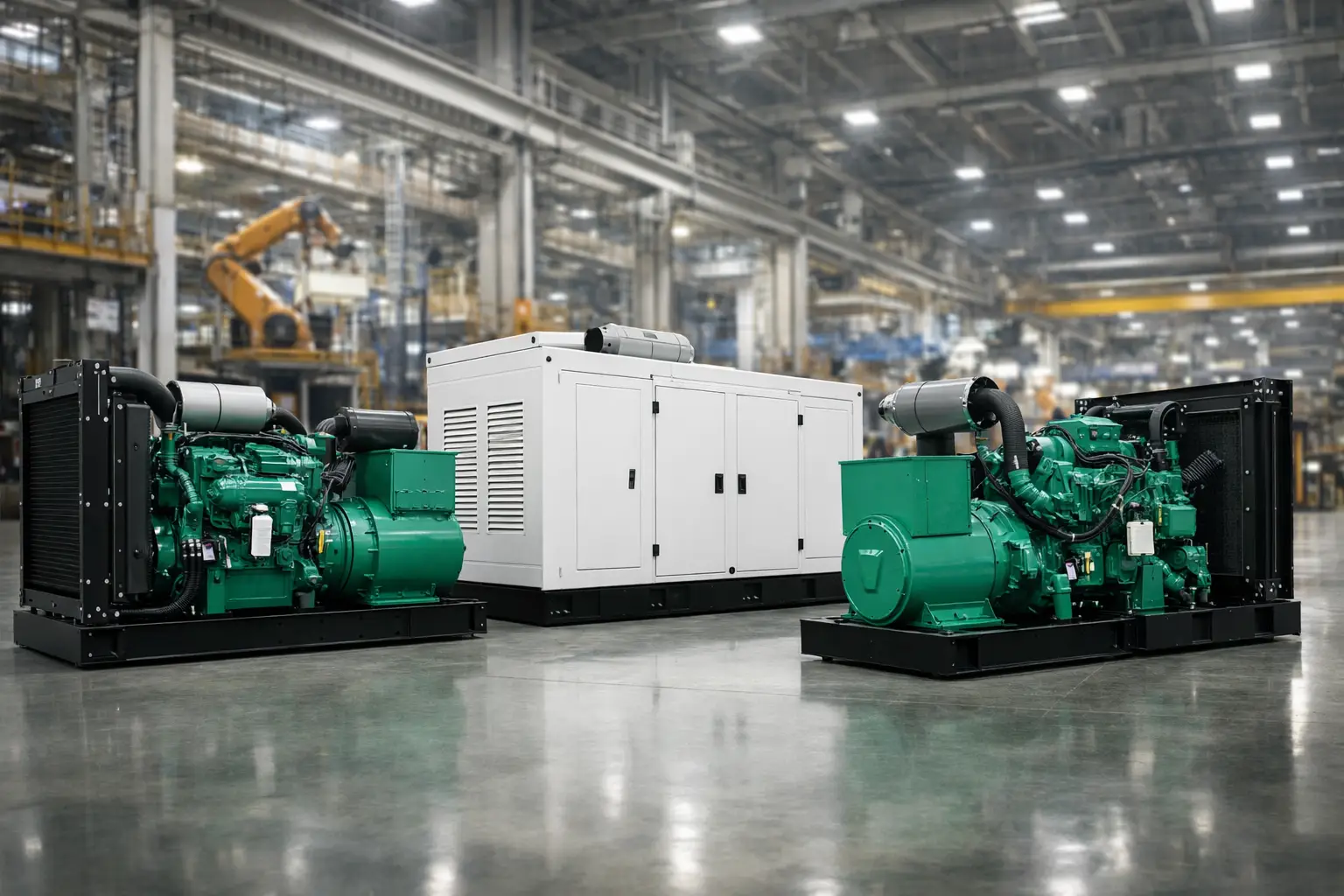
A manufacturing plant does not need a generator that merely starts when the mains fails. It needs a set that accepts the actual site load, manages motor starts, protects production equipment and keeps essential operations running for as long as the outage lasts. The top generators for manufacturing plants are therefore those specified around the process, not simply selected by headline kVA.
For plant managers, project engineers and procurement teams, the cost of an undersized or poorly matched generator can extend well beyond lost output. Failed starts, voltage dips, damaged drives, spoiled batches, interrupted extraction and unsafe shutdowns all create operational exposure. The correct solution begins with load behaviour, duty requirement and installation conditions.
What separates top generators for manufacturing plants
Manufacturing loads are rarely simple. A plant may combine motors, compressors, pumps, conveyors, welding equipment, process heaters, PLC-controlled machinery, extraction systems and IT infrastructure on the same electrical network. Each has a different effect on generator performance.
A generator must have enough capacity for the running load, but its ability to handle rapid load changes is equally important. Large motors can draw several times their normal running current during direct-on-line starting. Variable speed drives can introduce harmonic distortion. Compressors and refrigeration plant may cycle on unexpectedly. If these conditions are ignored, the generator may experience unacceptable frequency and voltage variation even where the calculated steady-state load appears within its rating.
The strongest specification will define the generator's standby or prime power rating, voltage, phase, frequency, alternator performance, control system, fuel autonomy and acoustic requirement. It should also state which loads remain live during an outage and which are deliberately shed.
Standby power or prime power
Standby-rated generators are intended for emergency use when the utility supply fails. They suit plants with a dependable grid connection where the generator supports critical production, safety systems, lighting, security and controlled shutdown during short-term or occasional outages.
Prime-rated generators are designed for variable load operation over extended periods. They are more appropriate where utility power is unreliable, where a site operates remotely, or where the set is expected to carry production for regular and sustained hours. A standby set should not be treated as a lower-cost substitute for continuous or frequent duty. The duty classification affects both the usable rating and the long-term reliability of the installation.
Generator sizes that suit different plant loads
There is no universal best kVA size for a manufacturing facility. A 200 kVA set can be appropriate for a small workshop's essential services, while a multi-line food, packaging, fabrication or processing site may require several megavolt-amperes of capacity. The following bands provide a practical starting point for assessing requirements.
100-300 kVA for essential operations and smaller facilities
Generators in this range are often used for smaller factories, workshops, maintenance buildings and defined essential-load boards. They can support selected machinery, compressed air, lighting, server rooms, fire systems, access control and critical extraction, provided motor starting is carefully assessed.
The main risk at this level is trying to retain every load. A properly designed emergency distribution board can prioritise the equipment that protects people, product and the production restart sequence. Load shedding may allow a smaller generator to deliver a more dependable outcome than an oversized set feeding an unmanaged network.
350-800 kVA for active production areas
This range commonly suits medium-sized manufacturing operations that need to retain substantial production capability during an outage. Typical applications include packaging lines, multiple compressors, machine shops, chilled storage, plastic processing, fabrication and automated warehousing.
At these ratings, starting method becomes a material consideration. Soft starters, variable speed drives and sequenced starting can reduce transient demand significantly. The generator, alternator and governor should be selected for the anticipated step loads, rather than judged only against the total connected load. A site with two large compressors may need a different generator specification from one with the same kW demand made up of resistive heating and lighting.
1,000-3,000 kVA for major industrial demand
Large plants may require 1,000 kVA to 3,000 kVA generator sets, often with parallel operation, for production continuity across high-demand processes. These applications can include large-scale food production, chemical processing, heavy engineering, materials handling, pharmaceutical manufacturing and facilities with significant refrigeration or pumping duties.
At this scale, resilience architecture matters as much as individual set rating. Two or more synchronised generators can provide N+1 redundancy, staged capacity and maintenance flexibility. They can also improve fuel efficiency when site demand varies materially between shifts. The additional controls and switchgear increase capital cost and commissioning requirements, but the operational benefit can be compelling where a single generator represents an unacceptable point of failure.
The technical factors that determine the right set
A recent load survey is the basis of a defensible specification. Do not rely solely on an old electricity bill, a transformer rating or a list of machine nameplates. These may not reflect simultaneous demand, future expansion, motor starting or the loads that must operate together after a power failure.
The survey should establish maximum demand in kW, power factor, starting currents, load sequence and the effect of non-linear equipment. Generator ratings are expressed in kVA, while plant consumption is often discussed in kW. The relationship between the two depends on power factor. As a simple example, a 500 kVA generator at a 0.8 power factor provides 400 kW. Actual performance must still allow for site conditions and transient loads.
Voltage and phase configuration also require clear confirmation. Most industrial manufacturing sites require a 400/230 V, three-phase, 50 Hz generator, but equipment may have particular voltage tolerances or require separate arrangements for sensitive controls. Three-phase balance should be reviewed, especially where a plant has accumulated single-phase loads over time.
An automatic transfer switch is essential where a rapid, controlled transfer from mains to generator is required. However, it should be designed alongside the generator controls and distribution system. The transfer sequence, load priorities, generator warm-up, retransfer settings and shutdown cooldown all affect how the plant behaves in a real outage.
Silent or open generators for plant installations
The physical format of the generator should follow its environment. A silent, weatherproof canopy is generally the practical choice for external installations near production buildings, offices or neighbouring premises. It offers protection from weather and reduces noise, though the enclosure must still have adequate airflow, exhaust routing and access for servicing.
Open generators are commonly selected for purpose-built plant rooms, containerised installations or acoustically treated enclosures. They can be well suited to major industrial installations, particularly where ventilation, cooling and exhaust systems are designed as part of the project. An open set placed in an unsuitable room is not a cost saving if high ambient temperatures or restricted air movement lead to derating and avoidable alarms.
Fuel storage deserves the same attention as the generator itself. Tank capacity determines runtime, but site consumption changes with load. A set operating at a modest load will consume far less than one carrying major production demand. Procurement teams should define the required autonomous runtime, fuel delivery access, bunding requirements and refuelling procedure before installation.
Why proven engine and alternator quality matters
Manufacturing buyers should assess the complete generating set, not just the engine badge or lowest purchase price. Engine, alternator, controller, cooling package and enclosure must operate as a matched system. Parts availability, service access and technical documentation are also central to uptime over the equipment's working life.
Cummins-powered generator sets remain a strong option for industrial applications because they are widely recognised for dependable performance across a broad kVA range. The final choice still depends on the operating profile, required rating and support plan. A correctly specified generator from a proven platform will normally deliver better value than a nominally larger set with unclear duty limits or limited serviceability.
Specify for recovery, not just survival
The decisive question is not simply whether the generator can carry the load after an outage. It is whether the plant can recover safely and predictably. Some sites need only life safety systems, controlled shutdown and data protection. Others need uninterrupted refrigeration, active process control or enough generation capacity to restart priority lines without waiting for grid restoration.
Define that recovery plan before requesting prices. Confirm the critical loads, starting order, acceptable interruption period, expected runtime and future capacity requirement. Global Generators can then match the required kVA, standby or prime rating, enclosure format and configuration to the plant's actual operational risk. A generator that is available quickly is valuable, but one that is specified correctly is what protects production when the grid does not.