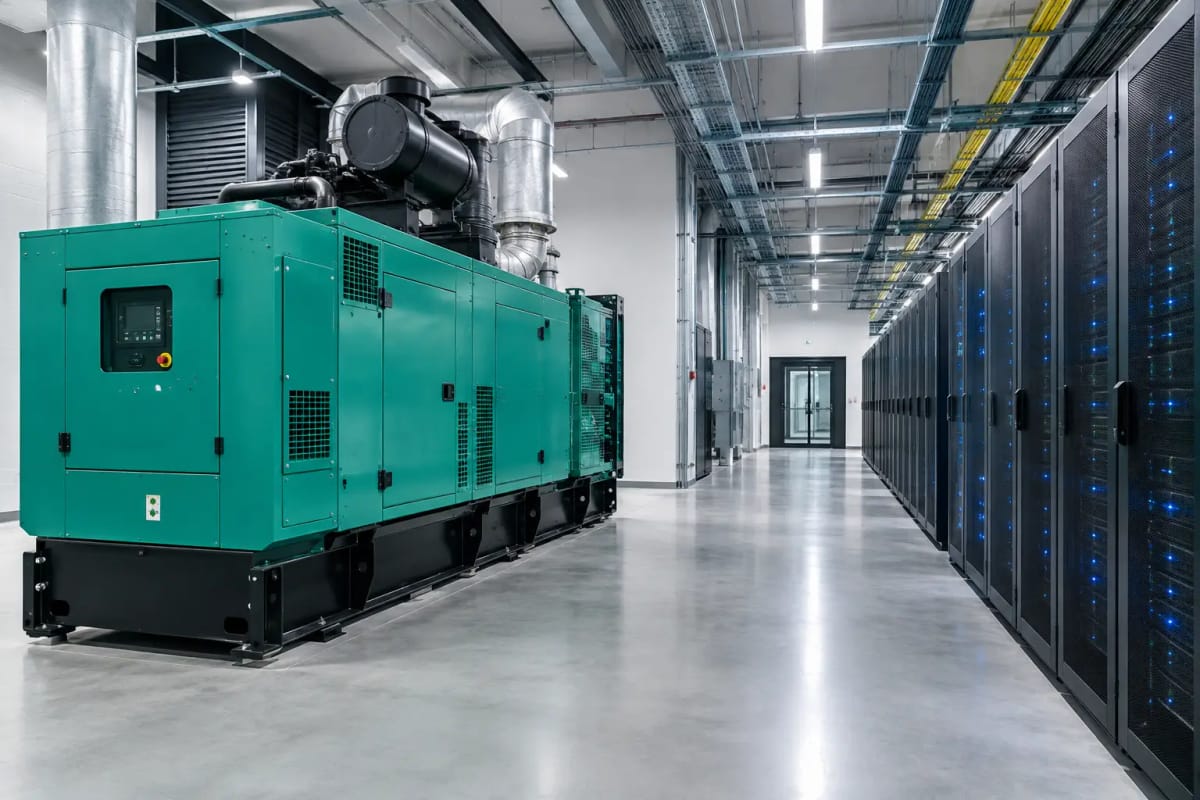
A 10 MW data centre was once a substantial power project. For many operators, it is now a single phase of a much larger campus plan. Data centre power demand trends are being shaped by AI workloads, higher rack densities, constrained grid connections and stricter expectations around uptime. For project teams, the issue is no longer simply securing enough utility capacity. It is designing a power system that can be delivered on time, maintained safely and relied upon when the grid cannot carry the load.
Data centre power demand trends are being reset
Traditional enterprise data centres were built around relatively predictable IT loads. Cloud growth increased total consumption, but the load profile remained manageable through familiar capacity planning methods. AI training, high-performance computing and increasingly dense compute clusters have changed that position.
A conventional rack may draw several kilowatts. High-density AI racks can require tens of kilowatts, and some designs are planning for considerably more. That shift affects every layer of site infrastructure: incoming utility supply, transformers, switchgear, UPS systems, cooling plant, generator capacity and fuel storage.
The headline figure for a site can also hide the real design challenge. A 50 MW facility may not arrive at its final load immediately, but its grid connection, land footprint and critical-power architecture often need to accommodate phased growth. Operators are therefore assessing not only current demand, but the credible maximum demand over five, ten or more years.
This is creating a greater separation between sites with secured power and sites with only an aspirational connection date. In constrained regions, the availability and timing of a grid connection can determine whether a data centre project proceeds at all.
Grid constraints are now a programme risk
The UK transmission and distribution networks are under pressure from electrification, renewable generation, industrial demand and major infrastructure projects. Data centres compete for capacity alongside housing developments, battery storage, transport electrification and manufacturing.
For developers, a connection offer does not automatically mean usable power at the required date. Reinforcement works, planning conditions and changing queue arrangements can affect programme certainty. A site may have enough land, fibre connectivity and planning potential, yet still face a delayed energisation date.
That uncertainty is changing procurement decisions. More operators are reviewing temporary and long-duration on-site generation earlier in the project lifecycle. This does not necessarily mean replacing the grid. In most permanent facilities, the grid remains the principal supply. It does mean that independent generation is becoming a more serious part of construction, commissioning and operational contingency planning.
The correct approach depends on the site. A facility with a firm utility connection may require generators primarily for standby duty. A remote site, a constrained development or a phased build may need prime-rated generation for extended operation. Confusing standby and prime ratings can result in an underspecified set, unsuitable maintenance intervals or unacceptable performance under sustained load.
Higher density changes the critical-power calculation
Power demand is not rising evenly across a facility. AI and high-performance workloads can create concentrated load zones that place unusual demands on distribution equipment and cooling systems. The electrical design must account for the total site load, but also for where and how that load appears.
Generator sizing should not be based on a simple addition of nameplate ratings. Engineers must consider starting currents, UPS input characteristics, harmonic loading, step-load acceptance, motor loads associated with cooling equipment and the permitted voltage and frequency deviation. The operating sequence matters as much as the headline kVA figure.
For example, a generator set may support the steady-state critical IT load but struggle if multiple chillers, pumps or air-handling systems restart simultaneously after a utility failure. Load sequencing, soft starts, variable-speed drives and properly configured controls can reduce this risk. They must be validated through commissioning, not assumed from a drawing.
Redundancy also requires careful definition. N+1, 2N and distributed redundant designs offer different resilience, cost and footprint outcomes. There is no universal best arrangement. The appropriate architecture depends on the facility tier, availability commitments, maintenance philosophy and the financial impact of an interruption.
UPS and generators must operate as one system
The UPS bridges the gap between utility failure and generator availability. Its autonomy is typically measured in minutes, while generators and fuel systems support a longer interruption. This relationship is fundamental, but it is often compromised by poor integration.
Automatic transfer schemes, generator controls, UPS rectifier settings and load-bank test procedures should be designed as a coordinated system. A generator that starts reliably in isolation is not sufficient. It must accept the live critical load in the expected sequence and remain stable as cooling and ancillary systems return.
Battery technology is also evolving. Lithium-ion UPS installations can reduce footprint and offer different lifecycle characteristics compared with traditional valve-regulated lead-acid systems. However, the choice introduces its own requirements around fire strategy, thermal management, monitoring and replacement planning. Shorter battery autonomy does not remove the need for dependable on-site generation.
Fuel resilience remains a practical decision
As data centre loads increase, fuel planning becomes more consequential. A larger generator fleet consumes more fuel during an extended outage, while higher resilience targets may require greater storage volume, more frequent deliveries or both. The calculation should include realistic load assumptions rather than a nominal percentage applied across the board.
Fuel quality and supply logistics deserve equal attention. Diesel stored for long periods requires monitoring and management to prevent contamination, water ingress and degradation. A large tank is not a resilience strategy if fuel cannot be transferred, filtered or delivered during a regional disruption.
Site access matters too. Can a fuel lorry reach the fill point in poor weather or during a security incident? Is there enough turning space? Are refuelling procedures compatible with the site's safety controls? These operational details can decide whether an engineered backup solution performs when required.
Environmental requirements also influence equipment selection. Noise limits may require acoustic enclosures, residential boundaries may constrain operating hours, and local air-quality requirements can affect generator specification and exhaust treatment. Silent generator sets are often appropriate for urban or mixed-use locations, while open sets may suit protected plant rooms or purpose-built compounds where enclosure design is handled at site level.
Procurement is moving towards deployable capacity
Long lead times for electrical infrastructure remain a major concern. Switchgear, transformers, utility equipment and specialist controls can all affect delivery programmes. Generator availability should therefore be assessed early, alongside technical suitability.
Buyers should establish the required duty rating, voltage, frequency, phase configuration, enclosure requirement, control interface and fuel autonomy before requesting quotations. They should also confirm whether the set will be installed as a single unit, in parallel, or as part of a modular power plant. A generator that meets the kVA requirement but cannot integrate with the site's synchronisation and changeover scheme is not a complete solution.
For urgent projects, stock availability can materially reduce risk. Global Generators supplies Cummins-powered diesel generator sets across a broad kVA range, enabling project teams to assess standby and prime-power options against the actual load profile rather than accepting a generic package.
What operators should plan for next
The strongest data centre power strategies recognise that demand forecasts will move. AI deployment rates, customer mix, cooling methods and utility programmes can all change after the initial business case has been approved. Designing in measured expansion capacity, physical space for additional plant and clear control-system integration points gives operators more options than attempting a wholesale retrofit later.
Resilience is not achieved by specifying the largest generator available. It comes from matching generation, fuel, UPS autonomy, distribution design and maintenance capability to the consequence of failure. Where demand is rising faster than grid certainty, that discipline is becoming a commercial necessity as well as an engineering one.
The practical next step is to review the site's maximum credible load, expected connection timeline and outage obligation together. Those three figures will indicate whether existing standby provision is adequate or whether a higher-capacity, prime-rated or modular generation strategy should be brought into the programme now.