Quick answer
Even as load shedding eases, South African businesses are buying more diesel generators, not fewer. Eskom tariffs are rising 8.76% for direct customers and 9.01% for municipal customers in 2026/27, on top of a court-exposed R76 billion regulatory miscalculation that's pushed costs higher than originally planned. Combine that with unpredictable local outages that have nothing to do with national load shedding, and diesel generators have shifted from an emergency purchase to a standing financial hedge against a grid that's both pricier and less predictable than it looks on paper
For a while, it looked like South African businesses might finally be able to relax about backup power. Eskom's generation fleet has stabilised. Load shedding, for the first time in eight years, has genuinely stopped. And yet demand for diesel generators hasn't slowed down — if anything, procurement teams are asking harder questions about sizing and specification than they were during the worst of the crisis.
The reason isn't stubbornness or habit. It's arithmetic. Grid electricity is getting more expensive, at a pace few businesses budgeted for, and the outages that remain are increasingly the unpredictable kind rather than the scheduled kind. Here's what's actually driving the numbers, and how to think about a generator investment against them.
The Two Pressures Squeezing SA Businesses in 2026
Two separate trends are converging on business owners at the same time, and it's worth understanding them as distinct problems rather than one blurry "power crisis." 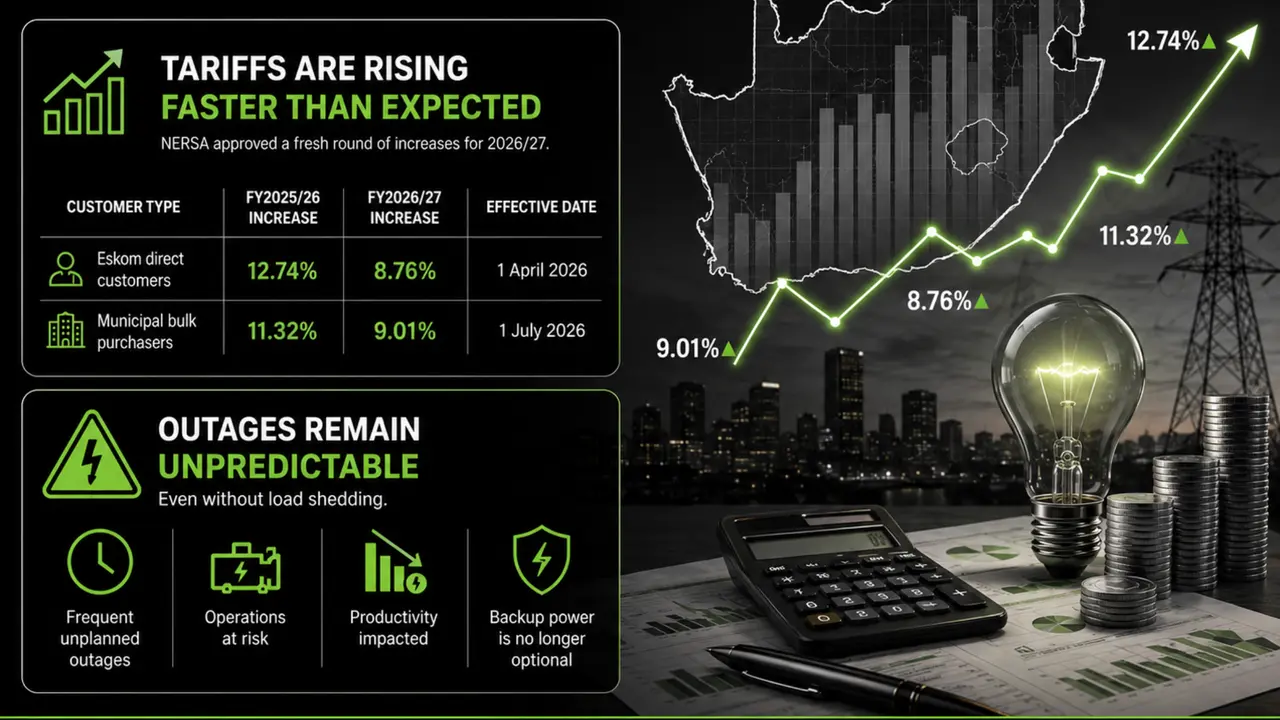
1. Tariffs Are Rising Faster Than Expected
NERSA (the National Energy Regulator of South Africa) approved a fresh round of increases for the 2026/27 financial year:
| Customer Type | FY2025/26 Increase | FY2026/27 Increase | Effective Date |
|---|---|---|---|
| Eskom direct customers | 12.74% | 8.76% | 1 April 2026 |
| Municipal bulk purchasers | 11.32% | 9.01% | 1 July 2026 |
For businesses buying through a municipality — the majority — that 9.01% increase compounds on top of last year's hike, and it isn't the end of the story. A South African court found that NERSA had miscalculated Eskom's allowable revenue by roughly R76 billion, a mistake originally expected to push the 2026 increase to as little as 5.4%. The corrected figure landed at 8.76% instead, with further recovery still working its way through future tariff years.
2. Outages Remain Unpredictable, Even Without Load Shedding
As we covered in our earlier look at South Africa's unplanned outages, ending national load shedding didn't end local disruption. Municipal underinvestment, electricity theft, and ageing distribution infrastructure continue to cause outages that have nothing to do with Eskom's generation capacity — and nothing predictable about their timing. > Expert Tip: Don't evaluate a generator purchase purely against outage risk anymore. In 2026, the stronger financial case is the tariff trajectory itself — a correctly sized diesel generator increasingly pays for itself through avoided peak-tariff consumption and demand charges, not just avoided downtime.
Why the ROI Case Has Changed
A few years ago, a generator was almost purely an insurance policy — a cost you accepted to avoid a bigger cost during a blackout. That calculation still holds, but it's no longer the whole picture.
With grid tariffs compounding at close to 9% a year and showing no sign of levelling off, businesses running significant load — refrigeration, manufacturing equipment, HVAC, server rooms — are increasingly running the numbers on partial self-generation during peak-tariff periods, not just emergency backup. A well-specified diesel motor generator, sized correctly and maintained properly, changes from a pure cost centre into a genuine hedge against a grid price curve that's proving hard to predict.
Choosing the Right Type of Diesel Generator
Getting value from a generator investment starts with matching the equipment to how your business actually draws power.
Single-Phase vs Three-Phase Diesel Generators
A single phase diesel generator suits smaller operations — retail premises, offices, and light commercial sites running standard 230V equipment. Larger operations, particularly anything running motors, compressors, or heavy machinery, generally need a three phase diesel generator, which supplies the balanced, higher-capacity power those loads require. Specifying the wrong phase configuration is one of the more common — and expensive — mistakes businesses make when buying under time pressure.
When You Need an Industrial Diesel Generator
Manufacturing sites, data centres, hospitals, and large commercial estates typically fall into industrial diesel generator territory — units built for higher kVA output and, in many cases, more continuous duty cycles than a standard commercial standby unit. If your site's peak load runs into the hundreds of kVA, this is the category worth specifying against, not a scaled-up commercial model.
Standby vs Prime Power
Alongside phase configuration, you'll need to decide between a standby-rated generator or a prime-rated unit for backup-only use or if you're planning to run it more frequently as a hedge against peak tariffs. Getting this classification right affects both the unit's lifespan and your maintenance costs, so it's worth specifying deliberately rather than defaulting to whichever option is in stock.
Getting the Sizing Right
Whatever type you land on, correct kVA sizing is what determines whether the investment actually performs. Undersizing leads to nuisance tripping and premature wear; oversizing wastes capital and runs the engine inefficiently at partial load. A proper load audit — including starting/surge loads, not just running loads — should come before any purchase decision.
Noise and Site Considerations
For businesses in mixed-use areas, town centres, or near residential premises, a silent, acoustically enclosed generator is usually the right specification — quieter neighbours, fewer complaints, and generally easier planning sign-off than an open-frame unit.
Sourcing a Diesel Generator in the UK for South African Operations
A growing number of South African businesses and project buyers are sourcing their equipment from established suppliers who buy a diesel generator in the UK for export, rather than sourcing locally. The appeal is straightforward: UK-stocked, factory-tested diesel motor generator units, built around established engine platforms, with the manufacturer support and documentation that larger commercial buyers and tender processes typically require. For businesses specifying equipment for a new site or a major expansion, that combination of build quality and export experience is often worth the extra logistics step. > Get It Right the First Time: Not sure whether your site needs single-phase, three-phase, or a full industrial unit? Talk to our team about sizing and specification before you buy — it's a five-minute conversation that avoids an expensive mismatch.
Frequently Asked Questions
Are diesel generators still worth buying in South Africa now that load shedding has ended?
Yes, for most commercial and industrial users. Load shedding ending addressed national supply, not local distribution reliability or rising tariffs — both of which continue to make backup and hedge generation financially and operationally worthwhile.
Do I need a single-phase or three-phase diesel generator for my business?
Small offices, retail premises, and light commercial sites usually suit a single phase diesel generator. Any business running motors, compressors, or heavier machinery should specify a three phase diesel generator to match its actual electrical load.
What size industrial diesel generator does a mid-sized business need?
It depends entirely on peak load, including start-up surge from motors and large equipment. A proper load audit is essential — sizing from average consumption alone is one of the most common and costly mistakes buyers make.
How much do rising Eskom tariffs actually affect generator ROI?
With municipal tariffs rising 9.01% in 2026/27 alone, and further increases already flagged for 2027/28, the payback period on a correctly sized generator used to offset peak-tariff consumption is shortening year on year for businesses with significant load.
Can I buy a diesel generator in the UK and have it shipped to South Africa?
Yes — this is a well-established route for commercial and industrial buyers, particularly for larger kVA units where UK stock availability, factory testing, and export documentation offer a more reliable procurement path than some local supply chains.
What's the difference between a standby and a prime-rated diesel generator?
A standby-rated unit is built for occasional, backup-only use during outages. A prime-rated unit is built to run more frequently and for longer periods, which suits businesses planning to use generation regularly to manage tariff exposure rather than only during blackouts.
The Bottom Line
South Africa's power story in 2026 isn't as simple as "the crisis is over." Tariffs are climbing faster than most businesses planned for, the regulatory process behind those increases has its own credibility problems, and local outages remain a live operational risk regardless of what's happening at national grid level.

A correctly specified diesel generator doesn't just protect a business from the next outage. Increasingly, it protects margins from a tariff curve that shows no sign of flattening — which is exactly why demand hasn't slowed down, even as the headlines have moved on.
Ready to Specify the Right Generator for Your Business?
Our team works with commercial and industrial buyers across South Africa and beyond to size, specify, and supply the right diesel generator for their site. Get in touch for a tailored recommendation — no obligation, just the right numbers before you buy.